
Close Menu
  • News
  • Industry
  • Solar Panels
  • Commercial
  • Residential
  • Finance
  • Technology
  • Carbon Credit
  • More
    • Policy
    • Energy Storage
    • Utility
    • Cummunity
What's Hot

Mitsubishi Electric Trane announces new heat pump line for hydronic heating – SPE

March 6, 2026

Origis is developing a 413 MW solar portfolio in West Texas

March 6, 2026

New Jersey expands state community solar program by 3 GW

March 6, 2026
Facebook X (Twitter) Instagram
Solar Energy News
Friday, March 6
  • News
  • Industry
  • Solar Panels
  • Commercial
  • Residential
  • Finance
  • Technology
  • Carbon Credit
  • More
    • Policy
    • Energy Storage
    • Utility
    • Cummunity
Solar Energy News
Home - News - Innovative coating increases the efficiency and reduces the costs of solar cells
News

Innovative coating increases the efficiency and reduces the costs of solar cells

solarenergyBy solarenergyAugust 2, 2024No Comments2 Mins Read
Facebook Twitter Pinterest LinkedIn Tumblr Email
Share
Facebook Twitter LinkedIn Pinterest Email

Innovative coating increases the efficiency and reduces the costs of solar cells


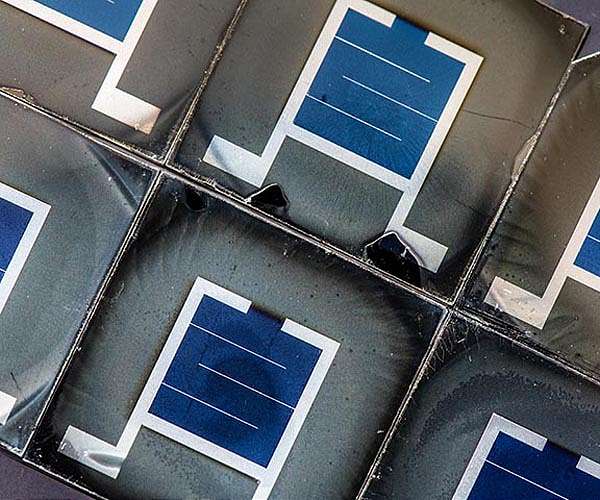
Coating solar cells with unique organic molecules could pave the way for more efficient and affordable solar panels. As reported in the journal Angewandte Chemie, this coating improves the efficiency of monolithic tandem cells made of silicon and perovskite, while reducing their costs. This is achieved by using industrial, microstructured, standard silicon wafers.

In solar cells, light excites electrons from a semiconductor, leaving positively charged “holes”. These charge carriers are separated and collected as current. Tandem cells have been developed to utilize the full spectrum of sunlight more effectively and increase the efficiency of solar cells. They are composed of two different semiconductors that absorb light of different wavelengths.

The main candidates for this technology are silicon, which mainly absorbs red and near-infrared light, and perovskite, which efficiently captures visible light. Monolithic tandem cells are made by laying these semiconductors on a support, usually using silicon wafers produced by the zone melting process with a polished or nanostructured surface. However, these waffles are expensive.

Cheaper silicon wafers produced by the Czochralski process contain micrometer-scale pyramid-shaped structural elements that improve light capture due to their lower reflectivity compared to smooth surfaces. However, coating these wafers with perovskite introduces defects in the crystal lattice, which affects the electronic properties, impedes electron transfer, and increases electron-hole recombination. This reduces both efficiency and stability.

A team led by Prof. Kai Yao of Nanchang University, in collaboration with Suzhou Maxwell Technologies, CNPC Tubular Goods Research Institute (Shaanxi), Hong Kong Polytechnic University, Wuhan University of Technology and Fudan University (Shanghai), has a surface passivation strategy to smooth out these surface defects. They use a thiophenethylammonium compound with a trifluoromethyl group (CF3-TEA), applied via a dynamic spray coating process. This forms a uniform layer even on micro-textured surfaces.

See also  Energyaid acquires SunWorks, Solcius assets and will maintain existing solar systems

The CF3-TEA coating, due to its high polarity and binding energy, effectively reduces the effects of surface defects, suppresses non-radiative recombination and optimizes electronic levels to facilitate electron transfer to the electron-capturing layer of the solar cell. This surface modification allows perovskite/silicon tandem solar cells, based on plain textured Czochralski silicon wafers, to achieve nearly 31% efficiency and maintain long-term stability.

Research report:Surface molecular engineering for fully textured perovskite/silicon tandem solar cells


Source link

cells coating costs efficiency increases innovative reduces solar
Share. Facebook Twitter Pinterest LinkedIn Tumblr Email
solarenergy
  • Website

Related Posts

Origis is developing a 413 MW solar portfolio in West Texas

March 6, 2026

New Jersey expands state community solar program by 3 GW

March 6, 2026

How to address imbalance datasets in solar panel dust detection

March 5, 2026
Leave A Reply Cancel Reply

Don't Miss
Solar Industry

Tecnalia, Vita International Developing Solar Gardrails

By solarenergyMarch 20, 20250

Vita International, based in Tecnaalia and Italy, have designed a new photovoltaic crash barrier, which…

Polar Racking adds hail protection features to the SOL-X tracking system

September 13, 2024

American commercial sales teams for solar energy go from micro management to coordination – PV Magazine International

October 4, 2025

Planted Solar’s automated construction platform will be used on projects in Illinois

June 18, 2024
Stay In Touch
  • Facebook
  • Twitter
  • Pinterest
  • Instagram
  • YouTube
  • Vimeo
Our Picks

Mitsubishi Electric Trane announces new heat pump line for hydronic heating – SPE

March 6, 2026

Origis is developing a 413 MW solar portfolio in West Texas

March 6, 2026

New Jersey expands state community solar program by 3 GW

March 6, 2026

How to address imbalance datasets in solar panel dust detection

March 5, 2026
Our Picks

Mitsubishi Electric Trane announces new heat pump line for hydronic heating – SPE

March 6, 2026

Origis is developing a 413 MW solar portfolio in West Texas

March 6, 2026

New Jersey expands state community solar program by 3 GW

March 6, 2026
About
About

Stay updated with the latest in solar energy. Discover innovations, trends, policies, and market insights driving the future of sustainable power worldwide.

Subscribe to Updates

Get the latest creative news and updates about Solar industry directly in your inbox!

Facebook X (Twitter) Instagram Pinterest
  • Contact
  • Privacy Policy
  • Terms & Conditions
© 2026 Tsolarenergynews.co - All rights reserved.

Type above and press Enter to search. Press Esc to cancel.