

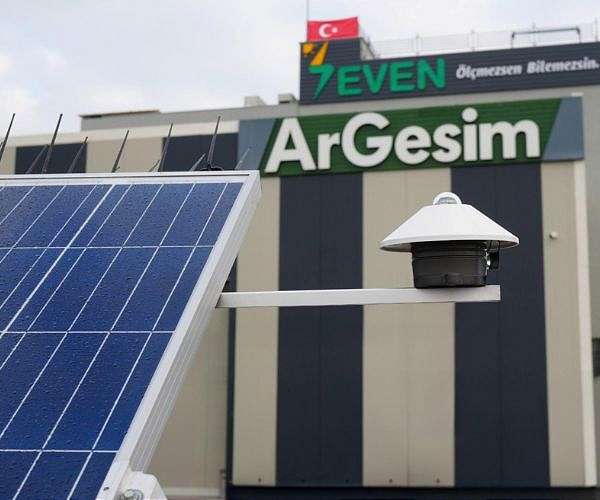
SEVEN introduces the newly developed Class A Thermopile Pyranometer – an advanced solution designed for highly accurate monitoring of solar radiation in PV installations, meteorological stations and research applications.
SEVEN Sensor Solutions: a global leader in sensor technology
SEVEN Sensor Solutions is a leading manufacturer of high quality sensors mainly designed to monitor the performance of PV installations (photovoltaic installations). As a company specialized in sensor production, SEVEN has successfully expanded into other areas, including meteorological and silo-related applications.
Thanks to its wide range of sensors, SEVEN Sensor has successfully reached more than 85 countries around the world, from Japan to the US and from Sweden to South Africa.
Driven by a strong focus on R&D, SEVEN was awarded two patents for its innovative sensor technologies.
SEVEN is known in the market for its high-quality reference cells and dirt sensors, which are installed worldwide in a variety of environmental conditions – from extremely hot areas to frigid climates, from very humid areas to dry areas, and from tropical weather to snowy areas.
Recognizing the growing market demand, SEVEN developed a new thermopile pyranometer to deliver highly accurate irradiance measurements and meet industry standards.
Features of the SEVEN Class A thermopile pyranometer
The Class A pyranometer of SEVEN Sensor is fully compliant with IEC 61724-1:2021 and ISO 9060:2018 standards, ensuring highly accurate irradiance measurements for accurate performance ratio calculations. The low zero offset and minimal instability are the main criteria that define a Class A pyranometer. To meet these performance criteria, SEVEN developed its pyranometer by using the white diffuser instead of a traditional black body and a single dome.
What is the difference between the black housing and the white diffuser for Pyranometer?
The black disk sensor has been used by almost all pyranometer manufacturers for decades. This sensor is a relatively inexpensive way to make a thermal sensor that absorbs radiation. It is made by painting a thermopile with soldered wire, a relatively inexpensive method. The disadvantages of this sensor are the long response time due to its size and thermal mass – about 10-20 seconds, later the response time in digital models was artificially improved by approximating the measurements, resulting in a response time of about 5 seconds. Another major problem with this technology is the fact that the paint will change its properties over time when exposed to UV light. This happens especially strongly in the first years of use. That is why pyranometers using this technology need to be recalibrated every 1-2 years.
On the other hand, the use of a white quartz diffuser protects the sensor from thermal effects in a similar way as the inner dome does in traditional pyranometers with a black housing design. That’s why the SEVEN Pyranometer only needs one dome.
According to the ISO 9060:2018 standard, response time is an important criterion for Class A classification. Thanks to its innovative white diffuser design, the SEVEN Pyranometer offers a fast response time of just 0.5 seconds.
Furthermore, this design is very stable over time and does not require frequent recalibration. As a result, SEVEN recommends recalibration only once every five years, significantly reducing maintenance efforts and long-term operating costs.
With its innovative design, the SEVEN Class A Pyranometer improves measurement stability, reduces thermal offsets and improves angular response for superior data accuracy.
In addition, the SEVEN Thermopile Pyranometer is equipped with an LED indicator.
LED indicator for easy operation
The LED indicator on the SEVEN Pyranometer provides real-time feedback on operational status. This ensures users can quickly verify that the sensor is functioning properly, reducing downtime and improving system reliability.
Although checking a Pyranometer on site can be a challenge as it typically requires connecting a computer, which is not always available, SEVEN has decided to eliminate the checks related to power supply by adding an LED indicator visible on the Pyranometer. If the green LED is lit, this means that the Pyranometer is properly supplied with power. If a communication problem occurs while the LED is green, users can rest assured that this is not a power-related problem.

SEVEN Sensor Class A Pyranometer: high quality solution
In summary, the main features and benefits of the new SEVEN Class A Pyranometer are:
- Complies with international standards — “ISO 9060:2018, fast response, spectral plane and class A” and “IEC 61724-1:2021 class A”.
- White diffuser technology — Improves stability, minimizes temperature effects.
- Quick response — Provides accurate and real-time measurements of solar radiation.
- Built-in LED indicator — Quick sensor check.
- Superior thermal performance — Reduces measurement errors under varying conditions.
- Easy integration — Fully compatible with SCADA systems and data loggers.
- Weatherproof — Designed for long-term outdoor use.
- Fast installation — Plug-and-play installation for minimal downtime.
With the Class A thermopile pyranometer from SEVEN you get the latest innovation in solar monitoring technology, ensuring accurate performance ratio calculations and optimized efficiency of PV installations.
Please refer to the technical data sheet for more information.
