

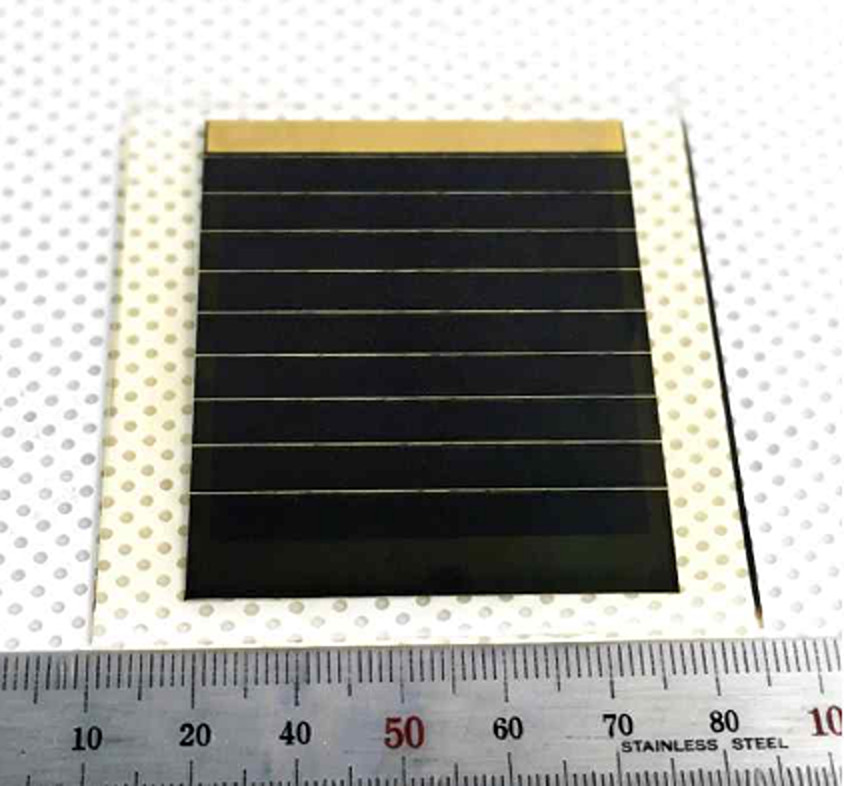
GIST researchers have developed a perovskite mini-module with an efficiency of 22.56% by enhancing the SnO₂ electron transport layer with PEI, reducing defects and electron loss. The module retained 94% of its performance after 500 hours, highlighting the potential for scalable, stable perovskite solar cells and modules.
A research team led by South Korea The Gwangju Institute of Science and Technology (GIST) has fabricated a mini perovksite module with an active area of 24.8 cm2 and an energy conversion efficiency of 22.56%.
The researchers explained that as the surface area of a solar cell or mini module increases, forming a uniform perovskite layer becomes more challenging. This non-uniformity increases electron losses during charge transport, resulting in reduced efficiency and stability.
To address this problem, the team focused on designing the electron transport layer (ETL) interface. They chose tin oxide (SnO₂), the most commonly used ETL material in perovskite solar cells. However, SnO₂ typically exhibits poor surface wettability, which can lead to uneven perovskite films and microscopic defects that act as electron loss pathways.
To overcome this limitation, the scientists took a ‘simple’ approach, integrating the polymer polyethyleneimine (PEI) into the SnO₂ layer during the initial ETL formation process.
“PEI fills microscopic defects on the SnO₂ surface, reducing electron loss and improving the electrical environment at the interface, facilitating smooth electron transport,” the researchers said. “This lowers the electron transport barrier within the solar cell, simultaneously improving efficiency and stability.”
They added that by precisely controlling the ETL interface, high-quality perovskite films could be produced with minimal performance variation, even over large areas and without additional processing steps. “This approach is especially beneficial for manufacturing methods suitable for mass production, such as printing-based thin-film processes,” the team said.
Using this device architecture, the researchers achieved an energy conversion efficiency of 24.49% in a small-area cell and 22.56% in the mini module. The mini module was found to retain 94% of its original performance even after 500 hours of operation.
“High efficiency and stability were consistently maintained not only in small-area cells but also in large-area solar cell modules, significantly improving the prospects for mass production and commercialization,” the researchers said.
The new cell design was presented in “Dual-Function Interface Engineering from SnO2 Electron transport layers: improving wettability and work function tuning for efficient and stable perovskite solar cells and mini modules”, which was recently published in nanomicro small.
This content is copyrighted and may not be reused. If you would like to collaborate with us and reuse some of our content, please contact: editors@pv-magazine.com.
