
Close Menu
  • News
  • Industry
  • Solar Panels
  • Commercial
  • Residential
  • Finance
  • Technology
  • Carbon Credit
  • More
    • Policy
    • Energy Storage
    • Utility
    • Cummunity
What's Hot

Dutch solar owners asked to switch off during peak periods to ease the distribution crisis

June 7, 2026

The hydrogen flow: Toyota demonstrates its racing prototype on liquid hydrogen

June 7, 2026

Era of electrification exposing Australia’s weakest link

June 6, 2026
Facebook X (Twitter) Instagram
Solar Energy News
Sunday, June 7
  • News
  • Industry
  • Solar Panels
  • Commercial
  • Residential
  • Finance
  • Technology
  • Carbon Credit
  • More
    • Policy
    • Energy Storage
    • Utility
    • Cummunity
Solar Energy News
Home - Solar Industry - Korean scientists improve the performance of tin monosulfide cells with new post-treatment
Solar Industry

Korean scientists improve the performance of tin monosulfide cells with new post-treatment

solarenergyBy solarenergyJanuary 31, 2026No Comments3 Mins Read
Facebook Twitter Pinterest LinkedIn Tumblr Email
Share
Facebook Twitter LinkedIn Pinterest Email

Researchers in South Korea improved the performance of tin monosulfide (SnS) solar cells with a potassium fluoride-assisted post-treatment and vapor transport deposition process. The treated solar cells had an energy conversion efficiency of 4.10% and reduced recombination sites, compared to 3.42% for untreated devices.

January 30, 2026
Valerie Thompson

Research led by Chonnam National University in South Korea has improved the performance of tin monosulfide (SnS) solar cells with a potassium fluoride-assisted (KF) post-treatment and a vapor transport deposition (VTD) process. The treated solar cells had an energy conversion efficiency of 4.10% and reduced recombination sites, compared to control devices.

The research topic is complementary to the research group’s previous research on germanium oxide (GeOx), which achieved a cell efficiency of 4.81%, said the study’s first author, Rahul Kumar Yadav.

“The KF treatment improves the intrinsic quality of the SnS absorber surface and provides a superior basis for subsequent interface engineering, while the GeOX interlayer optimizes band alignment and suppresses recombination at rear contact,” shared Kumar Yadav pv magazine.

“In our ongoing work we actively combine KF surface treatment with GeOX back interface engineering, as we expect their integration to deliver further gains in terms of voltage, operational stability and overall device efficiency,” he added.

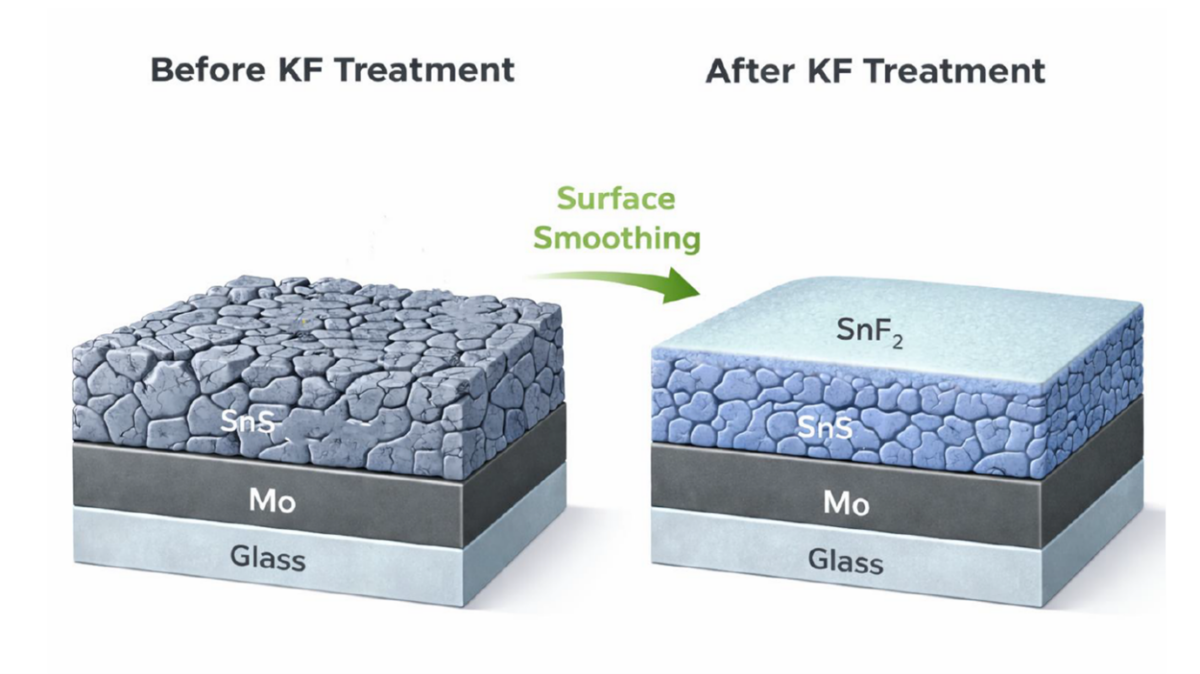
In the study, the researchers varied the concentration of the KF solution to measure the effect of drop-cast KF surface treatment on the structural, morphological and photovoltaic properties of VTD-SnS absorber layers.

Testing showed that the KF treatment improved “film uniformity, densification and wettability.” Devices based on the optimized KF-treated SnS absorber had a PCE of 4.10%, an improvement compared to 3.42% for untreated devices, with further analysis revealing reduced recombination sites.

See also  New method increases the efficiency of solar cells by refining nanorod distance

“The post-treatment of the KF-assisted solution functions as a surface modulation step, improving grain connectivity, reducing surface roughness and passivating electrically active defects,” says Kumar Yadav, adding that the resulting higher open-circuit voltage and fill factor enabled improved efficiency “without changing the overall device architecture.”

The researchers concluded that the study represents a “scalable strategy to overcome important interfacial limitations” and advance SnS thin-film solar photovoltaics.

Korea Aerospace University and Kyungpook National University also participated in the study.

The work is described in detail in “By modulating the surface morphology via post-treatment with potassium fluoride solutions, VTD-SnS thin-film solar cells can achieve an efficiency of more than 4%”, which appears in Materials today energy.

Looking ahead, the group is focused on developing SnS thin-film solar cells above the 4% efficiency threshold “through coordinated absorber surface, heterojunction interface and back-interface engineering, while maintaining compatibility with scalable manufacturing processes,” said Kumar Yadav.

This content is copyrighted and may not be reused. If you would like to collaborate with us and reuse some of our content, please contact: editors@pv-magazine.com.

Popular content

Source link

cells improve Korean monosulfide performance posttreatment scientists Tin
Share. Facebook Twitter Pinterest LinkedIn Tumblr Email
solarenergy
  • Website

Related Posts

ComEd starts a new energy pilot with a solar rebate on the roof of a brewery

June 5, 2026

Video: Understanding Safe Harbor Programs | Power forward!

June 3, 2026

Illinois board approves massive Pride of the Prairie site | Projects Weekly

June 1, 2026
Leave A Reply Cancel Reply

Don't Miss
Policy

Polysilicon prices extend decline – SPE

By solarenergyApril 11, 20260

State energy developer CECEP has raised CNY2.95 billion ($431.8 million) for PV and storage projects,…

Energy Toolbase modeling software now available for Sungrow BESS

December 14, 2025

In the production of perovskite PV cells, module production may face material supply risks

April 28, 2024

Large-scale agrivoltaic energy comes to Norway – SPE

December 7, 2025
Stay In Touch
  • Facebook
  • Twitter
  • Pinterest
  • Instagram
  • YouTube
  • Vimeo
Our Picks

Dutch solar owners asked to switch off during peak periods to ease the distribution crisis

June 7, 2026

The hydrogen flow: Toyota demonstrates its racing prototype on liquid hydrogen

June 7, 2026

Era of electrification exposing Australia’s weakest link

June 6, 2026

‘Come out from behind your screen, our industry is ultimately about people’

June 6, 2026
Our Picks

Dutch solar owners asked to switch off during peak periods to ease the distribution crisis

June 7, 2026

The hydrogen flow: Toyota demonstrates its racing prototype on liquid hydrogen

June 7, 2026

Era of electrification exposing Australia’s weakest link

June 6, 2026
About
About

Stay updated with the latest in solar energy. Discover innovations, trends, policies, and market insights driving the future of sustainable power worldwide.

Subscribe to Updates

Get the latest creative news and updates about Solar industry directly in your inbox!

Facebook X (Twitter) Instagram Pinterest
  • Contact
  • Privacy Policy
  • Terms & Conditions
© 2026 Tsolarenergynews.co - All rights reserved.

Type above and press Enter to search. Press Esc to cancel.