

Researchers from China found that large solar power plants have a positive positive impact on the ecological environment of desert areas. Their tests were conducted at a 1 GW solar farm in China’s northeastern Qinghai province.
A research team led by scientists from China’s Xi’an University of Technology has assessed the ecological and environmental impacts of large-scale PV development in desert areas.
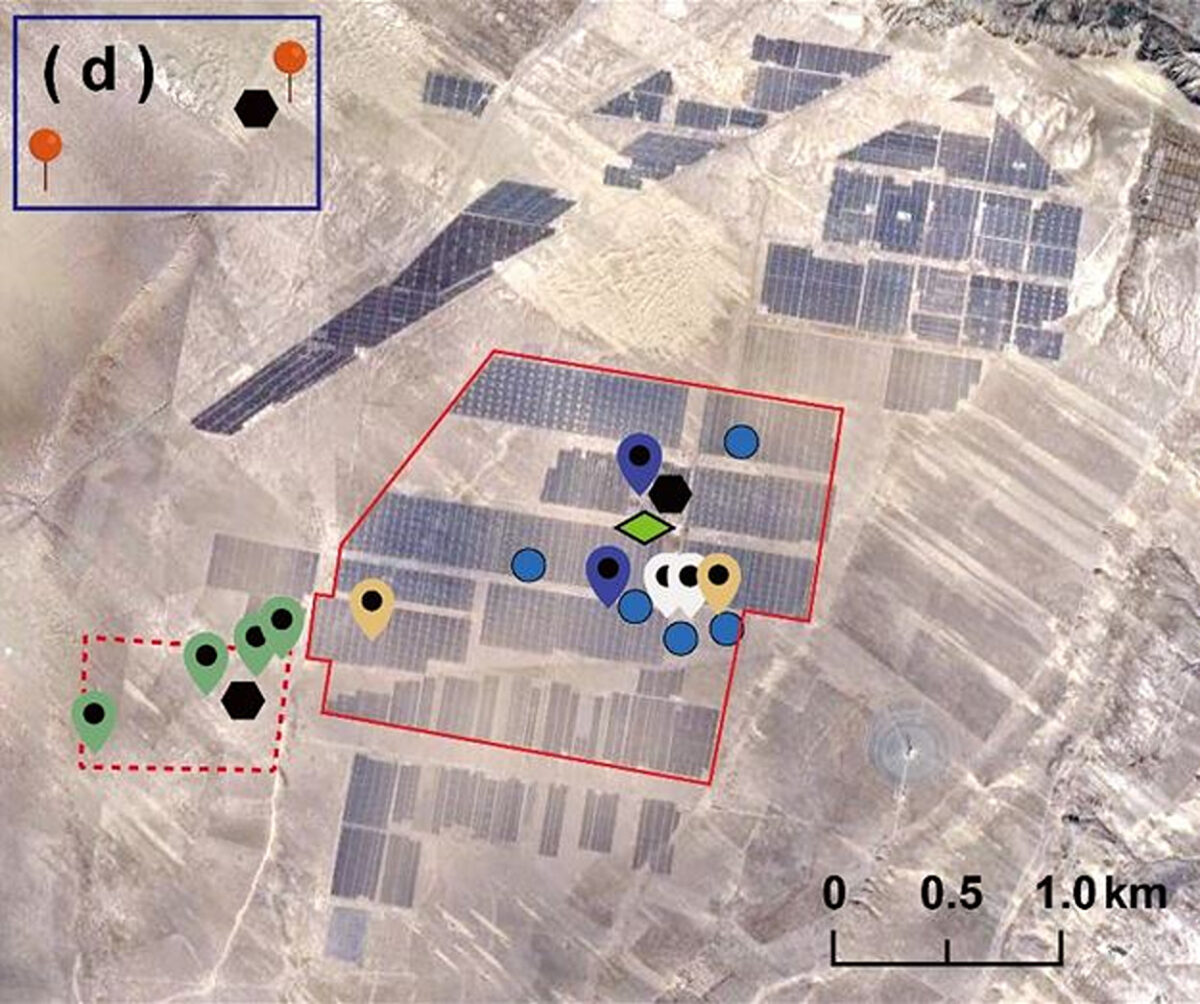
As a case study, they evaluated the on-site (WPS) effect of the Qinghai Gonghe Photovoltaic Park, a massive 1 GW facility located in a typical arid desert in Talatan, northeastern Qinghai province of China. The WPS was compared to transition zones (TPS) and off-site (OPS) areas to verify the findings.
Their analysis was based on the Driving-Pressure-Status-Impact-Response (DPSIR) model, which is recommended by the European Environment Agency (EEA). This framework divides environmental issues into five components, as stated in the name.
Driving forces refer to underlying causes of environmental change; pressure is the direct effect of driving forces on the environment; status refers to the current state of the environment as a result of pressure; while impact refers to its effect on human health and biodiversity; Finally, response is the action taken to address or reduce impacts.
A total of 57 indicators in these areas were analyzed. Some data comes from official documents, some from real-time monitoring, and some from sample testing and field research. The weight of each indicator was based on the entropy weight method, which gives greater importance to indicators with less variability.
In the DPSIR model, the environmental rating of “worse” is achieved when the index range is 0-0.2, while the rating of “poor” is achieved when the score is 0.2-0.35. The rating “general” is obtained when the score is between 0.35-0.55, the rating “good” when it scores between 0.55-0.75 and the rating “excellent” when it is between 0.75 and 1 is.
The site of Qinghai Gonghe Photovoltaic Park has an average annual temperature of 4.1 C, precipitation of 246.3 mm, evaporation of 1716.7 mm, sunshine duration of 2,300 hours to 3,500 hours, total radiation of 6564.26 MJ/m², wind speed of 1.8 m/m². s, where the wind direction is predominantly westerly and northwesterly. The park uses non-transparent monocrystalline silicon or polycrystalline silicon PV panels, some fixed, some with semi-tracking and some with full tracking.
Through their analysis, the scientists found that the overall score in the WPS was ‘overall’, with a score of 0.4393, while TPS and OPS scored ‘poor’ with 0.2858 and 0.2802 respectively. According to the scientists, this suggests that “the development of photovoltaics has had mainly positive effects on the microclimate, the physical and chemical properties of the soil and the diversity of the plant and microbial communities in the region, as supported by recent findings.”
The group also found that the desert PV installation may have affected the index in all issues: WPS scored 0.0513 as driving factors, while TPS and OPS both had 0.0257; it also fared better under pressure, scoring 0.0145, while TPS achieved 0.0090 and OPS 0.0072. In status, WPS scored 0.1818, while TPS scored 0.1155 and OPS showed 0.1114. On the impact indicators, WPS scored 0.1096, TPS 0.0945 and OPS 0.0948. In terms of response, the results were 0.0821, 0.0411, and 0.411, respectively.
The results are presented in “Assessment of the ecological and environmental impacts of large-scale photovoltaic development in desert areas”, published in scientific reports. The research team included scientists from the State Power Investment Group Qinghai Photovoltaic Industry Innovation Center.
This content is copyrighted and may not be reused. If you would like to collaborate with us and reuse some of our content, please contact: editors@pv-magazine.com.
