

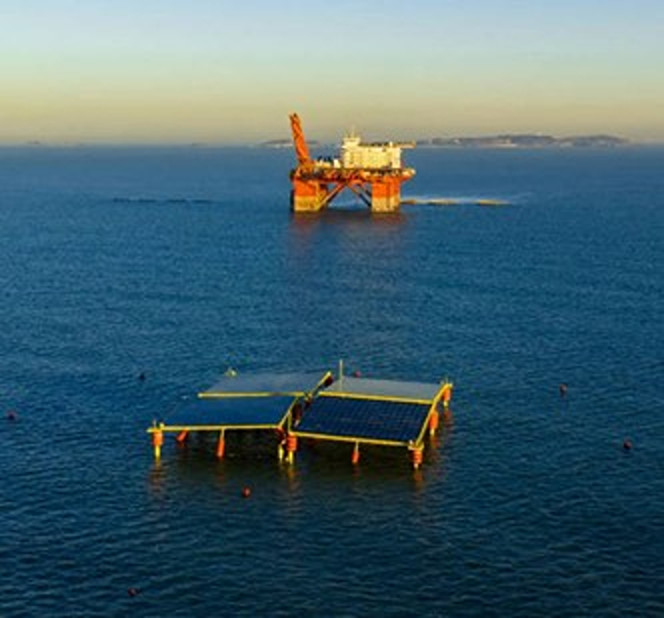
The Chinese manufacturer claims that back-contact Hi-MO 9 modules outperformed TOPCon counterparts in a six-month offshore test, showing higher power output, better low-light performance and lower operating temperatures.
Chinese module manufacturer Longi has released the results of a six-month test of its back-contact solar modules deployed in an offshore deep-sea experimental installation.
The company said the results, covering the period January-June 2025, were validated by the China National Photovoltaic Product Quality Inspection Center (CPVT).
The experimental site, located off the coast of Yantai, a major Chinese port city on the Yellow Sea, houses 10 Longi Hi-MO 9 modules with hybrid passivated back-contact (HPBC2.0) technology with an output power of 635 W, in addition to 10 TOPCon modules with an output of 615 W from unnamed manufacturers.
The bifaciality factor was reported at 75% for the Hi-MO 9 panels and 80% for the TOPCon modules, with theoretical rear power outputs of 476.25 W and 492 W, respectively. Empirical data from the tests indicated that the Hi-MO 9 modules delivered a 1.94% higher total power output compared to the TOPCon counterparts.
“Hi-MO 9 also performed exceptionally well in low-light conditions,” said Longi. “Test data from a cloudy and rainy day on February 4, 2025 showed a power generation gain of 0.98% per watt, demonstrating excellent performance even with insufficient irradiation.”
The company reported that its back-contact modules achieved an actual back-contact power of 32.05 W and a bifacial power of 667.05 W, compared to 33.11 W and 648.11 W for the TOPCon modules, noting that the Hi-MO 9 panels outperformed TOPCon modules across all time periods and irradiance levels.
Longi highlighted that the key factor behind the superior offshore performance of its back-contact technology was the lower operating temperature, which was 1.3C lower than that of the TOPCon modules.
“The empirical results indicate that Longi’s HPBC 2.0 technology offers significant benefits in power generation in offshore scenarios. Its strong performance in temperature control, low-light conditions and operational reliability meets the stringent requirements of offshore PV for high reliability, high efficiency and low maintenance costs,” the company added.
Further technical details of the tests have not been disclosed.
This content is copyrighted and may not be reused. If you would like to collaborate with us and reuse some of our content, please contact: editors@pv-magazine.com.
