

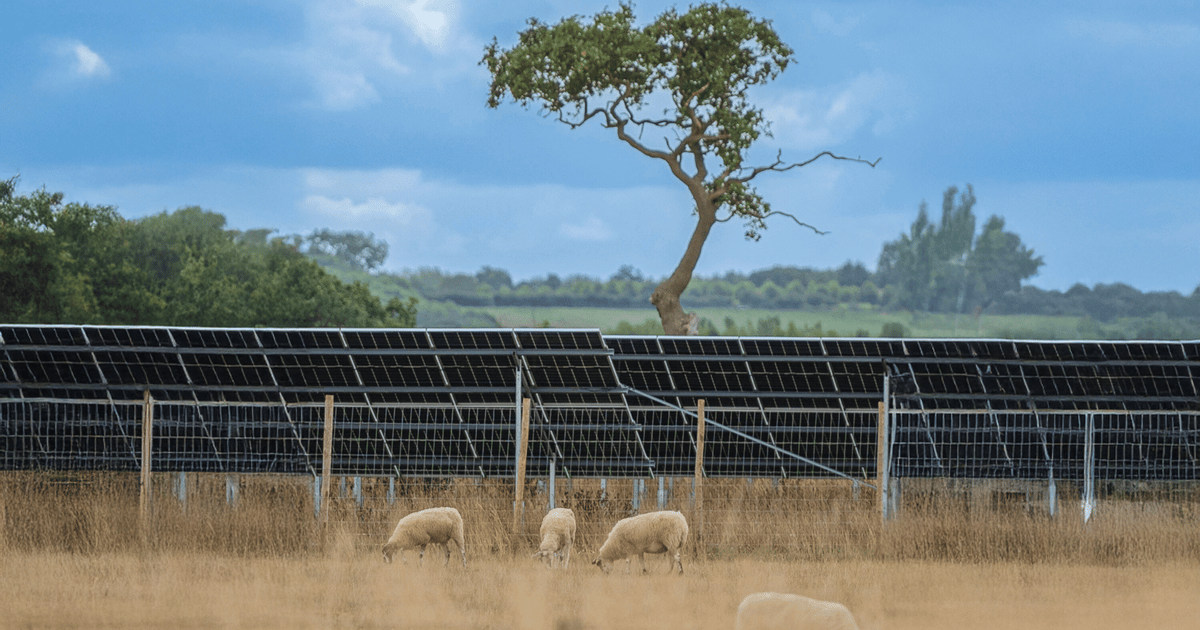
At the end of March, UK consumers were given the opportunity to own shares in the first community-operated battery energy storage system (BESS).
The community energy offer represents a simple proposal: buy shares in the BESSwhich will be co-located with a solar power plant also owned by the community, and will receive a portion of the project’s profits. The extra profit is spent on community initiatives, focusing on information about renewable energy sources.
Community ownership is a model that, in one form or another, has become more common in Britain and will be the focus of the current government’s £1 billion Local Energy Plan.
Low Carbon Hub, which is behind the community-owned BESS and the 19MW Ray Valley solar power plant with which it is co-located, was founded in 2011. The group was “inventing the model at the time,” says Barbara Hammond, the company’s co-founder and CEO since 2012.
“For us, the Community Benefit Society corporate structure was the right one because it legally requires you to make a profit which you then spend on a designated community benefit that you have written in your rules, your governing document.”
Establishment of the Low Carbon Hub
Hammond first became involved in what would become the Low Carbon Hub in 2007, working with West Oxford Community Renewables to bid for the NEST Big Green Challenge competition.
After raising £120,000 during the two-stage competition, the group installed what Hammond called Britain’s first third-party solar roof lease, before the Feed-in Tariff (FiT) was introduced. Hammond says: “There was a lot of focus on that project and that approach to community energy – we were quite surprised by the impact.”
The split to become the Low Carbon Hub came, in Hammond’s words, because: “West Oxford Community Renewables decided it didn’t want to grow. It wanted to stay focused on its own community. That’s why we set up the Low Carbon Hub to do the same work for the whole of Oxfordshire.”
That said, Community Benefit Society groups and community energy groups that operate under different models are necessarily very local.
Hammond says the impact of Low Carbon Hub has been far-reaching: “A lot of people learned early on from what we did, and so we now have a whole community energy sector.”
But “community energy has to have a geography,” she says, “because the big job we’re trying to monetize is engaging people and getting people to learn from each other locally.”
Hammond says: “We need the pipeline [of projects] to do that main task. The national government will not be willing or even able to commit the resources necessary for that long-term commitment.”
Low Carbon Hub’s approach focuses on education. “From the start it wasn’t so much about installing renewable energy,” Hammond explains, “it was about making a profit and helping people understand what they needed to do to help Britain move away from carbon-intensive energy sources, which we assumed would be to the benefit of everyone.
“That is still what we strive for and we must be able to do that demonstrably.”
Low Carbon Hub now has 56 active projects, with approximately 25MW of installed capacity across solar roof installations, the ground-mounted Ray Valley project and a hydroelectric power station on the River Thames.
It works with a network of community energy organisations, some of which are companies such as the West Mill Wind and Solar co-operatives, but many are groups governed by a written constitution, CICs or charities.
“We use our community benefits profits to support them in all kinds of ways: providing funding, but also a lot of advice, organizing events, keeping them informed about policy changes and how to talk about those changes with their communities,” says Hammond.
Of course, a lot has changed since the Low Carbon Hub started. “We’re at the point with solar roofs where the payback times are so short that we can’t really offer companies anything better than they could get for themselves if they invested,” says Hammond.
Therefore, the organization is targeting a 90 MWp pipeline in the coming years, which will mainly consist of ground-mounted solar and battery energy storage.
The reasoning behind the inclusion of energy storage in Low Carbon Hub’s plans is consistent with any developer’s justification for bringing the technology together with solar energy.
Hammond also notes that “one of the consequences of grid queuing reform is that mainstream developers will want to sell some of their pipelines in a way that they may not have done, or haven’t done at the moment, so we want to take advantage of that.”
In addition, she says Britain is at a point where “we know what we need and where we need it” in renewable generation. “If community energy doesn’t get into this set of projects, it’s going to be quite difficult for us to get into it at all.”
There are regional community energy groups active across Britain. Low carbon hubs Ray Valley Solar was the largest community-owned solar power plant when it came online in 2023.
Barbara Hammond, left, with Ray Valley Solar’s Low Carbon Hub team. Image: Low carbon hub.
Deril Water is now the largest operational community-owned solar power plant at 42 MW, but will be replaced by the Forest Gate solar farm when it comes online this year. The North Wiltshire solar power station was featured as a case study in both Regens paper, Best practices in community engagement and that of the British government consultation on community benefits.
That consultation came as the government said it was considering a legal mandate that developers implement a community benefit fund for the local community at a large-scale solar power plant.
While it is considered best practice to provide funding for the local area, Hammond says there is “increasing acceptance” that this should be legally required of developers.
Furthermore, her position is that the methodology for calculating the value of a community benefit fund needs to be updated.
“[Low Carbon Hub’s] The proposal would follow a number of European models that say the community benefit should be a percentage of income, rather than an amount per megawatt installed, which has been agreed before planning.
This is because, Hammond argues, at that stage of a project’s planning “people’s interests are not aligned, in fact they are completely opposed”. Major changes to a project usually occur during the construction permit process.
“The developer has to – I’m not criticizing them for this – try to keep that stake as low as possible because of those uncertainties, and yet this is the only time where the community can ask for something, so their incentive is to push it as far as possible.”
It’s also worth noting that a developer’s community fund can go towards something completely unrelated to renewables, which sets it apart from Low Carbon Hub’s approach.
Improving public perception
It is a fairly common anti-solar rhetoric that large, private developers use a community’s land for capital gain, without regard to the local environment.
While a community fund in itself could improve local attitudes towards a solar PV installation, it is arguably the education and engagement that Low Carbon Hub prioritises that will have a lasting impact on public perception.
Still, Hammond says the “loud voices” criticizing ground-mounted solar projects are not in the majority. Low Carbon Hub is a completely apolitical organisation, and Hammond says: “Hopefully we are at a point where politics has less of an impact on the transition than it might once have, because we have reached a general consensus where [renewables are] become normal.”
