

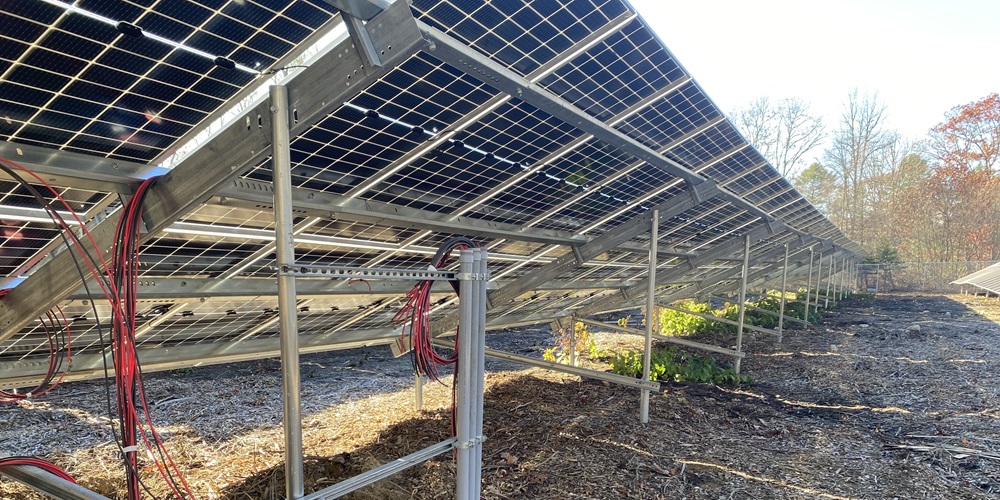
A UAE research team developed a hybrid 1D CNN and random forest model to detect multiple faults in bifacial PV systems, including dust, shading, aging and cracking. Using simulated IV curves and a 180-day synthetic dataset, the model achieved 100% accuracy in general condition detection and 97.6% in specific fault classification.
A research team led by the University of Sharjah in the United Arab Emirates has developed a new machine learning approach for fault detection in bifacial PV systems.
The method combines a one-dimensional convolutional neural network (1D-CNN) with the Random Forest (RF) learning method to identify specific defects such as dust, shadow, aging and cracks. The latter is a machine learning approach that uses multiple decision trees to improve the predictive accuracy of both classification and regression tasks, while the former is a feedforward neural network that learns features via filter optimization.
“This study pioneers a multi-fault classification framework for bifacial PV systems, integrating mathematical modeling of double-sided fault effects on current-voltage (IV) curves and a 180-day synthetic dataset with randomized severity,” the group said. “By combining the IV curve and analyzes of the maximum power point-based power profile, it demonstrates bifacial resilience, achieving up to 100% power advantage under heavy shade and 11.7-30% superior output at all faults.”
The academics started by developing a mathematical framework for modeling the IV characteristics of monofacial and bifacial PV modules. The simulated monofacial module has a short-circuit current of 9.30 A, an open-circuit voltage of 46.86 V, a maximum power point current (Impp) of 8.72 A, a maximum power point voltage (Vmpp) of 38.26 V, and a maximum power point power (Pmpp) of 333.8 W. The front of the bifacial module had values of 9.09 A, 46.89 V, 8.57 A, 38.32 V and 328.4 W respectively. The bifaciality factor was 0.8.
For both module types, the basic performance is determined by simulating regular operation. Further formulas were established to simulate different failure scenarios, namely shadow effect, dust accumulation, degradation effect, aging effect and cracking. All these profiles were simulated for 12 hours, from 6:00 AM to 6:00 PM, at 15-minute intervals, reflecting a typical solar day with realistic irradiance and temperature dynamics.
“The Phase 1 dataset includes Baseline, which consists of 90 days, 4,410 samples, which allocates 50.1% of the dataset, Obstruction consists of 60 days, 2,940 samples, which allocates 33.3% of the dataset, and Degradation, which consists of 30 days, 1,470 samples, which allocates 16.6% of the dataset,” the academics explained. “For phase 2, the 2,940 obstruction samples are distributed as shadow (592 samples, 20.1%), dust (588 samples, 20.0%), cracks (585 samples, 19.9%), none (585 samples, 19.9%), and aging (594 samples, 20.2%). This distribution reflects the realistic occurrence of errors, with degradation and rupture as minority lessons.”
For each block, 80% of the samples are randomly assigned to train the CNN-RF model, and 20% are assigned to testing. In the combination, the 1-D CNN is responsible for extracting features such as patterns in current, voltage, power, irradiance and others. At the same time, the RF receives these extracted features as input and performs the final classification. They both work in both phases: the first is a general operating status and the second is a specific error type.
“In phase 1, it achieves 100% accuracy in classifying baseline, degradation and obstruction states,” the results showed. “In phase 2, it identifies specific errors such as none, dust, shadow, aging and cracks with an accuracy of 97.6%, an area under the curve of 0.999 and a false positive rate of 0.006, outperforming standalone CNN with an accuracy of 89.7%, RBF-SVM with 96.1% and GBRT with 91.8%.”
The results appeared in “Improving fault detection in bifacial photovoltaic systems: a two-stage CNN-RF approach with IV curve analysis”, published in Energy conversion and management: X. Scientists from the United Arab Emirates University of Sharjah and the United Arab Emirates University participated in the study.
This content is copyrighted and may not be reused. If you would like to collaborate with us and reuse some of our content, please contact: editors@pv-magazine.com.
