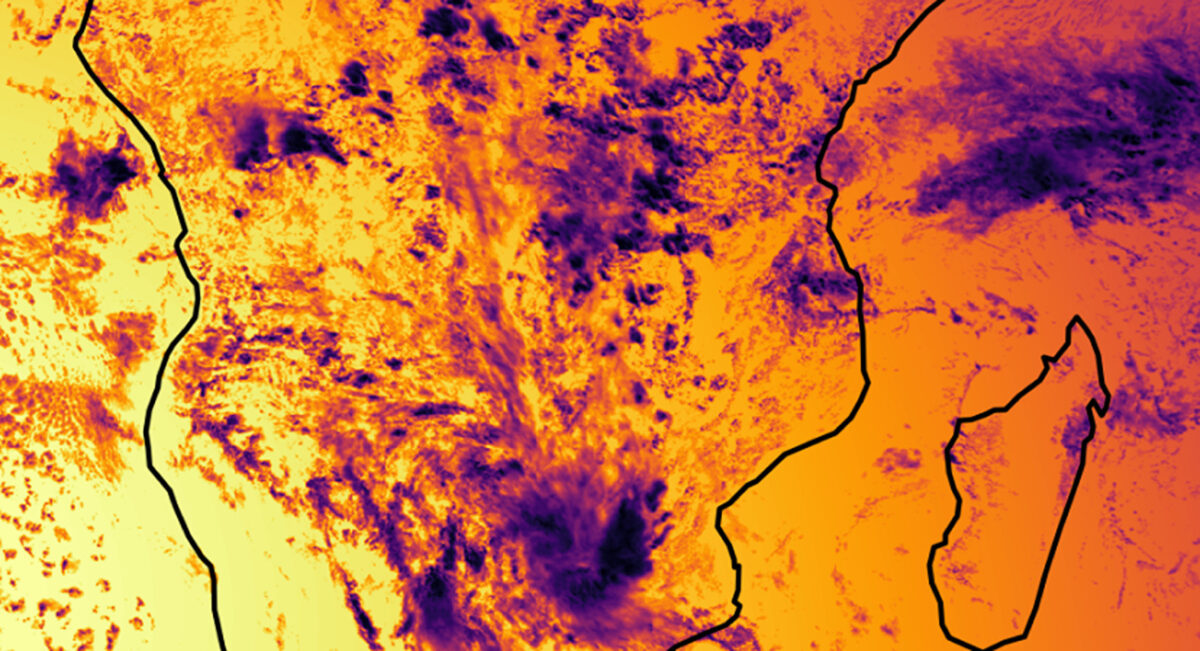
In a new weekly update for pv magazineSolcast, a DNV company, reports that the Meteosat Third Generation (MTG) satellite is now beginning operational testing. The new satellite will provide sharper and more detailed, more frequent images, which will provide a significant boost to solar radiation estimates.
According to analysis of early operational data by the Solcast Data Science team, solar forecasts across Europe and Africa will undergo a major upgrade as the Meteosat Third Generation (MTG) satellite begins operational testing. The new satellite, positioned alongside its predecessor from the Meteosat Second Generation (MSG) series, positioned at 0° longitude, delivers unprecedented improvements in spatial and temporal resolution, expanded spectral imaging capabilities and new tools to enhance atmospheric monitoring .
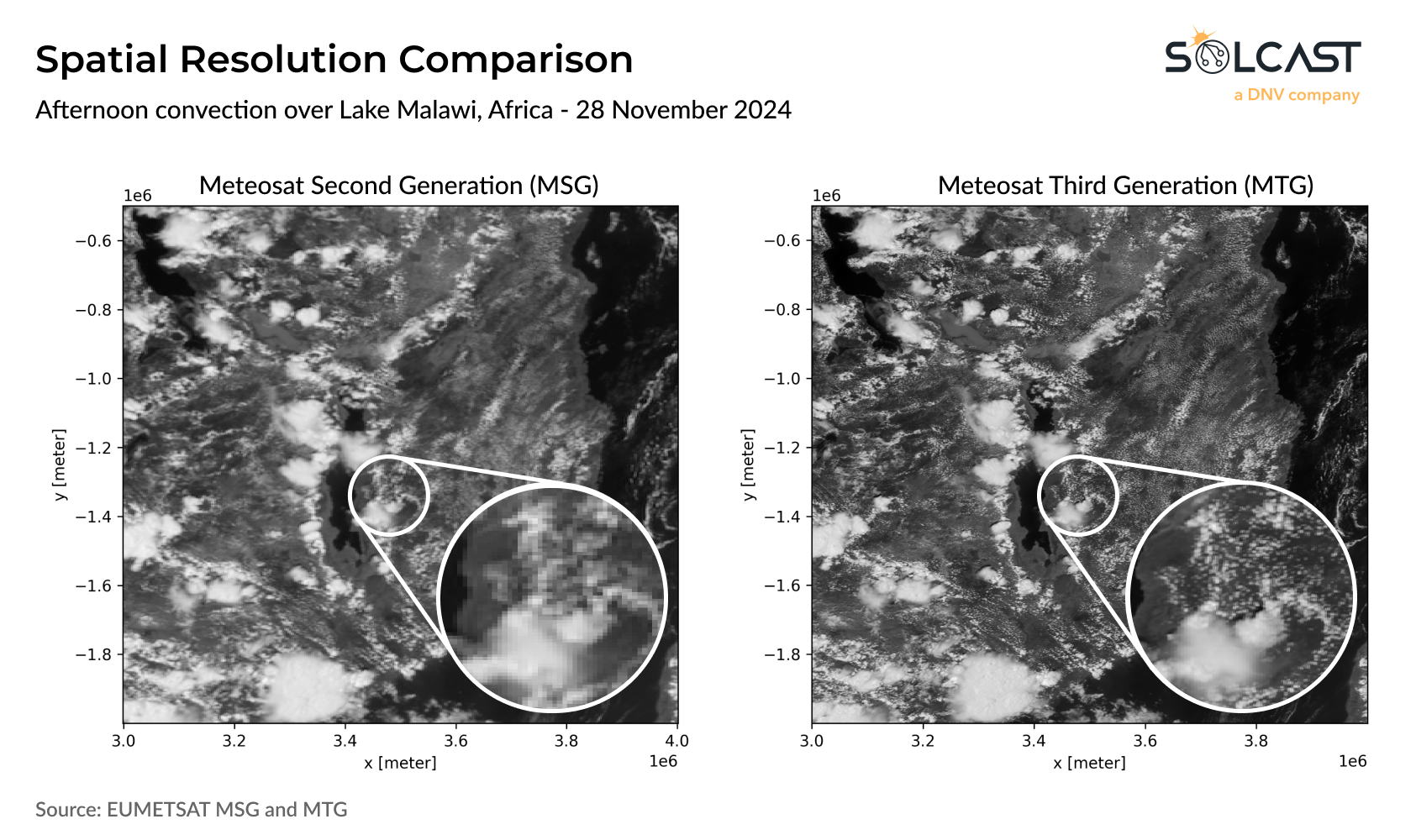
Compared to currently operational MSG satellites, MTG introduces sharper and more detailed, more frequent images, providing a significant boost to solar radiation estimates. Standard visible images now provide 1 km spatial resolution for whole-hemisphere scans,
compared to 3km at MSG. High-resolution visible images improve up to 0.5 km for the targeted regions and deliver twice the level of detail. Temporal resolution has also increased, with new images captured to full disk every 10 minutes, improving with MSG at 15-minute intervals.
Across Europe, MTG’s rapid scanning service will provide updates every 2.5 minutes – twice as fast as MSG’s 5-minute scans – supporting more accurate live and nowcast irradiance estimates.
The MTG satellite also features 16 imaging channels, compared to 13 on MSG, covering visible and infrared wavelengths. These additional channels allow better discrimination between clouds, snow, dust and sand in the atmosphere – key factors that influence irradiance. Improved spectral data supports more accurate identification of cloud types and heights, while also facilitating the tracking of atmospheric dust storms. Additionally, the MTG satellite’s new lightning camera instrument will provide critical insights into severe weather patterns,
providing a new data layer relevant to predicting solar energy generation.
With these improvements, the MTG satellite will improve solar forecasts through higher quality real-time and short-term cloud identification. Sharper, faster images improve cloud distribution forecasts, while better atmospheric data is incorporated into numerical weather
forecasting models (NWP) – which provide more accurate long-term forecasts. The faster distribution of satellite images, now split into 40 strips, ensures real-time data reaches forecast systems with minimal delay, enabling more up-to-date irradiation estimates.

Satellite-derived irradiation continues to offer several advantages over ground-based methods. Pyranometers require expensive maintenance, calibration and installation, while satellite imagery provides consistent radiation coverage at a much lower marginal cost. Importantly, satellites provide near-global spatial coverage and enable retrospective analyses, allowing for historical radiation data without the need for physical instruments at the time.
The operational launch of Meteosat Third Generation marks a significant leap forward in solar energy forecasting capabilities, improving the accuracy, detail and speed of data in Europe, Africa and surrounding regions.
Solcast produces these figures by tracking clouds and aerosols worldwide at a resolution of 1-2 km, using proprietary satellite data AI/ML algorithms. This data is used to drive irradiance models, allowing Solcast to calculate high-resolution irradiance, with a typical deviation of less than 2%, as well as cloud tracking predictions. This data is used by more than 300 companies that manage more than 150 GW of solar energy worldwide.
The views and opinions expressed in this article are those of the author and do not necessarily reflect those of the author pv magazine.
This content is copyrighted and may not be reused. If you would like to collaborate with us and reuse some of our content, please contact: editors@pv-magazine.com.
Popular content