

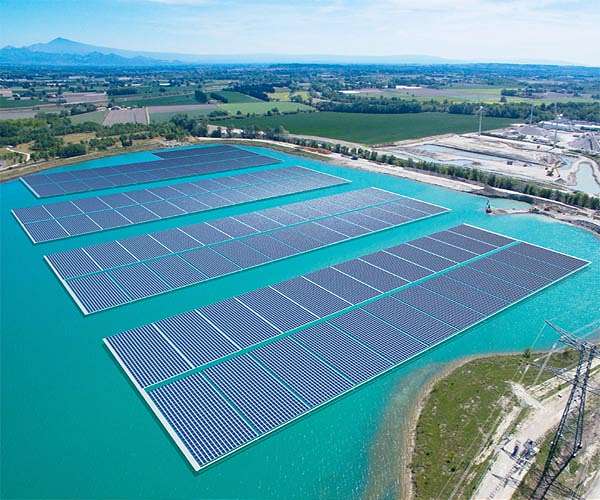
Morocco test floating solar panels to save water, generate electricity
Sun -baked Morocco, struggling with its worst drought in decades, has launched a pilot project that is aimed at slowing down water evaporation and at the same time generating green energy with floating solar panels.
In a large reservoir near the northern city of Tangier, thousands of so -called “floatovoltaic” panels protect the water surface against the blazing sun and absorb the light to generate electricity.
Authorities are planning to tackle the neighboring mandous medhaven complex with the resulting energy, and if it proves a success, the technology could have much broader implications for the North African Kingdom.
According to official figures, the water reserves of Morocco lost the equivalent of more than 600 Olympic swimming pools every day to evaporate between October 2022 and September 2023.
During the same period, the temperatures were on average 1.8 ° C higher than normal, which means that water evaporated at a higher speed.
In addition to other factors such as decreasing rainfall, this has reduced the national reservoirs to about a third of their capacity.
Officer of the Water Ministry Yassine Wahbi said that the Tangier -reservoir loses around 3,000 cubic meters per day to evaporation, but that is more than doubling in the hot summer months.
The floating photovoltaic panels can help to reduce evaporation by around 30 percent, he said.
The Ministry of Water has said that the floating panels “represent an important profit in a context of increasingly scarce water resources”, even if the evaporation they stop is relatively marginal for the time being.
Assessment studies are underway for two more similar projects in Oeed El Makhazine, at one of the largest dams in Morocco in the North and in Lalla Takerkoust near Marrakesh.
Similar technology is tested in France, Indonesia and Thailand, while China is already operating some of the world’s largest floating solar farms.
– ‘Pioneering’ –
Since the Moroccan pilot program started at the end of last year, more than 400 floating platforms have been installed in support of several thousand panels.
The government wants more, planning to reach 22,000 panels that would cover approximately 10 hectares at the 123-Hectare Tangier reservoir.
Once completed, the system would generate around 13 megawatt electricity – enough to provide the mandige medal complex with power.
Authorities also have plans to plant trees along the shores of the reservoir to reduce wind that is believed to aggravate evaporation.
Professor Mohammed-Said Karrouk of Climate Sciences called it a “groundbreaking” project.
However, he noted that the reservoir is too large and the surface is too irregular to completely cover with floating panels, which can be damaged with fluctuating water levels.
Official data show that water reserves fed by the rainfall in the past decade have fallen by almost 75 percent compared to the 1980s, which falls from an annual average of 18 billion cubic meters to just five.
So far, Morocco has mainly trusted descending to combat shortages, which produces around 320 million cubic meters of drinking water per year.
Authorities want to expand production to 1.7 billion cubic meters annually by 2030.
Karrouk said that an urgent priority should transfer the transfer of excess water from northern dams to regions in Central and South Morocco that are more affected by the years of drought.
The Kingdom already has a system that is called the “Water Highway”-one 67 kilometer channel that connects the Sebou basin with the capital Rabat-with plans to expand the network to other dams.
