

The use of native perennial ground covers for utilities – from solar sites to transmission rights (ROWs) to data centers – represents a critical evolution in grid hardening and vegetation management. Rather than being a superficial environmental initiative, extensive field data and financial analyzes now show that native rangelands are a quantifiable, cost-effective tool for reducing operating costs, optimizing energy output and improving critical infrastructure resilience.
The financial liability of ecological neglect
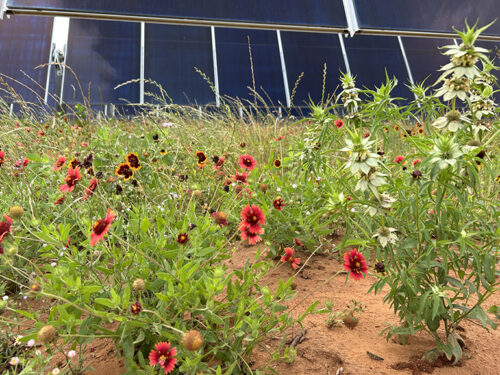
Revegetation of native plants at a solar project in Texas. Credit: McCarthy Building Companies
For utility finance teams and policymakers, the financial consequences of rejecting nature-based resilience are serious. In Remsen, Iowaa community clean water project has successfully utilized the deep, complex root systems of native prairie grasses near spring mouths, achieving a 40% reduction in well nitrate levels by naturally filtering runoff. When this effective ecological solution was abolished for political reasons and the native grasses were subsequently sprayed and destroyed, water pollution predictably increased. This forced return to non-productive land use ultimately resulted in $10 million in infrastructure expenditures for a new water treatment plant, placing a huge, unnecessary financial burden on local taxpayers. Neglecting ecological resilience entails immediate, significant financial liabilities.
This neglect impacts the entire state: If current pollution rates continue, Iowans will spend up to $333 million on nitrogen removal from drinking water systems in the coming years. the next five years. Crucially, these expenses fall heaviest on those who can least pay; individuals in small rural communities often face annual treatment costs that can amount to as much as $1,200 per personwhile city residents pay just $2 per person. Neglecting ecological resilience therefore entails direct, colossal and disproportionately regressive financial costs.
O&M and performance: quantifying efficiency gains
The technical benefits of using native, low-growing vegetation in utility-scale solar installations directly impact two critical operational metrics: operations and maintenance (O&M) costs and energy yield performance.

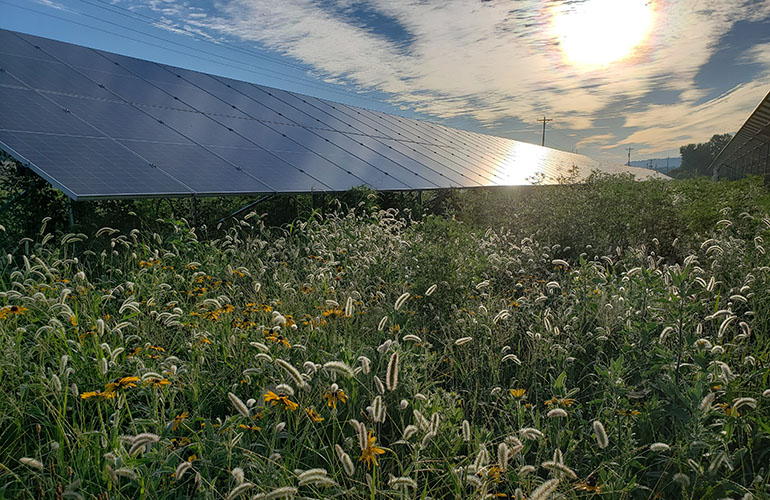
Pollinator-friendly arrays like this one in southern Ohio can preserve valuable grassland habitat. Credit: TMI Electric
Traditional ground cover, such as gravel or short grass, contributes to a “heat islandeffect around solar PV modules, which degrades the efficiency of the panels. Native vegetation, on the other hand, provides shade to the ground and regulates the site temperature through evaporation, creating a cooler microclimate. Technical comparisons of solar sites demonstrated this effect: areas with vegetation under PV panels had on average an 8% lower soil temperature and 34% higher groundwater potential compared to control areas, a thermodynamic condition that directly translates to improved PV performance, especially in dry, warm climates. As a result, one study found that panels located above cooling native vegetation had up to 10% more energy than that placed over gravel.
Furthermore, the conversion from resource-intensive turfgrass to a self-sustaining native habitat significantly reduces maintenance costs. Utilities can be a 80 to 90% reduction in operating and maintenance costs over a period of 10 years thanks to the lower mowing frequency and the absence of fertilizer. More than one typical period of 20 yearsthe cumulative cost of maintaining native prairie grasses is approximately $3,000 per acre, compared to approximately $20,000 per acre for turf grasses. The difference in operational expenses is large: one Fortune 500 The company reported spending $6,675 per acre annually on traditional lawn maintenance, compared to just $140 for existing prairie grass, a reduction of nearly 98%.
The cheap anchor: indigenous roots for geotechnical resilience
For transmission corridors, substation locations and solar farms, ground stability is fundamental to the physical resilience of the grid. Native perennial grasses are an important part of soil bioengineering and provide an essential, low-cost solution for… soil reinforcement and erosion control that minimizes the risk of infrastructure failure. The roots of prairie plants can penetrate to the depths 15 feet or more, creating an anchoring system. This fibrous root network dramatically improves water infiltration, stabilizes utility slopes, reduces surface runoff, and reduces the threat of soil-related infrastructure failures around transmission tower foundations, access roads, and substation foundations during extreme weather events. Especially with rainwater, runoff is reduced by 23% compared to conventional crops.
Quantifying stakeholder value: agricultural and financial spillovers
The deployment of large-scale renewable energy projects faces serious headwinds from local opposition and cited challenges. About 70% of large-scale solar parks in rural US are built on farmland, often leading to conflict over perceived land loss. A 2021 MIT study identified 53 U.S. renewable energy projects that were suspended, postponed or canceled due to local opposition, with environmental impacts being one of the leading causes of conflict. Moreover, a separate study found that this was almost the case a third of all solar energy projects Completing the Environmental Impact Assessment (EIA) review process faced legal challenges, which ultimately caused or contributed to the termination of three projects and significantly delayed six others.

Native grasses at the Sun Mountain solar project in Colorado. Credit: McCarthy Building Companies
By deploying native pastures, utilities can fundamentally reframe the value proposition for local communities and mitigate this critical risk. The project shifts its identity from a land consumer to a shared ecological and economic asset. When solar sites utilize pollinator-friendly native habitats, they transform into a valuable source of biodiversity that generates financial spillover benefits. That has been proven increase the yield of neighboring crops up to 20% on pollinator-dependent crops (e.g. soy, beans or specialty crops). A large-scale spatial analysis estimated that retrofitting U.S. solar farms with pollinator habitats could yield benefits $264 million in annual benefits for farmers. A research project found that native bee populations were increasing 20 fold in less than five years on habitat-friendly solar sites, creating a robust, readily available pollinator workforce for surrounding farms.
Native flowering plants provide essential food (nectar and pollen) and breeding grounds for declining insect populations, including native bees and the monarch butterfly. This turns the solar area into a de facto protected area, transforming the opposition by shifting the narrative from ‘damaging or taking away agricultural land’ to ‘restoring and improving the best locations for agriculture’. By providing these direct, quantifiable financial and agronomic benefits to adjacent landowners, native vegetation management transforms the utility site from a perceived “eyesore” or competitor for land into a shared ecological and economic asset. The use of native pastures is not just an aesthetic choice; it is a data-driven investment in utility O&M efficiency, physical infrastructure resilience, and long-term financial stability.
William Sweet promotes environmental sustainability by helping to draft legislation, promoting solar energy, and researching green finance and conservation. His work aligns sustainability with economic realism and ensures that what is good for the planet is also financially beneficial.
