

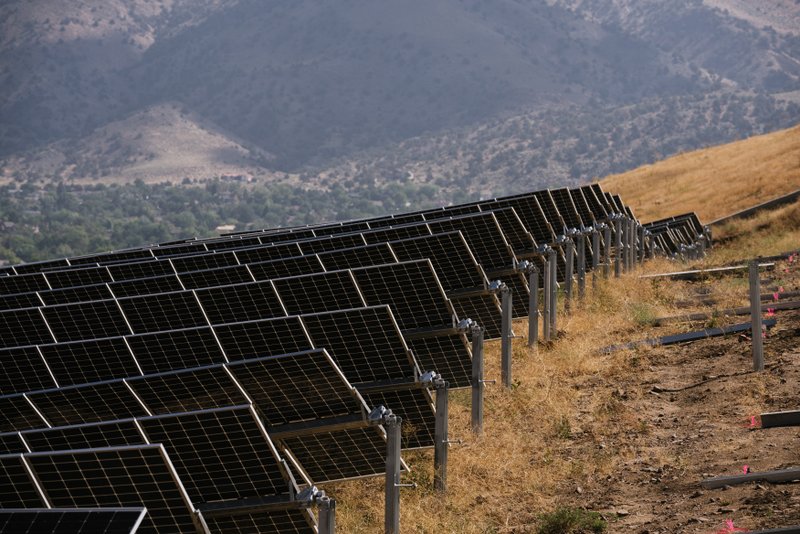
A construction analysis and consulting firm discovered that the Nevados tracker requires only 118 man-hours per megawatt, less than other comparable solar trackers.
According to a new report from Eclipse-M, an independent technical consultant for the construction of solar energy projects, the Nevados All Terrain solar tracker can be assembled and installed faster than any tracker in its class. The company reported that other solar trackers require between 159 and 244 operating hours per megawatt, compared to 118 for Nevados.
The adaptability of the All Terrain Tracker allows tracker bays to follow natural terrain, eliminating the need for extensive terrain layout to install the tracker. This keeps topsoil in place and prevents harmful runoff by maintaining the natural permeability of the land. It also reduces construction time due to the leveling process itself and the resulting muddy conditions that can delay installation of the tracker.
Nevados has found that the same flexible tolerances that allow the tracker to navigate terrain and eliminate leveling also enable efficient installation times.
“In addition to the terrain-following benefits you’ll see from Nevados, we don’t see a penalty in terms of installation, which is good news,” said Bill Poulin, managing partner of Eclipse-M, who presented his findings at the CLEANPOWER conference and trade show in Minneapolis. “We really think that terrain following is an important new development in tracker design and methodology, so it’s good to see that this can be achieved.”
Eclipse-M is an external service provider and consultancy for the solar energy industry, with decades of experience in executing projects in close consultation with developers and OEMs. It has helped develop and execute projects using 14 leading tracker and fix-tilt assemblies, giving the company unique insights into the factors that determine construction time.
“Nevados is a customer-focused company, so we always work with our partners to improve our products and processes to ensure our tracker can be constructed quickly and accurately,” said Yezin Taha, CEO and founder of Nevados.
For their report, Eclipse-M looked at a range of factors that affect installation speed under normalized conditions, such as the same module wattage for each tracker, including:
- Physical work of installing the tracker
- Material handling requirements to unpack the tracker
- Site preparation requirements, including layout
- Materials and logistics to get the tracker to the location
By looking at the amount of physical work involved in installing the tracker, Eclipse-M analyzed the complexity of the construction, the number of components, the tolerances of the product and the precision required for the construction. The drive and mounting systems, as well as the module mounting (with bolts/nuts or clamps), were also examined.
Even the most accurate site surveys will not be 100% accurate, so wide tolerances are critical. Nevados uses flexible bearings for every foundation. Even if the posts are not exactly in the expected location, the All Terrain Tracker can easily adjust without having to rework them.
At the Bartonsville solar plant in Virginia, the developer had to switch panel manufacturers late in the project’s development due to supply chain issues. The new panels used had different connection points and different dimensions than the original panels.
It was easy to make that change using the more flexible Nevados system, while other trackers required moving hundreds of foundation piles across many acres of trackers, and may require an entirely new torsion tube structure to adapt to this change .
Nevados also works closely with EPCs to optimize material handling and reduce preparation time. Through detailed post-project reviews with customers, Nevados learned that changes in the way components for the All Terrain Tracker arrived on site could deliver improvements in installation time for customers. Now some components come pre-assembled, while others that previously did so arrive disassembled.
Nevados uses American steel for its trackers instead of aluminum, eliminating long and volatile global supply chains. Tracker components are manufactured by Priefert Steel in Mount Pleasant, Texas, a central location to allow for easy shipping to locations throughout the United States.
Listen to more in-depth conversations on Solar Builder’s YouTube channel

Our most popular series include:
Power forward! | A collaboration with BayWa re to discuss industrial topics at a higher level.
The buzz | Where we give our 2 cents per kWh in the residential solar market.
The pitch | Discussions with solar manufacturers about their new technology and ideas.
Source link
