

UNSW researchers have developed a thermally aware tracking algorithm that reduces solar module temperatures and UV exposure during inverter clipping and trimming, slowing degradation without reducing AC output. When tested in Chile’s Atacama Desert, the strategy was found to be able to reduce module temperatures by as much as 7.7 degrees Celsius.
A research team from the University of New South Wales (UNSW) has developed a thermally aware tracking algorithm to reduce solar panel temperatures during periods of clipping and curtailment.
Inverter clipping occurs when the DC energy from a PV system exceeds the maximum input size of the inverter. This causes the inverter to become saturated and the excess DC energy is not converted into AC power. Curtailment refers to the intentional reduction of potential electricity generation to less than what a power plant could have produced, usually to maintain the stability of the electricity grid when supply exceeds demand or when network constraints arise.
“The algorithm moderates irradiation at the plane of the array only during clipping periods, when additional irradiation cannot be exported,” said the study’s corresponding author, Bram Hoex. pv magazine. “It also reduces cumulative UV exposure, further mitigating the causes of long-term degradation.”
“The proposed strategy explicitly aligns tracker control with real network constraints, improving sustainability without compromising AC output,” Hoex continued. “The concept can be extended beyond clipping to grid containment scenarios, which are becoming increasingly common.”
In the study “Thermal-aware tracking for solar photovoltaics: reducing module degradation without sacrificing efficiency”, published in IEEE Journal of Photovoltaicsthe researchers explained that the algorithm is effective in different locations, but its benefits and optimal use depend on the local climate and site conditions. Factors such as wind, humidity, cloud cover, altitude, terrain, shade, temperature and irradiation influence convective and radiative cooling and ensure optimal panel tilt.
The algorithm first simulates DC and AC power and module temperature over different tilt angles, identifying the tilt that delivers the full AC power of the inverter at the lowest module temperature. Clipping is predicted by comparing the simulated DC power to the limit of the inverter. If clipping is expected, the algorithm checks whether the event exceeds a set duration.
Short clipping events are ignored because fast tracker movements are impractical. For longer events, the algorithm selects tilt angles that maintain inverter-limited AC power. At each time step it chooses the module temperature that minimizes tilt, respecting the actuator speed limit. Any tilt position that requires movement beyond the capabilities of the actuator is excluded. If a clipping period is too short or if all possible angles exceed the speed limit, the tracker will default to standard tracking.
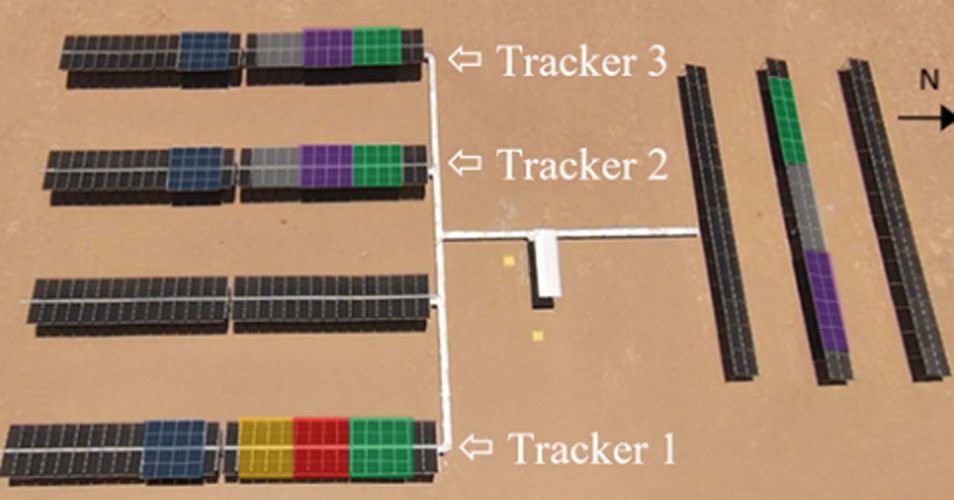
The tests took place at the Plataforma Solar del Desierto de Atacama in northern Chile. The site contained four single-axis trackers, each with four active module arrays of different technologies plus dummy modules. Each tracker is connected to a 60 kW inverter with separate MPPT inputs that control DC output, module temperatures and plane-of-array irradiation. A weather station recorded environmental conditions, with all data recorded every minute.
The team evaluated two tilting strategies during cutting. The lead-only approach kept the tracker slightly ahead of the standard angle to limit movement, while the lead-lag strategy allowed the tracker to move forward in the morning and lag behind in the afternoon, altering the panel’s thermal exposure.
The results showed that the algorithm was able to reduce module temperature by up to 7.7 C, with an average reduction of 2.7–3.1 C depending on the strategy. The lead-lag approach improved radiative cooling and provided stronger thermal benefits than the lead-only method.
Arrhenius analysis indicated that these temperature reductions could significantly slow the rate of degradation, which approximately doubles for every 10 degrees Celsius increase. The algorithm also reduced daily global UV radiation by up to 47 Wh/m², reducing UV-induced degradation and thermal stress.
“This work bridges system-level control and materials reliability, demonstrating that smart operational strategies can directly reduce thermally driven degradation in utility-scale PV,” Hoex concluded. “In future work, we will integrate these findings and examine module degradation on a global scale to put our laboratory results into perspective.”
This content is copyrighted and may not be reused. If you would like to collaborate with us and reuse some of our content, please contact: editors@pv-magazine.com.
