

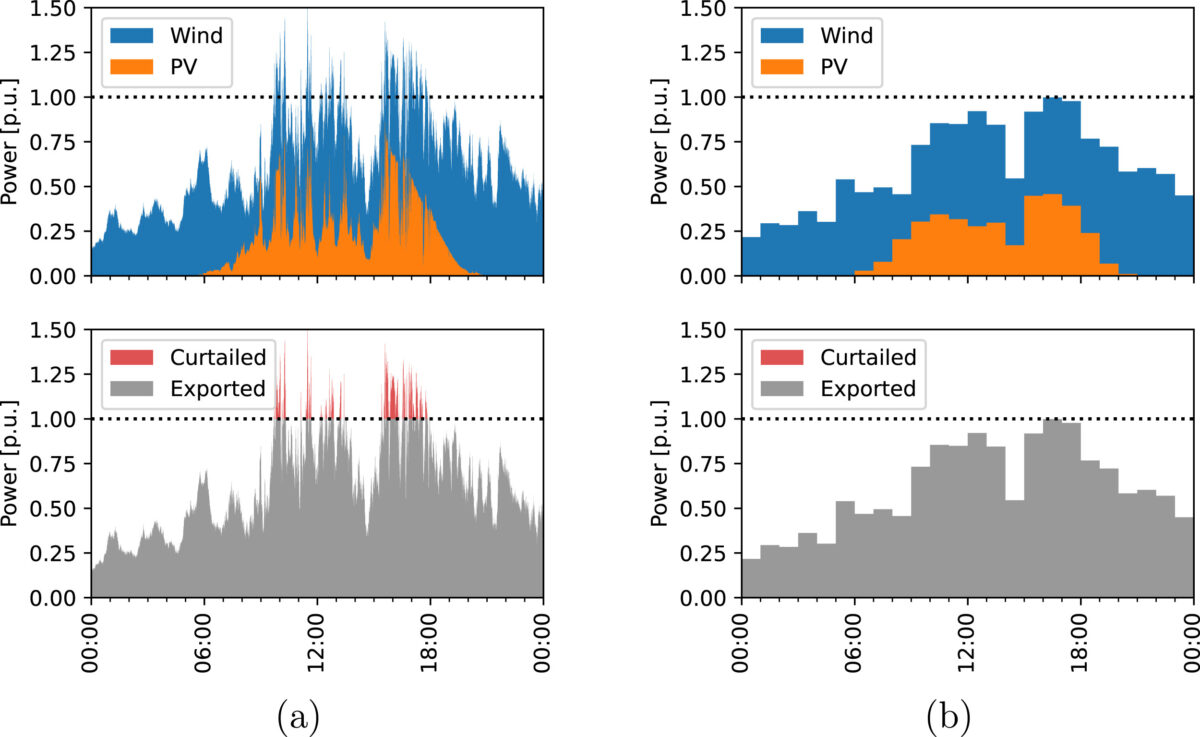
A European research team has proposed a new methodology for optimal design of hybrid wind-solar power plants. Their approach is based on 1-minute resolution data, which the scientists say provides much more accurate information about potential curtailment and clipping losses compared to 1-hour resolution data.
A European research team has investigated the effect of different time resolution data on the design of hybrid PV-wind power plants (HyPPs) and found that lower resolution can result in an overestimation of the net present value (NPV) of the facilities by up to 3%.
“When conducting feasibility studies for HyPPs, hourly resolution data or lower are typically used as this is the resolution commonly available in meteorological databases,” the group said. “However, when optimizing the topology of HyPPs with capacity limits at the point of interconnection (POI), the techno-economic feasibility of these power plants could be overestimated, as the curtailment and clipping losses will be underestimated when using hourly data instead of higher resolution data.”
The study was based on data obtained from an operational HyPP in East Germany. This plant has an installed PV capacity of 11.64 MW and a DC-AC ratio of 1.13. The wind turbines have an installed capacity of 24 MW and because they are installed 1.6 km from the PV panels, they do not cast any shadows. In 2020, the year in which the researchers conducted their research, the wind and PV installations generated 57.58 GWh and 12.80 GWh respectively.
Weather and generation data from the German HyPP were recorded at 5 second resolution and downsampled for one minute and one hour for the comparative analysis. As part of the analysis, different DC-AC ratios have been assumed for the PV portion, effectively changing the actual capacity of the plant.
“It has been shown that for a HyPP consisting of 1 wind, PV and POI capacity per unit (pu) respectively, the curtailment losses are estimated to be only 1.45% for the 5 seconds and 1.09% for the 1 hour. resolution dataset, which translates into income losses of 0.77% and 0.51% respectively in the German day-ahead market,” they found. “These results demonstrate a discrepancy between the losses estimated by the hourly and high-resolution data sets.”
Furthermore, the researchers found that using 1-minute resolution data appears sufficient to approximate the containment losses predicted by the 5-second data set. “Acquiring the data at 1-minute resolution seems to be a good compromise between accuracy and measurement effort,” they explained.
When conducting a techno-economic estimation to find the optimal size of the HyPP, the researchers found that using the 1-hour data set leads to a 1.86% overestimation of the total NPV compared to the 1-hour data set minute. They also said that this overestimation increases when the shares of PV and wind capacities are further increased relative to POI capacity.
“The techno-economic model indicates that the cost-optimal HyPP topology for this location consists of wind and PV capacities that are each slightly greater than, but still closely match, the POI capacity. Using the 1-hour instead of 1-minute resolution data appears to have little impact on identifying the optimal HyPP design,” they say. “However, for the optimal HyPP topology derived from the 1-hour data set, the NPV is overestimated by 2.99% when calculated using the 1-hour data set instead of the 1-minute data set.”
Their findings were presented in “Influence of high-resolution data on accurate mitigation damage estimation and optimal design of hybrid PV-wind power plants”, published on Applied energy. The group included academics from the Norwegian Institute of Energy Technology (IFE), the University of Oslo (UiO) and the German Fraunhofer Institute for Solar Energy Systems (ISE).
This content is copyrighted and may not be reused. If you would like to collaborate with us and reuse some of our content, please contact: editors@pv-magazine.com.
