

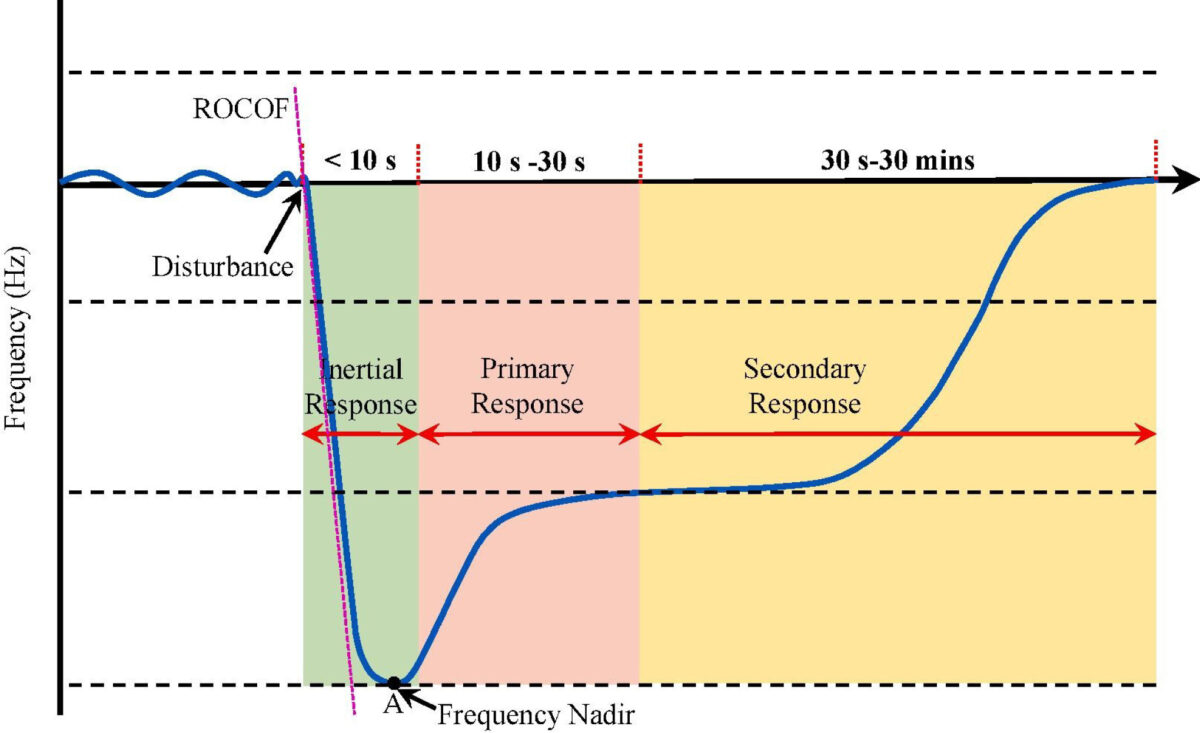
A group of researchers in Australia have outlined a new methodology to determine the minimum power of energy storage systems (ESSs) used for underfrequency response in emergency situations. The ESS size must be calculated to keep the frequency within the standard operating range.
A group of researchers from Edith Cowan University in Australia have proposed a new methodology to determine the optimal size of large inverter-connected energy storage systems (ESSs) planned for underfrequency response in emergency situations.
“Providing the necessary response with minimal ESS capacity is beneficial for power system planning and operating a fleet of partially discharged ESS units,” the scientists said, noting that the proposed solution is also feasible at low cost is. “Characteristics such as rise time, overshoot and stabilization time of the active power response can be controlled by adjusting specific parameters.”
In the newspaper “Optimizing grid-shaping inverters to prevent load shedding at underfrequency with minimal energy storage”, published in the Journal of Energy Storagethe researchers explained that the active power capacity of ESS can be used to minimize uunder-frequency load shedding schemes (UFLS), which are generally activated during low-frequency events, shedding predetermined loads to prevent further frequency drops.
“As UFLS events are rare, some transmission system operators do not need leeway to accommodate major disruptions,” the research team said. “The use of ESS for under-frequency response in emergency situations is therefore a cost-effective option. Furthermore, providing the necessary response with minimal ESS capacity is beneficial for power system planning and operating a fleet of partially discharged ESS units.”
The academics also explained that the novelty of their work was to determine the minimum power of a battery for both virtual synchronous generators (VSGs) and droop control-based grid-forming (GFM) inverters. The ESS size, which they specified, must be calculated to keep the frequency within the standard operating range.
“The ESS size is optimized to avoid under-frequency load shedding after switching off a large generator, by keeping the frequency within the frequency operating standard (FoS),” they also pointed out. “The calculation of control parameters and determination of ESS size takes into account the multi-step duration and thresholds provided by the FoS. UFLS protection settings are designed based on the FoS and sizing ESS to achieve a fixed frequency will not yield the optimal ESS size.
The proposed approach is based on a Hill Climbing algorithm, which iS a classic optimization technique in artificial intelligence that draws inspiration from climbing to the top of a mountain. It works by increasing the altitude value to find the top of the mountain or the best solution to a given problem. It ends when it reaches a peak value where no neighbor has a higher value.
The group examined a case study of a power system implemented via DIgSilent PowerFactory software.
The simulation showed that in GFM inverters, a decrease in the active power droop coefficient increases the active power output. However, this increase is limited by the limitations of current inverters. As a result, the scientists propose keeping the active power droop coefficient at a value that can avoid instability due to inverter limitations while maximizing active power output.
As for VSGs, they proposed keeping the acceleration constant, which can reportedly balance the rate of change of frequency (RoCoF) and power oscillations. They noted that the acceleration time constant of the VSG controller is proportional to the inertia and that increasing it increases the inertia.
“For the case investigated in this study, the minimum energy storage capacity for the virtual synchronous generator control is 85 MVA, while for the droop control the minimum storage capacity is 89 MVA,” the scientists concluded. “The results of this study should be useful for energy system planners to better utilize the potential of energy storage systems.”
This content is copyrighted and may not be reused. If you would like to collaborate with us and reuse some of our content, please contact: editors@pv-magazine.com.
