Researchers from Canada’s Western University have developed an open-source, blockchain-based virtual utility for peer-to-peer (P2P) solar trading, using smart contracts to save up to $1,600 (US dollars) for 10 homes in simulated scenarios.
Scientists from Canada’s Western University have designed a new open-source autonomous virtual utility to monitor PV users and enable P2P trading. Their SolarXchange A system based on blockchain technology creates smart contracts on its own and facilitates transactions between users on an hourly basis. “We are very interested in working with forward-looking electric utilities that want to enable widespread distributed solar generation and P2P exchanges to create a truly resilient electricity grid,” said corresponding author Dr. Joshua M. Pearce said pv magazine.
“For utilities that choose to embrace distributed generation, there are several business models. One tempting approach is to enable P2P solar trading,” the academics said. “The main problem is that billing systems have been set up for centralized energy production, a new method of billing/trading is needed that is built for distributed generation. One approach is to use blockchain technology, as it enables secure transactions.”
The new virtual utility is based on two levels of contracts, written with Solidity, one of the popular smart contract languages. In the blockchain context, smart contracts are codes that automatically perform tasks when certain conditions are met. At the first level, each participating home has a home contract, which describes the general state of the user’s PV generation and demand. At the second level, the virtual utility manages the HouseFactory contract, which absorbs information from the first-level contracts, tracks the demand and production of the individual homes, and decides when to exchange electricity.
“Unit tests for each of the contract methods are written in Solidity and gas consumption and cost data are collected. It should be noted that the ‘gas’ in the context of P2P networks refers to the metric for transaction costs and computing costs, and not natural gas,” the group said. “The total cost of deploying the contracts was calculated by migrating the contracts to the local Truffle blockchain and retrieving gas consumption and cost information from the terminal output.”
Image: Western University, Solar Energy Advances, CC BY 4.0
After testing the blockchain functions, a JavaScript simulation was developed to use the actual load contracts and PV generation data on an hourly basis for a year. The simulation considers two scenarios: both involve ten homes and real electricity information from New York City. The first case study, ‘True Peers’, represents a mature system in the future where all homes are prosumers with their own PV.
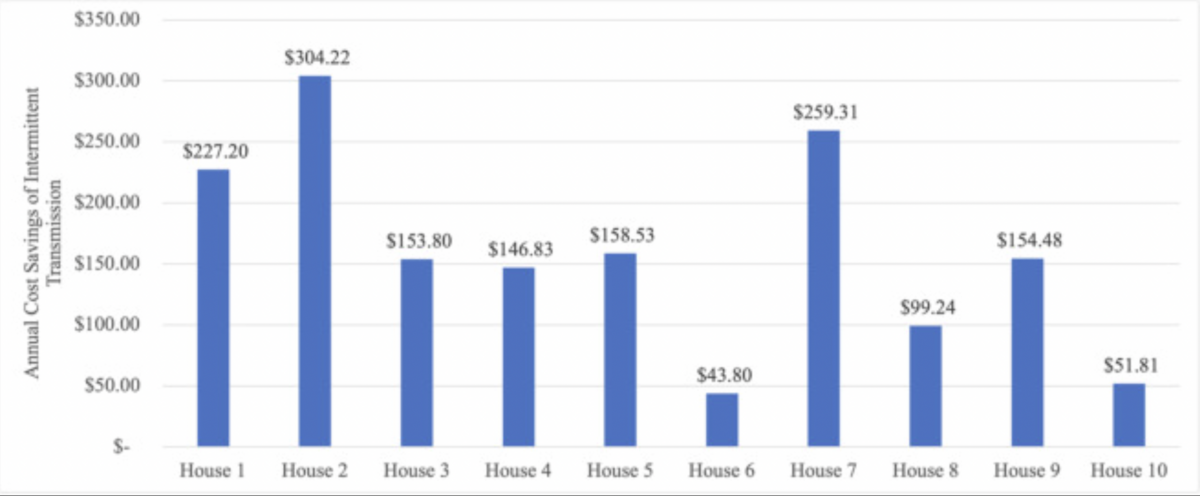
“The second case study is called the Intermittent Transition. In this case study, there are four types of houses,” the scientists explained. “Firstly, a quarter of homes have twice the PV they need for their own consumption, which equates to households with large, unshaded roof areas. Second, a quarter have enough PV to meet their annual electrical load, which would represent the way most rooftop PV systems today are designed to take advantage of net metering rates. Third, a quarter of homes have only half the PV needed to meet their load, which would equate to homes on a small lot or on a sub-optimal lot. Finally, a quarter have no PV, which means households without available PV area due to shade or households without access to capital to install PV.”
The True Peers case study resulted in 521 kWh of energy exchanges, delivering a total annual cost savings of $70.78 under a time of use (ToU) rate structure. In contrast, the Intermittent Transition case study resulted in 11,478 kWh of exchanges, with a total net savings of $1,599.24 under the same ToU rate structure.
“Having greater variability in PV production thus resulted in a more than 20-fold increase in exchanges and net cost savings,” the researchers said.
“This research aims to demonstrate that it is possible to create a gas-effective P2P virtual net metering system that requires minimal maintenance for users while saving users money,” the group concluded. “As a result, this system makes owning PV and participating in a P2P network more accessible. Both PV owners and non-PV owners benefit from participating in this system, as shown in the Intermittent Transition case study. Utilities should take over the role of the virtual utility in the proposed system to centralize the P2P process.”
They presented their system in “Using a ledger to enable autonomous peer-to-peer virtual net metering of distributed solar photovoltaic generation”, which was recently published in Advances in solar energy.
This content is copyrighted and may not be reused. If you would like to collaborate with us and reuse some of our content, please contact: editors@pv-magazine.com.
Popular content