

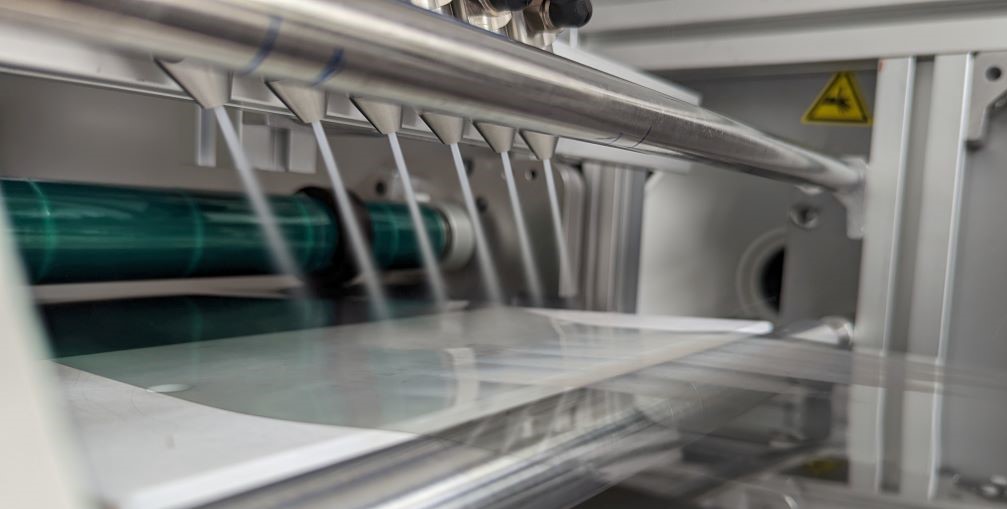
A German research team has developed a precision cleaning process for deburring electrodes in roll-to-roll perovskite and organic solar production lines. It is based on commercially available equipment from Germany-based ACP Systems.
German researchers have developed a process to remove conductive burrs on perovskite and organic PV substrates, which can be integrated into roll-to-roll production lines. It is based on an automated snowblast cleaning system based on liquid carbon dioxide, made by Acp Systems, a German industrial equipment manufacturer.
The deburring process emerged from a project called PV-CO2. The research team explained the rationale for the study in a technical paper published by ACP Systems. It explained that conductive burrs can arise after laser structuring of front electrodes of perovskite solar cells and organic PV (OPV) substrates.
The burrs only protrude by a few micrometers and if not removed there is a risk of damage and short circuit. “Current practice is to mechanically remove the burrs at very low web speeds. However, there is a risk that the structured layers are damaged by the mechanical impact,” the researchers said.
To develop a more accurate, automated and dry deburring step, the team applied Acp Systems’ Quattroclean snowblast cleaning technology. It is a solvent-free, dry process based on liquid carbon dioxide (CO2) in a compressed air jet system, which can be used for both complete surface and selective cleaning.
“Thanks to the dry process, components and assemblies that should not come into contact with moisture can also be cleaned,” says Jonas Illg, research engineer at Acp Systems. pv magazine. “In addition, the cleaning process with Quattroclean snowblasting technology can be easily automated, integrated into fully automated production processes and monitored.”
Liquid CO2 is the cleaning medium that Acp obtains from recycled chemical and biomass energy production processes. It is passed through wear-resistant dual-fluid ring nozzles and accelerated and mixed with compressed air upon exit to form CO2 snow crystal jets. As soon as they touch the surface to be cleaned, a combination of thermal, mechanical, sublimation and solvent effects are created, which, according to the manufacturer, forms the basis of the cleaning effect.
Snowblast cleaning technology is already being used in other industries, such as electronics and semiconductor manufacturing, battery production, coating and paint systems, as well as medical device production, Illg said.
The experimental setup
To refine the process for the insulator-metal-insulator (IMI) substrates with an indium tin oxide, silver, and indium tin oxide composition used to make perovskite and OPV devices, the researchers placed several snowjet nozzles above the web in a roll-to-roll R&D line. They then fabricated an 8 cm wide OPV module. One set of OPV modules was made on the IMI substrates cleaned with an appropriately calibrated and programmed snowblasting process, one set was cleaned manually, while the other was not cleaned.
The researchers found that the modules cleaned using the CO2 process had an energy conversion efficiency of 5.3%. The manually cleaned sample modules had an efficiency of 4.8%, while those made with an uncleaned substrate “had a high leakage current,” reducing efficiency to 2.3%.
Dark lock-in thermography was used to confirm that deburring is responsible for the better performance of the cleaned samples. The researchers said the difference in efficiency is attributed to scratches formed during manual cleaning, which significantly reduce the active area, creating dead zones that do not generate power, or are cut off from charge extraction.
Meanwhile, at the Institute Materials for Electronics and Energy Technology, at the Friedrich-Alexander Universität Erlangen-Nürnberg (FAU), a snowblast cleaning tool with seven nozzles has been integrated into an automated PV line with a 25 cm wide web. It is also integrated into a roll-to-roll tool from German R&D equipment supplier Sciprios.
The PV-CO2 consortium consisted of researchers from FAU, Acp Systems and Sciprios. It was funded by the German Federal Ministry of Economic Affairs and Climate Action (BMWK).
Acp Systems was founded in 1997. Its core technologies include Quattroclean snowblast cleaning, high-precision microdosing and smart handling solutions for films and flexible materials.
This content is copyrighted and may not be reused. If you would like to collaborate with us and reuse some of our content, please contact: editors@pv-magazine.com.
