

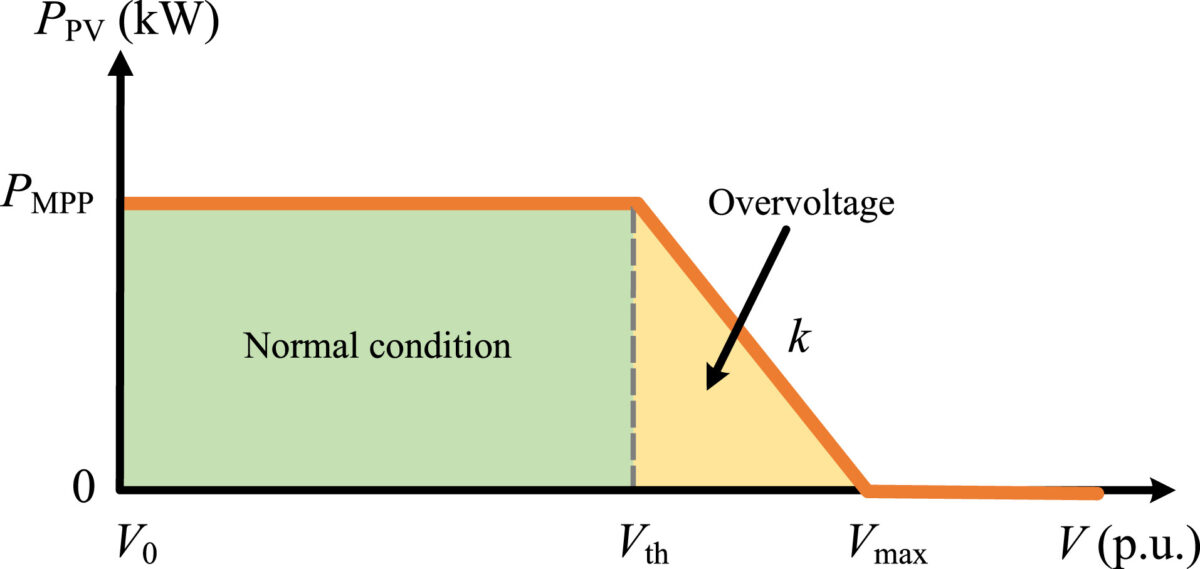
A group of scientists in Thailand have outlined a new approach to preventing oversizing and overvoltage in energy markets by applying volt-watt droop mitigation strategies. The new methodology leads to a reduction in the net present value of a PV system, but also increases the levelized energy costs.
Researchers from King Mongkut’s University of Technology North Bangkok in Thailand have proposed a new methodology to conduct techno-economic assessments of distributed PV systems taking into account surge-induced curtailment.
The scientists emphasized that, unlike previous methods for sizing PV systems, the new approach is not intended to identify the optimal size of a solar panel based on profit maximization and self-consumption policies. They previously suggested avoiding oversizing and “exaggerated profitability,” but said this choice leads to significantly improved levelized energy costs (LCOE), especially in scenarios where curtailment is expected to increase, due to higher penetration of renewables .
The research group conducted a sensitivity analysis to assess the impact of different voltage thresholds of overvoltage-induced production curtailment on the techno-economic performance of distributed PV systems, based on the electricity tariffs set by the Metropolitan Electricity Authority (MEA) in Thailand.
The academics monitored the load for a full year in 2018 and found that the maximum load was at 9 p.m., with consumption being highest in April. “As a result, air cooling loads increased significantly,” they explained. “The load tended to decrease when the season changed from summer (March to May) to winter (November to February). The lowest load was observed in December as the temperature was generally pleasant, significantly reducing the air cooling load.”
Electricity prices in the analyzed area ranged from $0.176/kWh to $0.057/kWh and a volt-watt droop mitigation strategy was assumed to be implemented. This method requires the deployment of an additional controller at the point of common coupling (PCC) and is generally used for local PV power limitation. “This strategy limits PV generation when the voltage reaches the 1.06 pu threshold, according to ANSI C84.1-2016, IEEE 1547-2018 and IEC 60038-2009 standards,” the researchers specified.
Their analysis took into account techno-economic parameters such as self-consumption rate (SCR), self-sufficiency rate (SSR), net present value (NPV) and LCOE.
They also adopted the so-called Jiménez-Castillo Approach to the optimization of PV system sizing, which aims at maximizing NPV values, and considers four different scenarios: Scenario 0, where overvoltage and curtailment are neglected; Scenario 1, where overvoltage-induced production limitation and the location of PV installations are taken into account and PV systems are installed at each node in each area; Scenario 2, where PV systems are installed on each node in two areas; and Scenario 3, where PV systems are installed at every node in every area of the feeder.
Through this assessment, the scientists found that to prevent short circuits and overvoltages, the size of the PV system could be reduced by up to 58.33%, depending on the number of PV systems and their location. This would lead to a reduction in the NPV of 21.34%, but also to an increase in the LCOE of 22.96%.
“Additionally, the findings indicate that the SCR increased slightly by up to 11%, but the SSR decreased marginally by up to 4% upon the implementation of surge-induced production cuts,” she added. “Ultimately, the sensitivity analysis showed that the optimal PV power remained unchanged, even though different voltage thresholds were applied. However, the NPV decreased significantly, by as much as 25%, and the LCOE increased by as much as 20.72%, while the voltage threshold decreased to 1.01 pu. The SCR tended to increase by about 10%, while the SSR remained unchanged.”
Their findings are available in the study “Techno-economic assessment of grid-connected residential photovoltaic systems considering overvoltage-induced curtailment of generation”, which was recently published in Energy reports.
This content is copyrighted and may not be reused. If you would like to collaborate with us and reuse some of our content, please contact: editors@pv-magazine.com.
