

Close Menu
  • News
  • Industry
  • Solar Panels
  • Commercial
  • Residential
  • Finance
  • Technology
  • Carbon Credit
  • More
    • Policy
    • Energy Storage
    • Utility
    • Cummunity
What's Hot

A deep learning model tracks the status of the EV battery with high precision

March 6, 2026

Mitsubishi Electric Trane announces new heat pump line for hydronic heating – SPE

March 6, 2026

Origis is developing a 413 MW solar portfolio in West Texas

March 6, 2026
Facebook X (Twitter) Instagram
Solar Energy News
Friday, March 6
  • News
  • Industry
  • Solar Panels
  • Commercial
  • Residential
  • Finance
  • Technology
  • Carbon Credit
  • More
    • Policy
    • Energy Storage
    • Utility
    • Cummunity
Solar Energy News
Home - Technology - New discovery paves the way for more efficient perovskite solar cells – SPE
Technology

New discovery paves the way for more efficient perovskite solar cells – SPE

solarenergyBy solarenergyAugust 6, 2024No Comments2 Mins Read
Facebook Twitter Pinterest LinkedIn Tumblr Email
Share
Facebook Twitter LinkedIn Pinterest Email

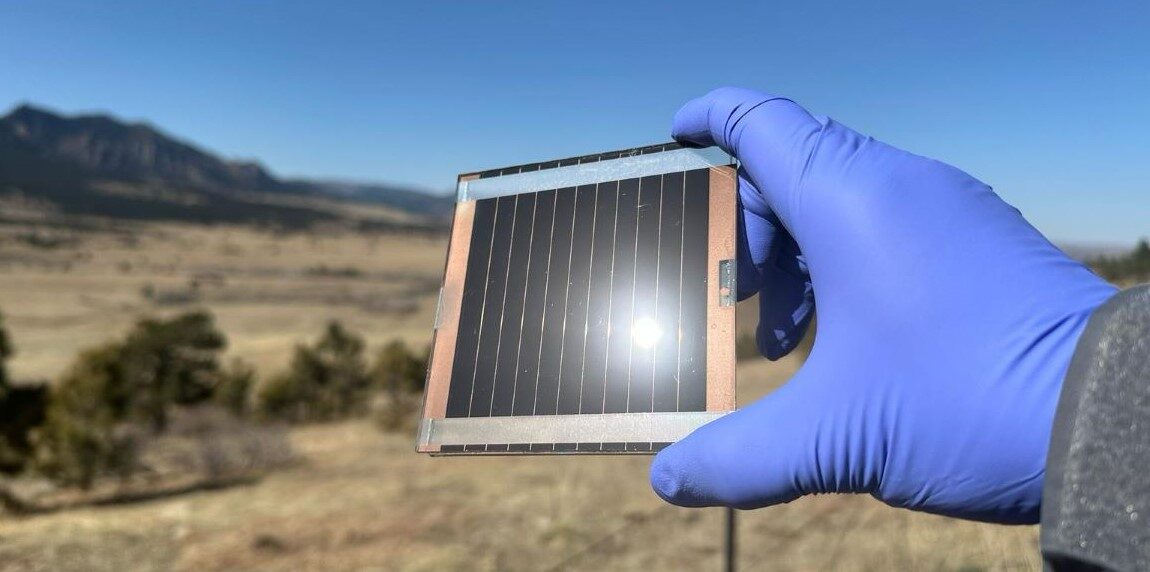
Researchers at the University of Texas have used computational methods to study the formation of polarons in halide perovskites. The findings revealed topological vortices in polaron quasiparticles.

August 6, 2024 Patrick Jowett

Skyrmion-like polaron with large hole in the halide double perovskite Cs2AgBiBr6

Image: J. Lafuente-Bartolome

Researchers at the University of Texas at Austin have investigated the formation of polarons research into the properties of halide perovskites.

Halide perovskites are used in applications such as solar photovoltaics due to their optoelectric properties. In the research paper “Topological polarons in halide pervoskites,” published in the Proceedings of the National Academy of Sciencesscientists used supercomputers Lonestar6 and Frontera from the Texas Advanced Computing Center (TACC) to analyze these properties at the individual atom level.

The team developed EPW, an open-source Fortran message passing interface code that computes properties related to electron-phonon interaction. The EPW code specializes in studying how electrons interact with vibrations in the lattice of a solid, causing the formation of polarons.

“We discovered that electrons form localized, narrow wave packets, known as polarons,” Feliciano Giustino, one of the paper’s lead authors, told TACC. “These ‘clumps of charge’ – the quasiparticle polarons – give perovskites special properties.”

“These polarons show very intriguing patterns. The atoms rotate around the electron, forming vortices never seen before. We suspect that this strange vortex structure prevents the electron from returning to the unexcited energy level,” Giustino explains. “This vortex is a protected topological structure in the halide-perovskite lattice material that stays in place for a long time and allows the electrons to flow without losing energy.”

See also  IEA calls for sixfold expansion of global energy storage capacity – SPE

In the research paper, the scientists add that polarons take many different shapes in halide perovskites, including small polarons, large polarons and charge density waves.

“We find that these emerging quasiparticles support topologically non-trivial phonon fields with quantized topological charge, making them a non-magnetic analog of the spiral Bloch points found in magnetic skyrmion lattices,” the researchers said. “Our findings suggest that halide perovskites can be regarded as a class of quantum materials where electron-phonon couplings replace the traditional electron-electron interactions of correlated electron systems.”

This content is copyrighted and may not be reused. If you would like to collaborate with us and reuse some of our content, please contact: editors@pv-magazine.com.

Popular content
Source link

cells discovery efficient paves perovskite solar SPE
Share. Facebook Twitter Pinterest LinkedIn Tumblr Email
solarenergy
  • Website

Related Posts

Mitsubishi Electric Trane announces new heat pump line for hydronic heating – SPE

March 6, 2026

Origis is developing a 413 MW solar portfolio in West Texas

March 6, 2026

New Jersey expands state community solar program by 3 GW

March 6, 2026
Leave A Reply Cancel Reply

Don't Miss
Policy

What the only Big Beautiful Bill Act means for the American residential solar energy – PV Magazine International

By solarenergyJuly 9, 20250

By PV Magazine USA On July 4, US President Donald Trump signed HR 1 in…

The TOPCon IP battle is heating up as Qcells launches infringement notices

January 17, 2025

Energy storage yards set a new record in 2024

March 20, 2025

India looks towards self-reliance in battery cells with lithium recycling – SPE

January 18, 2025
Stay In Touch
  • Facebook
  • Twitter
  • Pinterest
  • Instagram
  • YouTube
  • Vimeo
Our Picks

A deep learning model tracks the status of the EV battery with high precision

March 6, 2026

Mitsubishi Electric Trane announces new heat pump line for hydronic heating – SPE

March 6, 2026

Origis is developing a 413 MW solar portfolio in West Texas

March 6, 2026

New Jersey expands state community solar program by 3 GW

March 6, 2026
Our Picks

A deep learning model tracks the status of the EV battery with high precision

March 6, 2026

Mitsubishi Electric Trane announces new heat pump line for hydronic heating – SPE

March 6, 2026

Origis is developing a 413 MW solar portfolio in West Texas

March 6, 2026
About
About

Stay updated with the latest in solar energy. Discover innovations, trends, policies, and market insights driving the future of sustainable power worldwide.

Subscribe to Updates

Get the latest creative news and updates about Solar industry directly in your inbox!

Facebook X (Twitter) Instagram Pinterest
  • Contact
  • Privacy Policy
  • Terms & Conditions
© 2026 Tsolarenergynews.co - All rights reserved.

Type above and press Enter to search. Press Esc to cancel.