

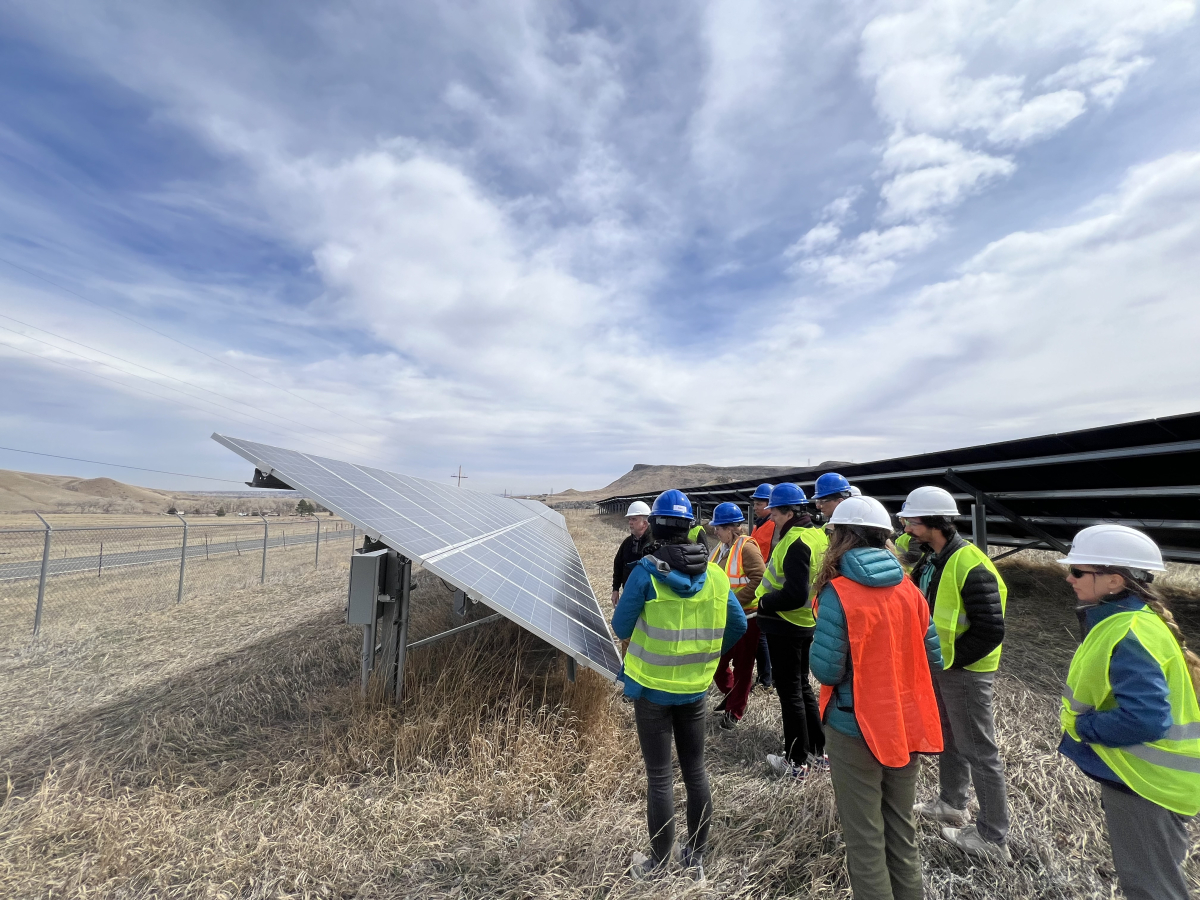
Researchers at McGill University used deep computer vision to analyze 719 solar energy projects in the western US. The study establishes a new ‘land-saving’ benchmark, providing developers with accurate data to balance rapid capacity expansion with conservation and land use priorities.
With solar expected to become the world’s leading renewable energy source by 2029, competition for land has become a bottleneck for utility-scale developers.
By applying deep learning neural networks to high-resolution aerial imagery, a McGill University-led team led by Associate Professor Sarah Marie Jordaan has successfully mapped 13,272 MW of installed capacity to determine how technical and site choices impact a project’s physical footprint.
The findings highlight a clear correlation between geographic irradiance and land efficiency. Projects in sunnier regions, coupled with compact system designs, delivered significantly higher energy density.
“This research creates a replicable framework for understanding the implications of rapid solar growth on land,” Jordaan noted. “It takes us beyond anecdotal data to a standardized way of measuring how much land we actually need to reach net zero.”
A companion study published in Joule expanded this scope to a global scale, examining nearly 69,000 installations in 65 countries. The analysis identified enormous, untapped potential in rooftop solar.
While utility-scale ground-mounted systems offer a lower upfront investment, researchers found that the cost gap between rooftop and ground-mounted systems varies significantly by region. The study suggests that targeted policies could make rooftop integration a more economical choice if land acquisition and environmental mitigation costs are included.
The data suggests that even under high-growth scenarios, the total global solar land requirement to meet net-zero targets remains “negligible” if managed strategically.
By prioritizing brownfields, contaminated land and rooftop environments, developers can limit ‘energy sprawl’, which often triggers local opposition and enables delays.
The research underlines a shift towards integrating solar energy into the built environment to minimize transmission losses and infrastructure needs.
“Our results show that technology-driven efficiencies can more than offset land constraints,” the study concludes.
By leveraging these AI-driven insights, the industry is poised to evolve from reactive land acquisition to a proactive, data-driven model that protects both revenue and the environment.
This content is copyrighted and may not be reused. If you would like to collaborate with us and reuse some of our content, please contact: editors@pv-magazine.com.
