

A Husqvarna researcher developed a fast, interpretable PV hotspot detection method using IR thermography and Lab* color space features instead of heavy neural networks, achieving up to 95.2% accuracy with shallow classifiers. The lightweight system works in real time on drones or edge devices and could save 17,620 kWh and 8.9 tons of CO₂ annually by improving fault detection in solar panels.
A researcher at the Husqvarna Group, a Swedish manufacturer of outdoor power products, has developed a new, lightweight and interpretable framework for a real-time PV fault detection method.
The technique uses infrared (IR) thermography and, instead of relying on general image feature descriptors based on high-dimensional texture, uses analysis in the uniform Lab* color space. Lab* is widely used in printing, photography, design, manufacturing and color science because it is device independent and perceptually uniform. By separating the luminance (L) from the chromaticity (a and b), it improves the detection of surface-level degradations.
“This work presents a novel, application-oriented approach to multi-hotspot detection that deviates from prevailing trends in PV thermography,” said researcher Waqas Ahmed. pv magazine. “Rather than relying on convolutional neural networks or high-dimensional texture descriptors, I propose a patch-wise feature extraction pipeline based on the perceptually uniform Lab* color space, which produces a compact vector of 80 statistical descriptors per image.”
“The new design prioritizes interpretability, computational efficiency and robustness in terms of illumination and environmental variability, making it suitable for drone, handheld and embedded edge deployments,” Ahmed further explains. “It was surprising to see how the new technique achieved strong hotspot discrimination, comparable even to much heavier models, while remaining robust under different lighting and examination conditions.”
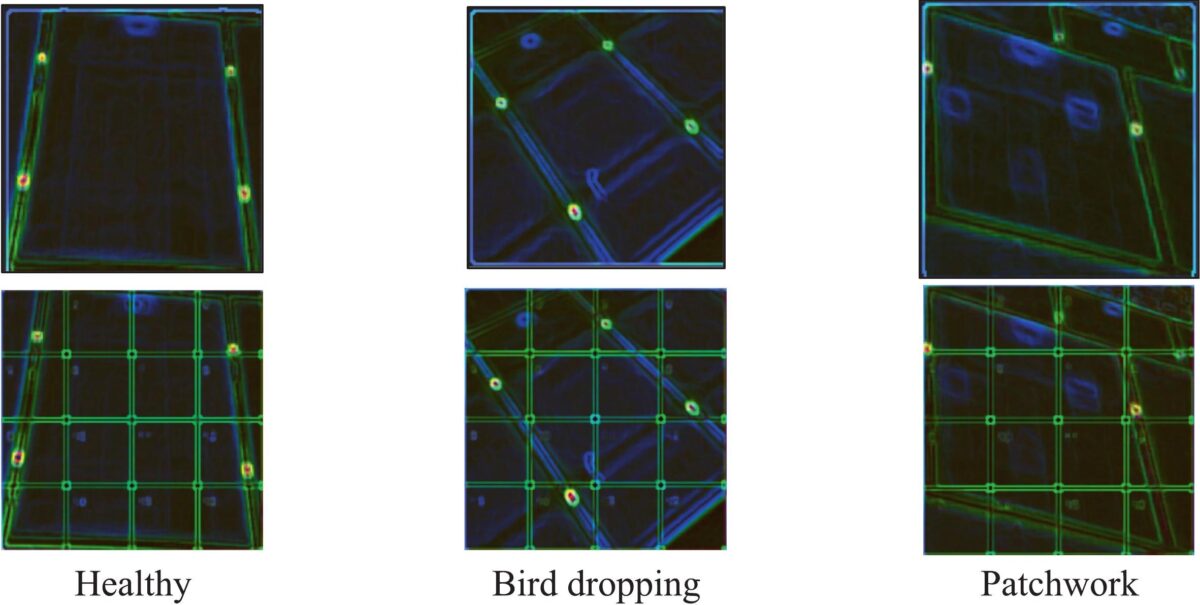
The new method starts by capturing IR thermographs from PV modules operating at 640×512 pixels and converting them from their native channels to the L*, a*, b* color space. Each image is then divided into 16 patches of 64×64 pixels to enable local error detection.
The system then extracts two metrics from the L* channel (mean and standard deviation) and three from the b* channel (mean, standard deviation and entropy). In total, each image yields 80 features, with five features extracted from each of the 16 segments. Accordingly, shallow classifiers can be trained to extract features.
To demonstrate the new method, Ahmed collected IR data from a 44.24 kW rooftop PV system in Lahore, Pakistan. The system consisted of 376 PV modules, each with a power of 240 W, organized into eight strings, with 22 modules connected in series per string, for a total of 5.28 kW per string.
Thermal imaging was performed while the ambient temperature ranged from 32 C to 40 C, the wind speed was 6.9 m/s, and the solar radiation was 700 W/m2 or more. The researcher then categorized 309 IR thermographs as healthy, hot spot or faulty panels.
The dataset was then randomly split into 80% for training (246 images) and 20% for testing (63 images), with equal representation of hotspot subtypes. It was then fed into a series of superficial classifiers, namely SVM, KNN, Decision Tree, Naive Bayes and Ensemble. SVM was found to achieve a test accuracy of 95.2%, KNN 93.7% and the ensemble 90.5%. Naive Bayes achieved a test accuracy of 84.1% and the decision tree achieved 81.0%.
“The method demonstrates training latency of less than 6 seconds on edge platforms and reports measurable benefits at the system level, saving up to 17,620 kWh per year and reducing 8.9 tons of CO₂, linking algorithmic novelty with operational and environmental impact,” Ahmed concludes. “My next job, together with my colleague Manahil Zulfikarwill focus on label noise and misannotations in PV datasets for AI applications. We will explore methods to detect and correct mislabeled examples, separate overlapping hotspot subclasses, and combine cross-modal consistency checks, uncertainty estimation, and active relabeling to improve field reliability.”
The new method was presented in “Thermal and chromatic analysis for scalable detection of photovoltaic hotspots”, published in Solar energy. Ahmed is affiliated with the Swedish Husqvarna Group, Jönköping University and the British Imperial College London.
This content is copyrighted and may not be reused. If you would like to collaborate with us and reuse some of our content, please contact: editors@pv-magazine.com.
