

Scientists led by the Massachusetts Institute of Technology (MIT) have designed a new PV-powered desalination system based on time-variant electrodialysis reversal (EDR) technology. The proposed system reportedly delivers lower water costs than conventional solar desalination technologies.
A global group of scientists led by the Massachusetts Institute of Technology (MIT) has developed a new, low-cost, solar-powered brackish water desalination system that reportedly can reduce the levelized cost of water (LCOW) compared to conventional PV-powered desalination systems .
The proposed desalination system uses time-variant electrodialysis reversal (EDR) technology, which the researchers developed as a flexible variant of traditional EDR desalination. “Our research aims to address water scarcity in rural India, where most of the underground water is too salty to drink. The access and stability of the power grid are not good and suffer from frequent power outages,” said corresponding author Wei He pv magazine.
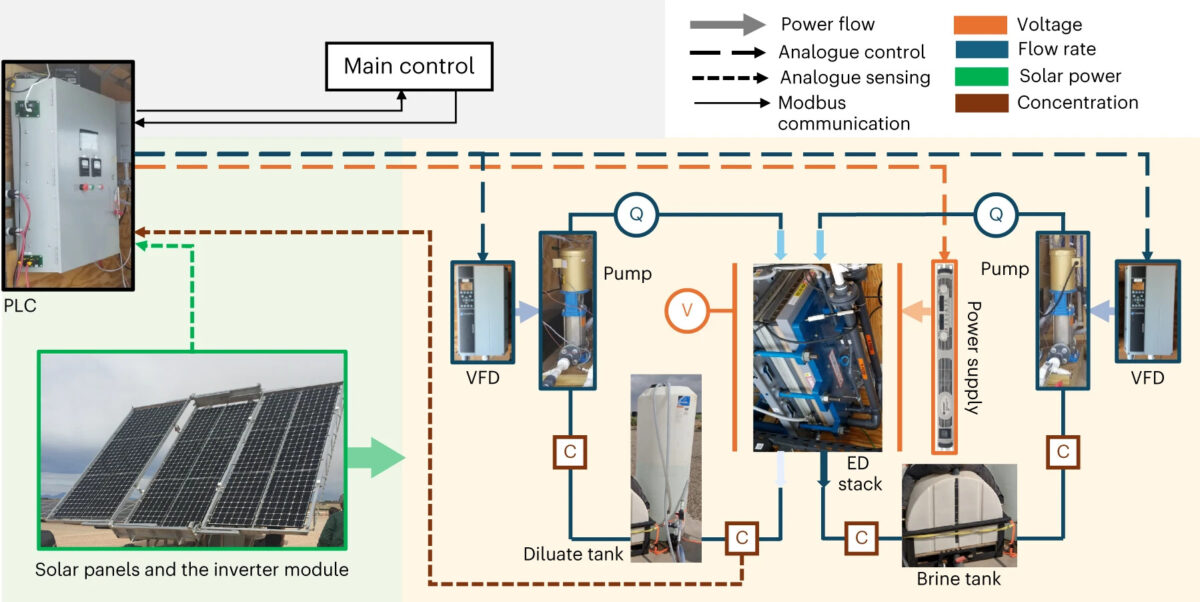
“An EDR module consists of a stack of ion exchange membranes and uses an electric field to move ions from the dilute flow channels to the brine flow channels between each membrane,” the research group said. “This electric field can be reversed intermittently to prevent limescale deposits on the membrane.”
However, due to the intermittent nature of solar energy, the classic EDR is not perfectly suitable. They require constant power to operate, which is why PV-EDR installations require the support of batteries or oversized solar systems, especially at the beginning and end of the day when solar energy is low.
“To overcome these problems, we developed a flexible batch EDR technology that involves time-variant adjustment of the voltage and flow rate,” the academics explained. “Thanks to a model-based control method, the EDR system can match its energy consumption at each time step to the available solar energy, while optimizing water production under varying solar conditions.”
To verify operation, the team created a feed-forward, model-based master controller that runs in Python to calculate optimal pump flow rate and EDR stack voltage based on real-time sensor readings. A prototype was built in a research facility, closely matching the typical design parameters and operating conditions for a community-scale PV-EDR system with a capacity to produce 6 m3 of freshwater per day. It was powered by a solar panel with an area of 37 m2 and a tilt of 30 degrees.
This pilot system was tested for one-day and six-day analysis and compared to the traditional EDR system with constant operation. Both systems were fed with water with an average starting salinity of 970 mg l−1. The system was set at a conservatively low water recovery ratio of 60%.
Image: Massachusetts Institute of Technology, Nature Water, CC BY 4.0 deed
“The flexible system can use an average of 77% of available solar energy directly, compared to only about 40% in the conventional system (an increase of 91%),” the scientists pointed out. “This suggests that a conventional system would require much more solar panel area to operate out of the box (that is, without any energy storage), increasing capital costs.”
Furthermore, the analysis showed that the average minimum required battery capacity for the flexible system was 0.27 kWh, a reduction of 92% compared to 3.3 kWh in the constant system. “Ultimately, the results show that the flexible system can reach its production volume up to 54% faster than the conventional system,” she added.
Following the experimental results, the researchers conducted a case study of cost analysis for using such a system in Chelluru, a rural village in India near Hyderabad. Using computer simulation and optimization, it was compared with a conventional PV-EDR system, a state-of-the-art constant PV-EDR system and a commercial on-grid reverse osmosis (RO) desalination system. “RO uses pressure to force water through a polymer membrane, while the constitutive ions are blocked by the membrane,” the group said.
“The optimized levelized water cost (LCOW) achieved by the proposed flexible PV-EDR system is 1.66 m−3, which improves costs by 22% compared to the current advanced PV-EDR system and by 46% compared to the conventional PV-EDR system,” the scientists found. “The LCOW for grid-based RO is 1.71 m−3.3% above the LCOW of flexible PV-EDR.”
Their findings were presented in “Flexible batch electrodialysis for low-cost solar desalination of brackish water,” published in Natural water. The team included researchers from King’s College London in Great Britain and the Helmholtz Institute Erlangen-Nürnberg for Renewable Energy (HI ERN) in Germany.
“For the next step, investigating the long-term performance and broadening the application possibilities of our PV-EDR technology beyond brackish water desalination provides an important opportunity to address a broader range of global challenges related into the treatment of water and liquid waste,” he concluded. .
This content is copyrighted and may not be reused. If you would like to collaborate with us and reuse some of our content, please contact: editors@pv-magazine.com.
