

The NC Clean Energy Technology Center (NCCETC) has released its publication Edition Q3 2025 from “The 50 States of Solar Energy.” The quarterly series provides insight into the state’s regulatory and legislative discussions and actions on distributed solar policy, with an emphasis on net metering, distributed solar rating, interconnection rules, community solar, residential fixed charges, residential solar demand and loads, financial incentives and third-party ownership.
The report shows that 45 states, plus the District of Columbia and Puerto Rico, have taken some form of policy action on distributed solar by the third quarter of 2025, with the largest number of actions continuing to focus on net metering policies (57), residential rate or minimum bill increases (43), and community solar policies (40). A total of 217 distributed solar policy actions were taken in the third quarter of 2025, with the majority in Connecticut, Colorado, Minnesota, New York, Arizona and California.
Policy actions in Q3 2025 on net metering, rate design and solar ownership
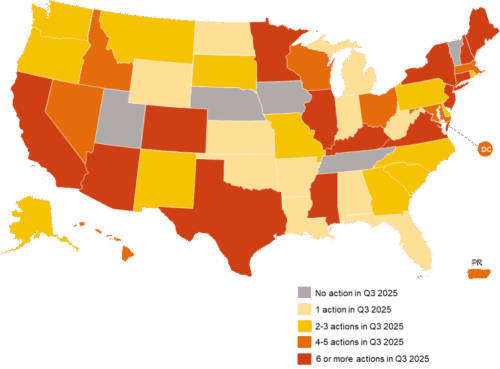
The report identifies three trends in solar policy activity in the third quarter of 2025: (1) utilities continuing to move to net billing rates, (2) states and utilities pursuing supportive mechanisms for community solar, and (3) states responding to the loss of federal incentives.
Read Solar Power World’s story about solar policy advocacy aimed at the United States here.
“After the federal government passed HR1 in July, states are revising programs and guidelines to maximize the use of existing investment and production credits,” said Rebekah de la Mora, senior policy analyst at NCCETC. “Regulators are revising interconnection rules to help projects connect to the grid ahead of the federal deadline for operation, implementing extensions and exceptions for projects under incentive programs, and considering program expansions to ‘make up for’ the loss of the credits.”
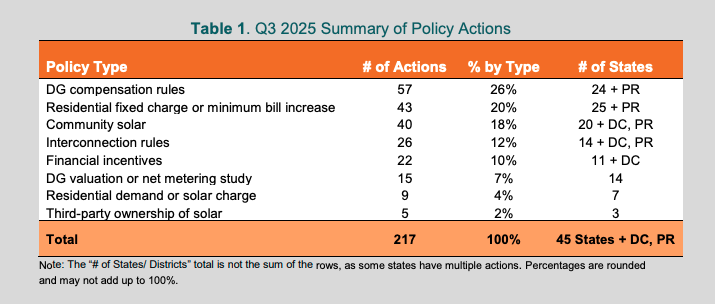
The report lists the top five distributed solar policy actions for the third quarter of 2025:
- Nevada’s Public Utilities Commission adopted new demand charges for Nevada Power and a new settlement interval for Sierra Power;
- PacifiCorp Requests Approval for a Follow-On Net Metering Tariff in Washington;
- The West Virginia Public Service Commission approves net billing for Appalachian Power and Wheeling Power;
- Puerto Rico Energy Bureau Begins Community Solar Energy Study; And
- Colorado Springs Utilities offers exclusive rates for net metering customers.
“States and utilities continue to struggle with appropriate compensation structures for distributed generation. In the third quarter of 2025, multiple utilities proposed and approved new net billing rates,” said Brian Lips, senior project manager at NCCETC. “Utility settlement rate intervals generally range from instantaneous settlement to hourly settlement, compared to the standard monthly net metering interval.”
News release from the NC Clean Energy Technology Center
