

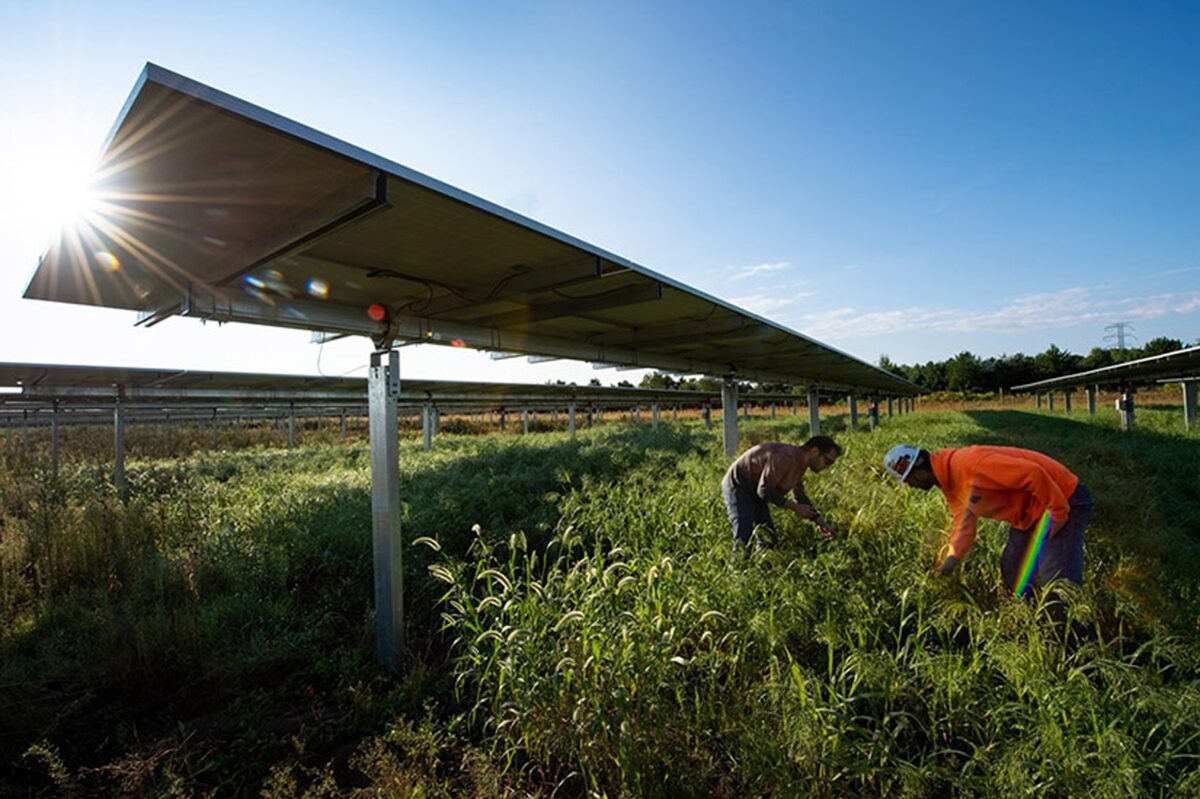
A series of longitudinal studies of three solar pollinator sites in Minnesota have provided evidence of native prairie growth under solar panels, providing both soil benefits and habitat for wildlife and pollinators.
Research led by the U.S. Department of Energy’s National Renewable Energy Laboratory (NREL) collected data on the interactions between habitat, pollinators, soil, and solar energy production at three utility-scale solar projects in Minnesota.
NREL’s Innovative Solar Practices Integrated with Rural Economies and Ecosystems (InSPIRE) team has been conducting research at the three sites over the past six years. According to the laboratory, this is the longest-running, most comprehensive assessment of the interactions between solar energy, soil, habitat and pollinators to date.
The findings are presented in three studies, “Environmental benefits of conserving native vegetation with solar photovoltaic infrastructure”, available in The future of the earth, “If you build it, will they come? Responses of insect communities to habitat establishment at solar energy facilities in Minnesota, USA”, available in Environmental Investigation Letters And “Little prairie under the panel: Testing seed mixes for native pollinator habitats at three utility-scale solar sites in Minnesota”, available in Environmental research communications.
The three solar facilities studied in the papers are the Chisago, Atwater, and Eastwood solar sites. that are part of the Aurora solar project, owned by Enel Green Power and located in and around Minneapolis. NREL says these solar pollinator sites are the first commercial utility-scale solar projects in the U.S. with extensive ecovoltaics research.
The research showed that prairie restoration activities can take place under solar panels. Once prairie vegetation was established, pollinators were observed using both the site and dedicated conservation lands, with evidence indicating increased abundance and diversity of both vegetation and pollinators under the solar arrays.
It took three to four years after the solar farm was constructed for the prairie vegetation to become fully established, with some species not appearing until the fifth and sixth years.
Planting pollinator habitat and native vegetation was found to mitigate some of the environmental damage to soil and habitat when solar installations are built and can ultimately protect soil from future erosion, the study adds, but it also warns that it may take a long time can take time to recover soil after damage from intensive corn and soy production. NREL says the overall impact of soil restoration activities at these sites will not be clear for years to come.
The researchers also observed little to no impact on annual electricity generation at the sites. Although native habitats were found to reduce the temperature of PV modules compared to base soil, this was not found to increase electricity production.
NREL says this finding contradicts studies in other regions, suggesting that the microclimatic interaction between PV arrays, soil and vegetation is not consistent across different landscapes and climates. “One of the key takeaways from this study is that we need to study more sites,” said NREL agricultural researcher Chong Seok Choi. “For example, the location-specific climate – how much moisture is in the air, for example – can influence whether the cooling we observe from the native habitat can lead to increased PV efficiency. There is still so much work to be done.”
The three studies were funded by the U.S. Department of Energy’s Solar Energy Technologies Office and conducted by NREL and Argonne National Laboratoryalong with research partners from the University of Minnesota and Temple University and practitioners from MNL, formerly Minnesota Native Landscapes.
This content is copyrighted and may not be reused. If you would like to collaborate with us and reuse some of our content, please contact: editors@pv-magazine.com.
