

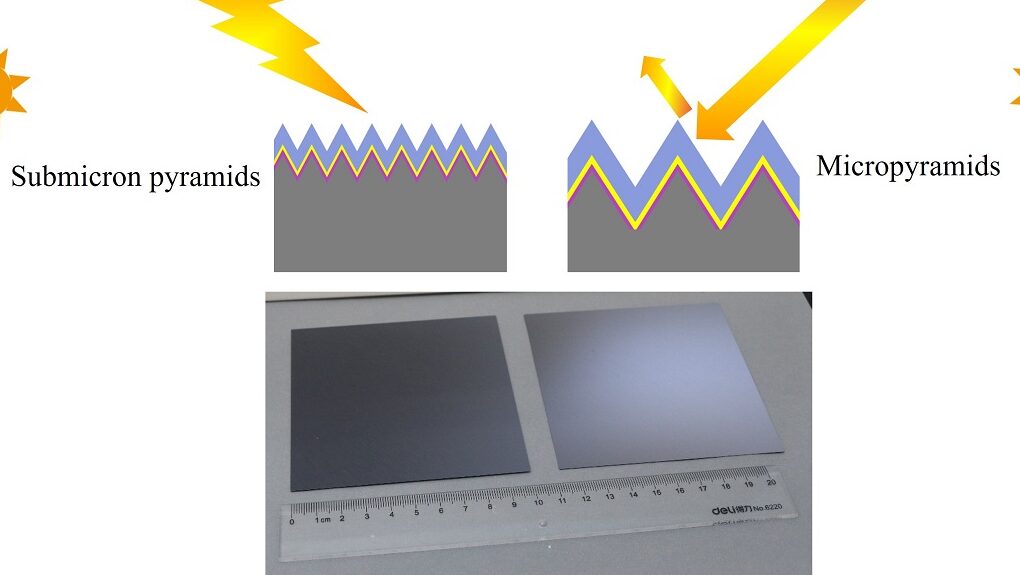
Chinese researchers have demonstrated a one-step submicron structured surface texturing process that improved the absolute efficiency of a TOPCon solar cell by 1% through broadband anti-reflection and lower electrical resistance. Cell-level performance was validated in laboratory and outdoor tests.
A research group led by Jiangsu Ocean University in China has demonstrated a one-step surface texturing process that can reportedly increase the absolute efficiency of tunneling oxide-passivating contact (TOPCon) silicon solar cells by 1%. Cell-level performance was validated in laboratory and outdoor tests.
“This study introduces a new rapid one-step method for fabricating dense silicon submicron pyramids (SiSMPs) with an average base size of 0.68–0.76 μm by incorporating indium tin oxide additives into a conventional alkaline texturing solution,” the study’s first author Sihua Zhong shared. pv magazine.
The researchers investigated the surface texture of SiSMPs as a way to improve the silicon micropyramids (SiMPs) currently used in industrial crystalline silicon solar cells. In particular, the study describes an approach that “significantly simplifies” the fabrication process of SiSMPs compared to existing multi-step or lithography-based techniques, Zhong said. It also investigates the optimal functional films for use with SiSMPs to maximize the optical gain of solar cells.
“This new one-step texturing process increases solar cell efficiency by 1% absolute due to broadband anti-reflection and lower electrical resistance,” said Zhong.
The study combined experiments and simulation. In the experiments, the team used pseudo-square n-type Czochralski silicon wafers (CZ Si), 110 μm thick and with dimensions of 182 mm x 182 mm. Both TOPCon and silicon heterojunction (HJT) devices were fabricated with SiSMPs or conventional SiMPs texturization, and with silicon nitride (SiNx) or indium tin oxide (ITO) films for comparison.
Outdoor electrical tests were conducted in one day in April on a south-facing setup with a slope of 34° to match the latitude of the site.
The results showed “improved energy yield for SiSMP textured devices” under both direct sunlight and shade. “The anti-reflective power of the resulting submicron pyramid texture is much less sensitive to angle of incidence than that of the micropyramid counterparts, leading to a 6.8% higher daily energy output in outdoor testing,” said Zhong.
Improvements in shading performance were also observed. “Interestingly, the modified devices show a 12% higher energy yield under shaded conditions than their conventional micropyramid structure counterparts,” Zhong added.
The optical performance of SiSMPs and SiMPs devices was modeled using Finite-Difference Time-Domain (FDTD) calculations, among other simulations. The team found that the developed SiSMP textures exhibited “strong Mie scattering resonances” and lower reflectance than SiMP textures over a wide wavelength range.
Analysis attributed the improvements to reduced optical losses, which increased the short-circuit current density by 0.7 mA/cm², and improved carrier collection through larger current paths at the silver-silicon interface, which increased the fill factor by 2.2% absolute.
Full-size SiSMP TOPCon devices achieved a power conversion efficiency (PCE) of 25.4%, representing a 1% absolute efficiency gain over SiMP textured counterparts. HJT cells did not show the same broadband benefits in the EQE results, the researchers noted, attributing this to interference from doped amorphous silicon (a-Si:H) coating layers.
The researchers emphasized that these results are currently limited to the solar cell level, highlighting the need for further outdoor testing at the module level to confirm practical performance gains.
The research is described in detail in “Surface texturing for advanced light management in crystalline silicon solar cells”, published in Renewable energy. Other groups participating in the study were from JA Solar and Jiao Tong University.
Research into high-efficiency, low-cost crystalline silicon solar cell technologies is the group’s ongoing focus. “Our current projects include further optimizing the submicron surface texturing process by adjusting the additives used and eliminating, for example, isopropanol; developing more reliable transparent conductive oxides with low indium content; and designing novel heterojunction solar cells that use wide bandgap materials as carrier-selective contacts,” Zhong said.
This content is copyrighted and may not be reused. If you would like to collaborate with us and reuse some of our content, please contact: editors@pv-magazine.com.
