
Close Menu
  • News
  • Industry
  • Solar Panels
  • Commercial
  • Residential
  • Finance
  • Technology
  • Carbon Credit
  • More
    • Policy
    • Energy Storage
    • Utility
    • Cummunity
What's Hot

Dutch solar owners asked to switch off during peak periods to ease the distribution crisis

June 7, 2026

The hydrogen flow: Toyota demonstrates its racing prototype on liquid hydrogen

June 7, 2026

Era of electrification exposing Australia’s weakest link

June 6, 2026
Facebook X (Twitter) Instagram
Solar Energy News
Sunday, June 7
  • News
  • Industry
  • Solar Panels
  • Commercial
  • Residential
  • Finance
  • Technology
  • Carbon Credit
  • More
    • Policy
    • Energy Storage
    • Utility
    • Cummunity
Solar Energy News
Home - Solar Industry - New technology to improve energy efficiency in Siemens’ polysilicon production process
Solar Industry

New technology to improve energy efficiency in Siemens’ polysilicon production process

solarenergyBy solarenergyOctober 17, 2025No Comments3 Mins Read
Facebook Twitter Pinterest LinkedIn Tumblr Email
Share
Facebook Twitter LinkedIn Pinterest Email

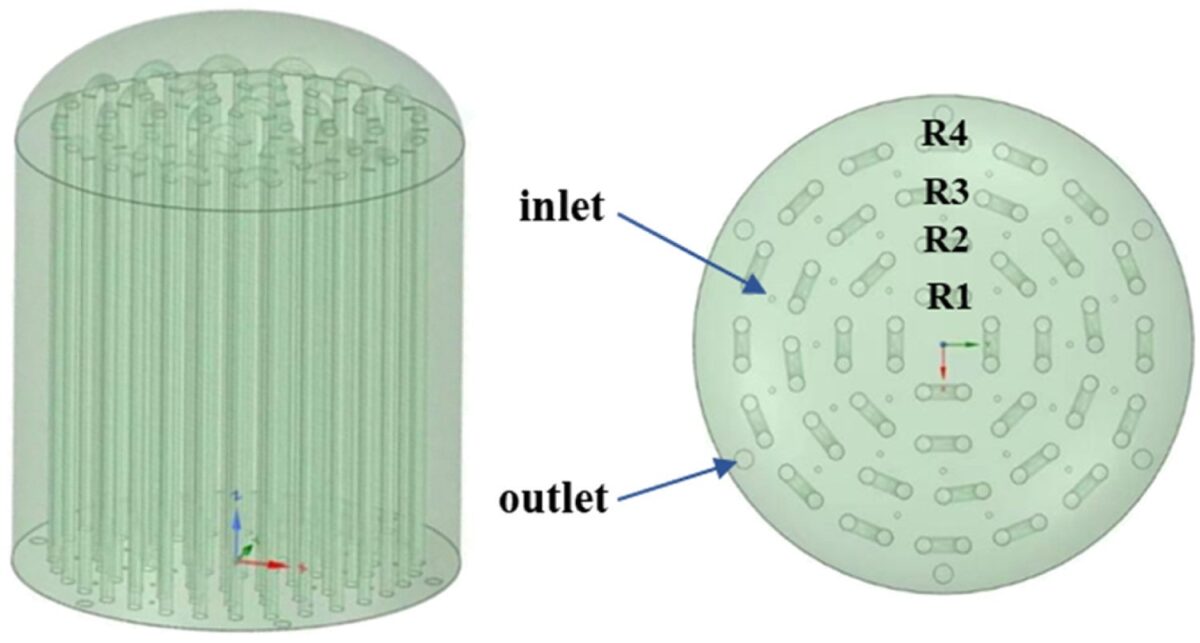
Chinese researchers developed an electric heating model to support uniform material temperature in a new four-ring, 80-rod industrial Siemens reactor.

October 17, 2025
Valerie Thompson

A Chinese team led by researchers from Kunming University of Science and Technology and Yunnan Yuntong Zinc Co. built a model to simulate the electrical heat processing of U-shaped silicon rods in a new four-ring, 80-rod industrial Siemens reactor.

The research team noted that previous studies showed that using high-frequency alternating current (AC) “could significantly improve temperature uniformity in polysilicon rods due to the skin effect,” albeit in much smaller reactors, and developed a new heating model. It covered thermal and electrical behavior and multi-ring interaction for large-scale polysilicon reduction furnaces.

In the study “The temperature uniformity within U-style silicon located in a new Siemens reactor with 80 rods and a high silicon core”, published in Results in technologythe team described its research into the effects of direct current (DC) and AC heating on the thermal and electrical performance within the polysilicon reduction furnace.

The goal was to support a more uniform temperature distribution between the center and surface of the silicon rods to improve the energy efficiency of the process.

The numerical simulations of the polycrystalline silicon material were done with Comsol software. The study also used the Joule heating model, the direct current model and the heat transfer model. Details were also given on the boundary conditions, key parameters and how the temperature gradients in the reactor were determined.

To validate the accuracy of the simulation, the stress obtained from the model was compared with data from an industrial 80-bar polysilicon reduction reactor.

See also  Large-scale agrivoltaic energy comes to Norway – SPE

The analysis showed that the model “accurately” predicts thermal and electrical behavior with a relative error of less than 10%, the article said.

The researchers said that AC heating “significantly improves temperature uniformity” and that adjusting the frequency can reduce the center temperature. The regression equation, based on the average data from four rings, developed by the team reportedly predicts accurately with an average relative error of only 4.62%.

The team also noted the “strong” interaction between frequency and diameter between 5 kHz and 200 kHz. Above 300 kHz the temperature difference stabilizes and the interaction effect weakens.

The research team included members from Yunnan Yuntong Zinc Co., Kunming University of Science and Technology, Yunnan Tongwei High Purity Crystal Silicon, a unit of Tongwei, and Kunming Metallurgical Research Institute.

This content is copyrighted and may not be reused. If you would like to collaborate with us and reuse some of our content, please contact: editors@pv-magazine.com.

Popular content

Source link

efficiency Energy improve polysilicon process production Siemens technology
Share. Facebook Twitter Pinterest LinkedIn Tumblr Email
solarenergy
  • Website

Related Posts

Britain’s next energy dependency is already taking shape

June 5, 2026

ComEd starts a new energy pilot with a solar rebate on the roof of a brewery

June 5, 2026

Malaysia expects to reach 29.7 GW of solar energy by 2035

June 5, 2026
Leave A Reply Cancel Reply

Don't Miss
News

Fullmark Energy Start Commercial activities on 40-MWH Ortega Energy Storage Project

By solarenergyAugust 20, 20250

Fullmark Energy announced the Commercial Operations Date (COD) of its 20-MW/40-MWH Energy Storage project in…

New Jersey is expanding its building renovation grant program to cover solar and storage upgrades

October 28, 2025

Organic-an organic perovskiet cell that relies on Furan-based polymer, achieves the efficiency of 21.39%

February 17, 2025

egg Power acquires a 49.9 MW solar power plant from PS Renewables

December 22, 2025
Stay In Touch
  • Facebook
  • Twitter
  • Pinterest
  • Instagram
  • YouTube
  • Vimeo
Our Picks

Dutch solar owners asked to switch off during peak periods to ease the distribution crisis

June 7, 2026

The hydrogen flow: Toyota demonstrates its racing prototype on liquid hydrogen

June 7, 2026

Era of electrification exposing Australia’s weakest link

June 6, 2026

‘Come out from behind your screen, our industry is ultimately about people’

June 6, 2026
Our Picks

Dutch solar owners asked to switch off during peak periods to ease the distribution crisis

June 7, 2026

The hydrogen flow: Toyota demonstrates its racing prototype on liquid hydrogen

June 7, 2026

Era of electrification exposing Australia’s weakest link

June 6, 2026
About
About

Stay updated with the latest in solar energy. Discover innovations, trends, policies, and market insights driving the future of sustainable power worldwide.

Subscribe to Updates

Get the latest creative news and updates about Solar industry directly in your inbox!

Facebook X (Twitter) Instagram Pinterest
  • Contact
  • Privacy Policy
  • Terms & Conditions
© 2026 Tsolarenergynews.co - All rights reserved.

Type above and press Enter to search. Press Esc to cancel.