
Close Menu
  • News
  • Industry
  • Solar Panels
  • Commercial
  • Residential
  • Finance
  • Technology
  • Carbon Credit
  • More
    • Policy
    • Energy Storage
    • Utility
    • Cummunity
What's Hot

Dutch solar owners asked to switch off during peak periods to ease the distribution crisis

June 7, 2026

The hydrogen flow: Toyota demonstrates its racing prototype on liquid hydrogen

June 7, 2026

Era of electrification exposing Australia’s weakest link

June 6, 2026
Facebook X (Twitter) Instagram
Solar Energy News
Sunday, June 7
  • News
  • Industry
  • Solar Panels
  • Commercial
  • Residential
  • Finance
  • Technology
  • Carbon Credit
  • More
    • Policy
    • Energy Storage
    • Utility
    • Cummunity
Solar Energy News
Home - Solar Industry - New technology to recover high-purity silicon powder from solar panels that are at the end of their lifespan
Solar Industry

New technology to recover high-purity silicon powder from solar panels that are at the end of their lifespan

solarenergyBy solarenergyOctober 29, 2024No Comments3 Mins Read
Facebook Twitter Pinterest LinkedIn Tumblr Email
Share
Facebook Twitter LinkedIn Pinterest Email

Korean researchers have used thermal and wet gravity separation (WGS) to separate EVA from recovered silicon powder in end-of-life PV modules with “minimal” chemical use. The proposed technique produces silicon powder that can be reused as a raw material for upcycling into silicon nitride, silicon oxide or silicon carbide.

October 29, 2024
Emiliano Bellini

Researchers from Gyeongsang National University Jinju in South Korea have developed a new method for separating ethylene vinyl acetate (EVA) encapsulant from recycled silicon energy in end-of-life (EoL) solar panels.

Common mechanical recycling processes involve blending EVA after crushing or grinding, while chemical and delamination methods are generally time-consuming or produce hazardous waste products. The new process uses thermal and wet gravity separation (WGS) to separate EVA from recovered Si powder with “minimum.” chemical use, the researchers said.

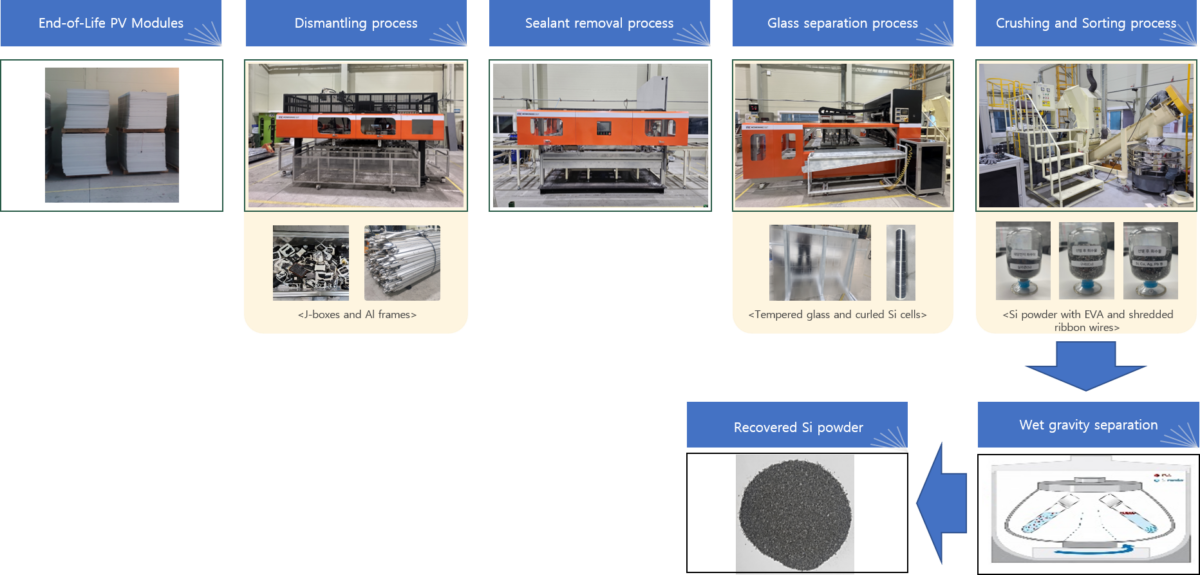
The wet gravity separation process uses an aqueous sodium chloride (NaCl) solution that takes advantage of the gravity difference between silicon and EVA, and the WGS process uses the specific gravity of the two materials to facilitate their centrifugation. “All recycling processes were carried out in the commercial facility, except for the wet gravity separation to remove the ethylene vinyl acetate (EVA) encapsulant,” the study’s corresponding author Jongsung Park said. pv magazine.

The whole process starts with disassembling the aluminum frame of the module and removing the sealant. Then a grinding process removes the backing layer and a heating process separates the remaining layers. The next step consists of a shredding process to select EVA encapsulated solar cells, followed by a sorting process based on particle size differences of shredded materials. In addition, powdered solar cells and small particle size metals are separated and a thermal process eliminates the EVA in silicon powder.

See also  Organic PV module based on ultra-narrow interconnections achieves a record efficiency of 16.1%

“The thermal process at 550 C effectively removed all polymer components, especially EVA, from the recovered silicon powder, as confirmed by various analytical techniques such as TGA, FT-IR, SEM and EDS,” the group explained. “Although effective, the thermal process has notable disadvantages, including high energy consumption and significant carbon dioxide emissions, making it less environmentally friendly than the WGS.”

Further analysis confirmed the effective removal of EVA and other polymers. “The recycling of EoL PV modules was carried out in a commercial facility and an environmentally friendly process was used to recover high-purity silicon,” Park explains. “We have recovered the silicon in powder form and will no longer use it for the production of solar cells, but as a raw material for upcycling into silicon nitride (SiNx), silicon oxide (SiOx) or silicon carbide (SiC).”

The scientists presented the new technique in the study “Development of environmentally friendly pretreatment processes for the recovery of high-purity silicon from photovoltaic modules at the end of their life”, which was recently published in the Royal Society of Chemistry.

This content is copyrighted and may not be reused. If you would like to collaborate with us and reuse some of our content, please contact: editors@pv-magazine.com.

Popular content

Source link

highpurity lifespan panels powder recover silicon solar technology
Share. Facebook Twitter Pinterest LinkedIn Tumblr Email
solarenergy
  • Website

Related Posts

Dutch solar owners asked to switch off during peak periods to ease the distribution crisis

June 7, 2026

Letter from China’s PV Industry: Arctech wins 2.1 GW solar deal

June 5, 2026

ComEd starts a new energy pilot with a solar rebate on the roof of a brewery

June 5, 2026
Leave A Reply Cancel Reply

Don't Miss
Utility

Overcoming NIMBY solar challenges

By solarenergyJanuary 2, 20250

In the United States, the rise in solar energy project proposals is meeting growing opposition…

Greece is launching a battery storage program of 4.7 GW in the field of aid programs-PV Magazine International

March 19, 2025

Hexagonal perovskite oxides as advanced electrolytes for protonic ceramic fuel cells

July 9, 2024

Solar Policy Report finds numerous Net-Meetwerk, Community-Sonne Updates in Q2 2025

July 18, 2025
Stay In Touch
  • Facebook
  • Twitter
  • Pinterest
  • Instagram
  • YouTube
  • Vimeo
Our Picks

Dutch solar owners asked to switch off during peak periods to ease the distribution crisis

June 7, 2026

The hydrogen flow: Toyota demonstrates its racing prototype on liquid hydrogen

June 7, 2026

Era of electrification exposing Australia’s weakest link

June 6, 2026

‘Come out from behind your screen, our industry is ultimately about people’

June 6, 2026
Our Picks

Dutch solar owners asked to switch off during peak periods to ease the distribution crisis

June 7, 2026

The hydrogen flow: Toyota demonstrates its racing prototype on liquid hydrogen

June 7, 2026

Era of electrification exposing Australia’s weakest link

June 6, 2026
About
About

Stay updated with the latest in solar energy. Discover innovations, trends, policies, and market insights driving the future of sustainable power worldwide.

Subscribe to Updates

Get the latest creative news and updates about Solar industry directly in your inbox!

Facebook X (Twitter) Instagram Pinterest
  • Contact
  • Privacy Policy
  • Terms & Conditions
© 2026 Tsolarenergynews.co - All rights reserved.

Type above and press Enter to search. Press Esc to cancel.