

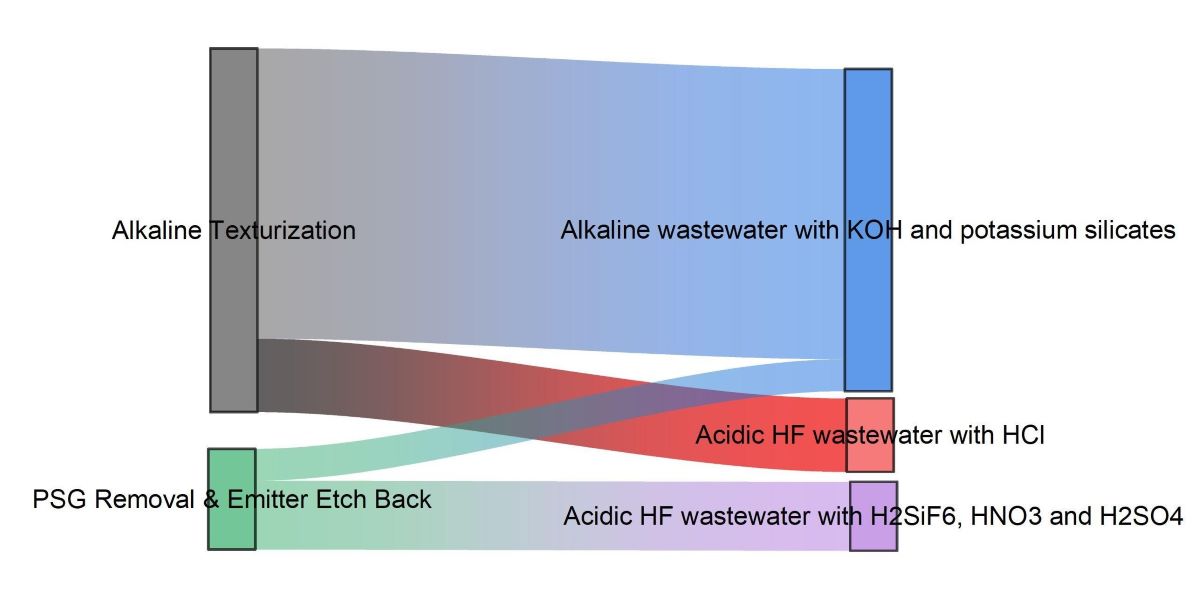
Researchers from Germany’s Fraunhofer Institute for Solar Energy Systems (Fraunhofer ISE) developed models to assess and compare two circular water strategies in a 5 GW passivated emitter and rear (PERC) solar cell factory.
They claim this is the first published ‘comprehensive water model’ for a solar cell factory.
The team compared two freshwater and wastewater flow scenarios with a water strategy in a conventional PERC cell manufacturing plant. The first scenario, known as low polluted wastewater (LCR), reuses rinse water so that it can be discharged indirectly in accordance with regulations. “In addition, certain wastewater streams were used as freshwater for downstream applications,” the researchers said.
The second scenario, known as minimal liquid discharge (MLD), reduces the amount of wastewater leaving the plant as much as possible while identifying and retrieving potential valuables from the wastewater, the team said.
For each scenario, a cost-benefit analysis and life cycle assessment (LCA) was carried out using Umberto 11 software, commonly used to analyze the environmental impacts of companies and products, and the Ecoinvent database for life cycle inventory. The analysis was also based on a specific material flow model, environmental assessment and total cost (TCO) calculations.
“An overall environmental impact analysis is needed to determine whether the proposed solutions provide a net environmental improvement to the solar cell manufacturing system,” the team said. “The results show that for the scenarios examined, 38% and 79% of water consumption and 40% and 84% of indirect wastewater discharge at the cell factory can be saved by the LCR and MLD approach, respectively.”
Additionally, cost savings of 0.5% and 0.7% on cell production were identified for LCR and MLD strategies, respectively. “Compared to the reference scenario, the proposed circular water strategies offer significant water and wastewater savings,” the group said.
Different types of water and wastewater treatment technologies were considered, taking into account costs, energy demand, operational risks and complexity. Only water recycling technologies that are commercially available and specifically suited to the chemical properties of PV wastewater, such as reverse osmosis, calcium fluoride precipitation and ultrafiltration technologies, were considered.
The team also collected extensive data for each of the production steps of PERC solar cells. Other relevant limitations included a throughput capacity of 2819 m32 cells per hour, and products with the following characteristics: 160 µm thickness, 244.32 cm2, 5.37 W and 22% cell power conversion efficiency.
Various tools were used to build the scenario models. For stream mixing, evaporation, precipitation and neutralization reactions and chemical use, the team used the phreeqc software, a computer program for speciation, batch reaction, one-dimensional transport and inverse geochemical calculations. Solutions for the evaporation processes were modeled using the SIT.dat database for high salinity solutions. Membrane processes were simulated using DuPont WAVE water treatment design software. Water and wastewater flow models were also demonstrated, including water recovery processes.
Regarding the Life Cycle Impact Assessment (LCIA), the EU Environmental Footprint, version 3.0 was used, and an improvement in the single environmental impact score of cell production was achieved. It fell by 0.4% for LCR and by 3.2% for MLD.
“The life cycle cost analysis conducted showed that such technologies are economically viable for this application, but prices for energy, water and wastewater discharges needed to be carefully assessed,” the academics said, adding that net cell production costs would be reduced by €0.025/W and €0.035/W is feasible for the LCR and MDL strategies, respectively.
“The reduction in environmental impact on the cell factory is estimated from -1.4% to 34.3% for the different impact categories, with significant reductions in freshwater ecotoxicity, freshwater and marine eutrophication for both circular water strategies,” explains the team.
The researchers provided capital expenditure (CAPEX) and operating expenditure (OPEX) for each of the two circular water strategies, noting that the LCR’s overall energy consumption is “relatively low,” with “very low CAPEX and OPEX.” They also noted that, compared to the reference case, no resources other than water are recovered.
In their analysis of the MLD scenario, they noted that high thermal energy and greater CAPEX and OPEX were required for the required machines. That said, they noted that MLD allows for a 79% reduction in freshwater consumption and an 84% reduction in wastewater, resulting in annual savings on freshwater and wastewater costs, as well as the ability to recover “valuable byproducts.” extract for use in other industries.
Looking ahead, the researchers see adoption in tunnel oxide-passivated contact (TOPCON) and heterojunction (HJT) plants, as “many of the wastewater streams analyzed are similar.” A demonstration setup is recommended, “to validate the estimated savings, as many technical challenges had to be overcome.”
The new water circulation concept was presented in the study “Circular water strategies in solar cell production,” published in Solar energy. The study was a collaboration between researchers from Fraunhofer ISE, RENA Technologies GmbH, Technische Universität Berlin and the Fraunhofer Institute for Building Physics.
This content is copyrighted and may not be reused. If you would like to collaborate with us and reuse some of our content, please contact: editors@pv-magazine.com.
