

Join us on April 22 for the 3rd SunRise Arabia Clean Energy Conference in Riyadh.
The event will spotlight how solar and energy storage solutions are powering sustainable and reliable infrastructure, with a particular focus on powering the country’s fast-growing data center sector.
According to Salge, active networks are key, not passive systems that simply respond to circumstances. With more renewable energy sources, changing demand patterns, new load centers and storage options such as batteries and existing facilities such as hydroelectric power plants, it is critical to actively coordinate these resources to maintain security of supply, power quality and cost optimization.
“But when you talk about the impact and correlation between renewables and data centers, you must always consider the full scope of flexibility in an energy system from all elements: the demand side, the generation side, the storage side and the active network in between,” he said, noting that weak or congested networks would not serve this purpose.
AI data centers
Salge cautioned that not all data centers are the same. “There are conventional data centers and AI data centers,” he said. “Conventional data centers are essentially high load systems, with some fluctuations on top of that. They contain many processors that process requests (from search engines or other applications), so the workload is stochastically distributed among them. This creates a base load with random ups and downs, which is the typical load pattern of a conventional data center.”
AI workloads, on the other hand, rely heavily on GPUs or AI accelerators, which continuously consume a lot of power. Unlike conventional data centers, AI data centers often run at persistently high loads, sometimes close to maximum capacity for long periods.
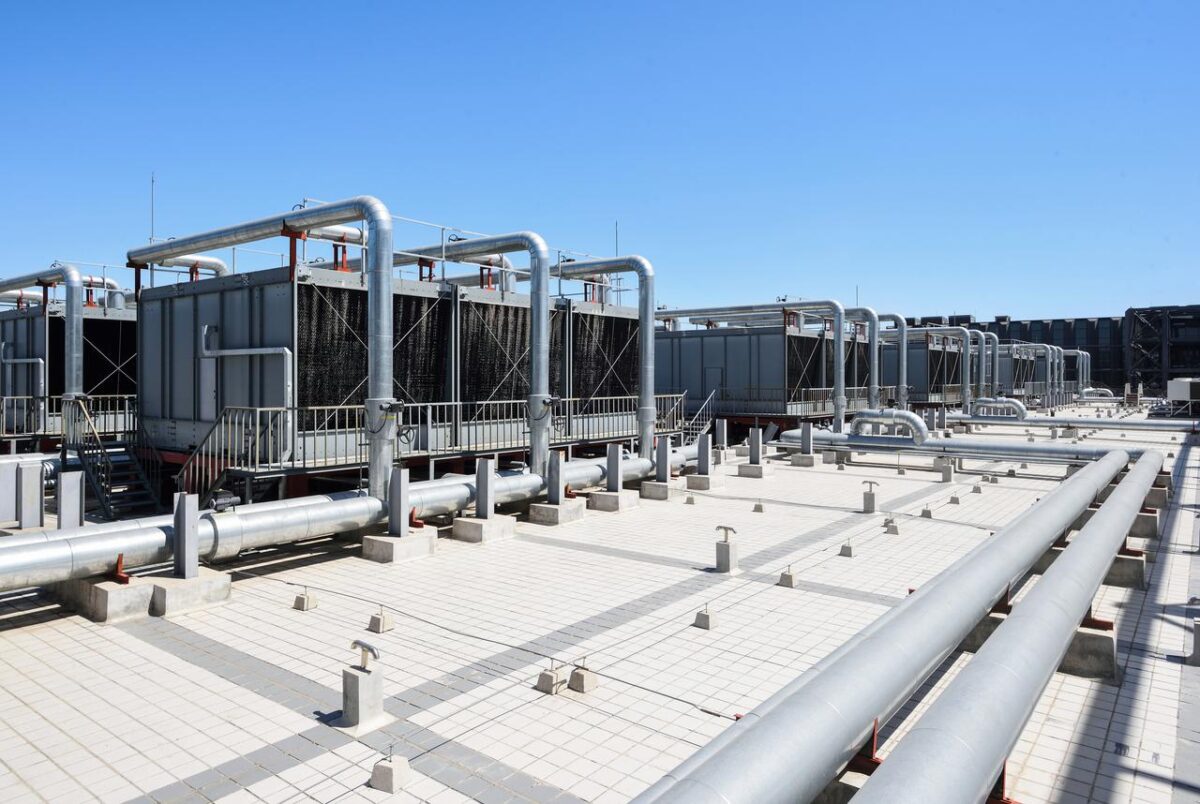
Image: Hitachi Energy
“AI data centers are especially good at parallel computing,” Salge explains. “So many of them are activated at the same time with the same demand pattern, creating these peaks up and down the demand profile, and they’re all coming in parallel.”
These fluctuations test both the power supply and the voltage and frequency quality of the connected electricity grid. “So you have to transport active power from an energy storage system or a supercapacitor to the demand of the AI data center. And then you really have to have control over the active power of the data center. What you need is the interaction between the storage unit and then the AI data center to supply active power or absorb it later when the peak goes down. That can also be done by a supercapacitor.”
Batteries can store much more energy than supercapacitors, but the latter can store smaller energies more often. “However, if you put a battery that is smaller than the load, and you really have to run the battery at its full capacity, then the battery is not going to last long in your data center, because the frequency of these bursts is so high, then you age the battery very, very quickly, yeah, so supercapacitors can do more cycles,” Salge pointed out.
He also noted that batteries and supercapacitors are both mature technologies, but the optimal setup (whether one, the other, or a combination with traditional capacitors) depends on storage size, number of racks, voltage levels, and overall system design.
AI training burst management
Salge emphasized the importance of adhering to the network codes in all geographical areas. “You have to become a good citizen for the system of power,” he said. “You need to work with local utilities to ensure that you are not violating the network codes and that you are not disrupting the data center in the network. A good way to do this, when renewables and data centers are co-located, is to already manage the renewable energy supply within the data center area. Moreover, having a future-proof developed network is a clear advantage. Because you have many more of these flexibility elements and the active elements to manage the storage and the integration of renewable energy and to manage the dynamic loads of the manage data centers.”
If the electricity grid is not future-proofed with modern, actively operating equipment, operators will experience significantly more stress. “With holistic planning, you can even use some of the data center flexibility as a manageable and demand-driven function instead,” says Salge, adding that data center operators can coordinate AI training bursts to periods when the power system has more available capacity. This makes the data center a predictable, manageable demand that only puts pressure on the power grid when it is ready.
“In conclusion, as far as technical feasibility is concerned, yes, it is possible, but it requires the right configuration,” said Salge.
Economic feasibility
Economically, Salge believes that solar and wind energy remain the cheapest energy sources, even when you take into account the network flexibility required to integrate them with data centers. Solar energy can be deployed most quickly, wind complements this well and both can be scaled up in parallel.
“Any increase in demand for data centers requires investments, whether in renewable energy or conventional energy. The economy is market dependent, and market mechanisms, regulations and technical network planning are interrelated, affecting energy flow, pricing and system stability,” he said.
“We recommend that developers work with all stakeholders (utilities, technology providers and planners) from the outset to ensure reliability, affordability and social acceptance. Holistic planning avoids reactive solutions and leads to better long-term outcomes,” concludes Salge.
This content is copyrighted and may not be reused. If you would like to collaborate with us and reuse some of our content, please contact: editors@pv-magazine.com.
Popular content

