

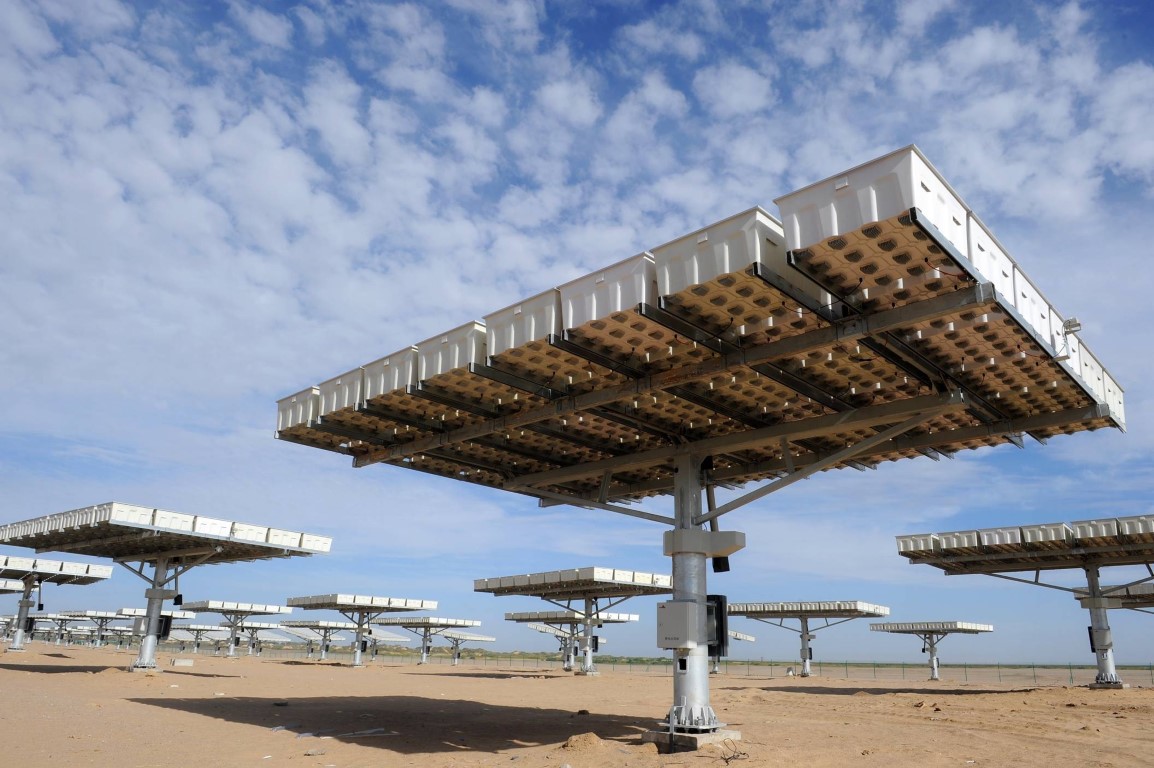
The cpvlib framework, devised by Spanish scientists, is configured as a modular tool that can accurately predict the energy production of different CPV configurations. It can reportedly analyze complex behavior such as the impact of air mass on CPV performance, angle of incidence limits and light spill.
A research team led by the Universidad Politécnica de Madrid (UPM) in Spain has developed an open-access modeling tool for the design of concentrating photovoltaic (CPV) systems.
Called cpvlibthe framework is described as an advanced tool for modeling CPV systems. “The need for such a tool arises from the limitations observed in existing PV simulation tools, leading to the development of an adaptable and open source solution,” said the study’s corresponding author, Rubén Núñez Júdez, pv magazine. “The basis of cpvlib lies in the established pvlib frameworka collection of functions and classes designed for the simulation of PV energy systems developed in Python, supported by the open source community. The code is hosted in a public repositoryfostering a collaborative environment with features such as online documentation, issue tracking, code style guidelines, continuous integration development and extensive test coverage.”
The cpvlib philosophy is configured as a modular tool that can accurately predict the energy production of different CPV configurations. “Unlike some PV simulation tools that integrate CPV models as proprietary components, cpvlib stands out for its flexibility and customizability,” Núñez Judez said. “Traditional models are often unable to integrate state-of-the-art architectures and modeling methods, which hinders progress in this field. Examples of these innovations include integrated tracking, planar microtracking and hybrid CPV flat plate modules for efficient stray light capture. The cpvlib library fills this gap by providing a flexible model designed for these new architectures, with the ability to easily adapt to new developments.”
The new tool was presented in “cpvlib: a comprehensive open source tool for modeling CPV systems”, published in Solar energy materials and solar cellswhere the research group explained that it can analyze complex behavior such as the impact of air mass on CPV performance, angle of incidence limits and light spill. The tool’s library uses PVSyst’s usage factors to model deviations from the single-diode model, taking into account spectral and thermal effects.
The proposed tool was validated by long-term monitoring of hybrid CPV/flat plate modules developed by Swiss startup Insolight.
The company has developed these CPV panels for agricultural voltaic applications and is currently planning to start commercial production. The product specification states that the CPV panel has an efficiency of 30% and an output power of 160 W at standard conditions of 25 C and 1,000 W/m2 irradiation. The product can reportedly operate at a maximum system voltage of 500 V and at temperatures ranging from -40 to 85 degrees Celsius. The 1,141 mm x 595 mm x 50 mm module weighs 20 kg and is just as easy to install as conventional solar panels, according to the developer. The connector is MC4 compatible and the junction box has an IP 67 rating.
The panel relies on expensive III-V multi-junction solar cells from an undisclosed manufacturer. The cells cover just 0.5% of the panel surface and are covered with protective glass and optical lenses to concentrate and focus sunlight at approximately 100 times the intensity of standard solar glass. The cells can reportedly track the sun through horizontal movement
The modeling tool reportedly achieved a root mean square error of 2.7% to 3.5% in testing.
“Conventional PV technology based on flat-panel silicon currently has such low energy costs (LCOE) that not only other PV technologies, but also other power generation technologies cannot achieve,” Núñez Júdez stated. “That is why CPV technologies can have potential in niche environments where their characteristics are improved, such as in locations with high direct irradiation. In addition, CPV systems can use high-efficiency cells, which is an advantage in applications where space is limited. This is for example the case with underground contact cell modules, which have found a niche in residential installations.”
This content is copyrighted and may not be reused. If you would like to collaborate with us and reuse some of our content, please contact: editors@pv-magazine.com.
