A team of researchers in Canada has developed the Jericho Open Resistive Data Logger: an open-access photovoltaic (PV) monitoring platform that integrates data acquisition and processing hardware, a software framework, and a comprehensive sensor array. The system is designed primarily for agrivoltaic applications and has a total estimated cost of approximately $2,000.
Researchers from Western University in Canada, in collaboration with Jericho Lab, a provider of environmental monitoring solutions, have developed a new open-source modular monitoring platform for long-term outdoor solar experiments.
The system is called Jericho Open Resistive Data Logger (RDL) and is said to bridge the gap between inexpensive do-it-yourself (DIY) devices and expensive proprietary data acquisition systems (DAQs).
“We worked with Jericho Lab to further develop their commercial RDL product to create an advanced solar photovoltaic monitoring system at a fraction of the cost of proprietary DAQs on the market,” said corresponding author Joshua M. Pearce. pv magazine. “This system was established primarily for agricultural voltaic projects, a field that is still in its infancy in Canada. Therefore, there are many new types of systems to explore.”
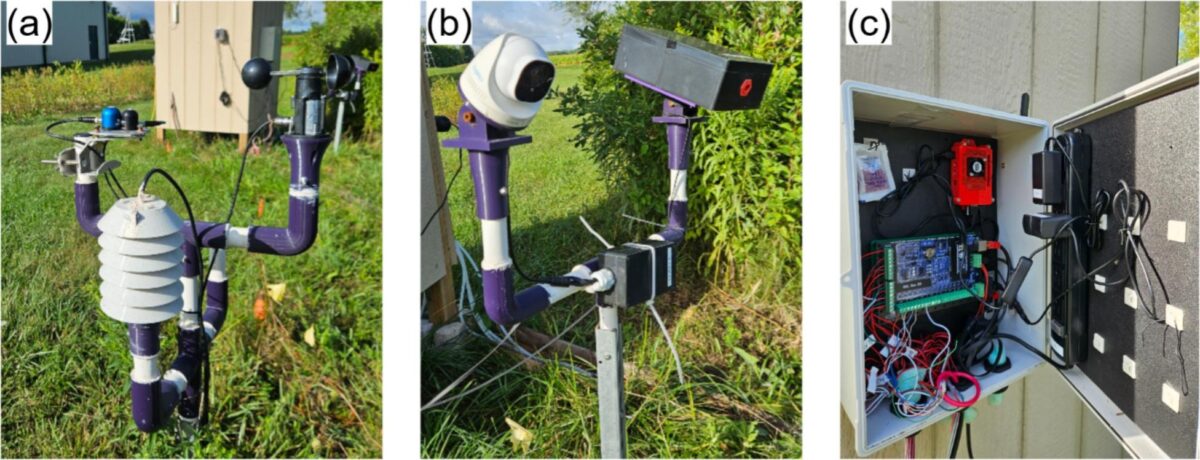
In a hardware article, the group provided precise details on how to set up the system and also published it repository for source files. The Jericho Open RDL (JOR) consists of three central systems: the data collection and processing hardware; the sensor array for experimental measurements; and the embedded software framework responsible for system operation, sensor-to-DAQ communication, and local data storage management.
The data acquisition and processing platform consists of an RDL combined with an I2C expansion shield, an Arduino Nano microcontroller, a Raspberry Pi 4 single-board computer, and the necessary structural and electrical fixtures that support the operation of the central hub.
The platform uses air temperature, humidity, solar radiation, wind speed and PV temperature sensors. It also includes cameras for visible light and infrared imaging, as well as a Hall effect transducer for measuring direct current. The group also has 3D printed connectors, housings, shields and brackets.
“The Raspberry Pi runs on 64-bit Pi OS and runs Python 3 scripts alongside the Arduino firmware. It handles USB serial input, image capture, system monitoring and data organization. The architecture provides a modular framework in which additional sensors or services can be incorporated with minimal changes to existing processes,” the academics explained. “Firmware on the Nano includes variable declarations, initialization, and a continuous acquisition loop. User parameters and programmer parameters reside in EEPROM and are loaded at boot.”
Image: Western University, HardwareX, CC BY 4.0
In total, the system’s components had a total price of CAD 2,827.74 ($2,020.21). The most expensive item was a thermal camera with an ABS housing priced at CAD 999, followed by a silicon cell pyranometer at CAD 582.62 and a Reolink camera with an ABS housing at CAD 199. The JOR was verified in two ways: against the commercially available smart sensor Lufft WS 501 to ensure accuracy and precision, and against a second JOR to ensure consistency of performance between devices.
Data for the Lufft comparison was collected between August 22 and August 26, 2025. The between-device comparison was obtained from July 4 to July 11, 2025. All testing was conducted outdoors at the Environmental Sciences Western Field Station as part of Western Innovation for Renewable Energy Deployment (WIRED) outdoor experiments in Ilderton, Ontario, Canada.
“Statistical comparison of irradiation, relative humidity, temperature and wind speed was compared to a proprietary system and found to be well within acceptable differences for validation, although wind speed was found to have the largest deviation,” the researchers said. “Two independent open source units confirm excellent inter-device repeatability for all measured variables.”
In conclusion, Pearce said that “it was refreshing to work with an industry partner who wanted to advance the science and help us get the best possible data. We are currently deploying ten of the RDLs in a wide range of agrivoltaic, floatovoltaic and H2 generation applications, and BIPV experiments. We are using them to test new open-source PV racks and new types of agrivoltaic systems.”
The system was described in “Jericho open resistive data logger: an open-source modular weather station and monitoring system for long-term outdoor solar photovoltaic experiments”, published in HardwareX.
This content is copyrighted and may not be reused. If you would like to collaborate with us and reuse some of our content, please contact: editors@pv-magazine.com.
Popular content