
Close Menu
  • News
  • Industry
  • Solar Panels
  • Commercial
  • Residential
  • Finance
  • Technology
  • Carbon Credit
  • More
    • Policy
    • Energy Storage
    • Utility
    • Cummunity
What's Hot

Distributed solar capacity in Argentina grew by 34.5% in the first half of the year

July 23, 2026

The UK government has urged to ensure that plug-in solar is properly regulated

July 22, 2026

Cornwall Insight cuts price ceiling forecast after Burnham’s VAT cut

July 22, 2026
Facebook X (Twitter) Instagram
Solar Energy News
Thursday, July 23
  • News
  • Industry
  • Solar Panels
  • Commercial
  • Residential
  • Finance
  • Technology
  • Carbon Credit
  • More
    • Policy
    • Energy Storage
    • Utility
    • Cummunity
Solar Energy News
Home - Solar Industry - Optimized antimony trisulfide solar cells can achieve an efficiency of 11.68%
Solar Industry

Optimized antimony trisulfide solar cells can achieve an efficiency of 11.68%

solarenergyBy solarenergyJune 12, 2024No Comments3 Mins Read
Facebook Twitter Pinterest LinkedIn Tumblr Email
Share
Facebook Twitter LinkedIn Pinterest Email

An international research group has analyzed the main barriers that prevent antimony trisulfide solar cells from achieving satisfactory energy conversion efficiencies and proposed a set of optimization parameters that could bring them closer to commercial production.

June 12, 2024 Emiliano Bellini

An international research team led by the Bangladesh Atomic Energy Commission has developed a new design for thin-film solar cells based on antimony trisulfide (Sb2S3)

This kind of cell typology is far from reaching commercial production so far due to the low crystallinity and high resistance of the Sb2S3 film, which affects efficiency. However, Sb2S3 has a good band gap, ranging from 1.70 to 1.90 eV, and a remarkable light absorption coefficient, and remains a promising material for future PV cell applications.

With this in mind, the researchers examined transport mechanisms, resistance and defects in Sb2S3 cells. “The novelty of this work lies in the detailed theoretical research of Sb2S3 solar cells, specifically aimed at the complex interplay of different transport mechanisms such as tunneling-enhanced recombination, Sb2S3/CdS interface recombination and non-radiative recombination,” they explained.

To address these barriers, the research group adopted a modeling framework to analyze transport mechanisms and their interactions. “The primary objective of this study is to rigorously determine the dominant recombination mechanism,” the report said, noting that other factors influencing a Sb2S3 cell efficiency are doping of the cadmium sulfide (CdS) layer, thickness, band gap and affinity.

The scientists also examined the effects of shunt resistance (Rs) and series resistance (Rs) on cell performance, as well as the impact of interfacial defects at the CdS/Sb2S3 couple.

See also  Polysilicon Market has a fixed, pending policy -driven shift

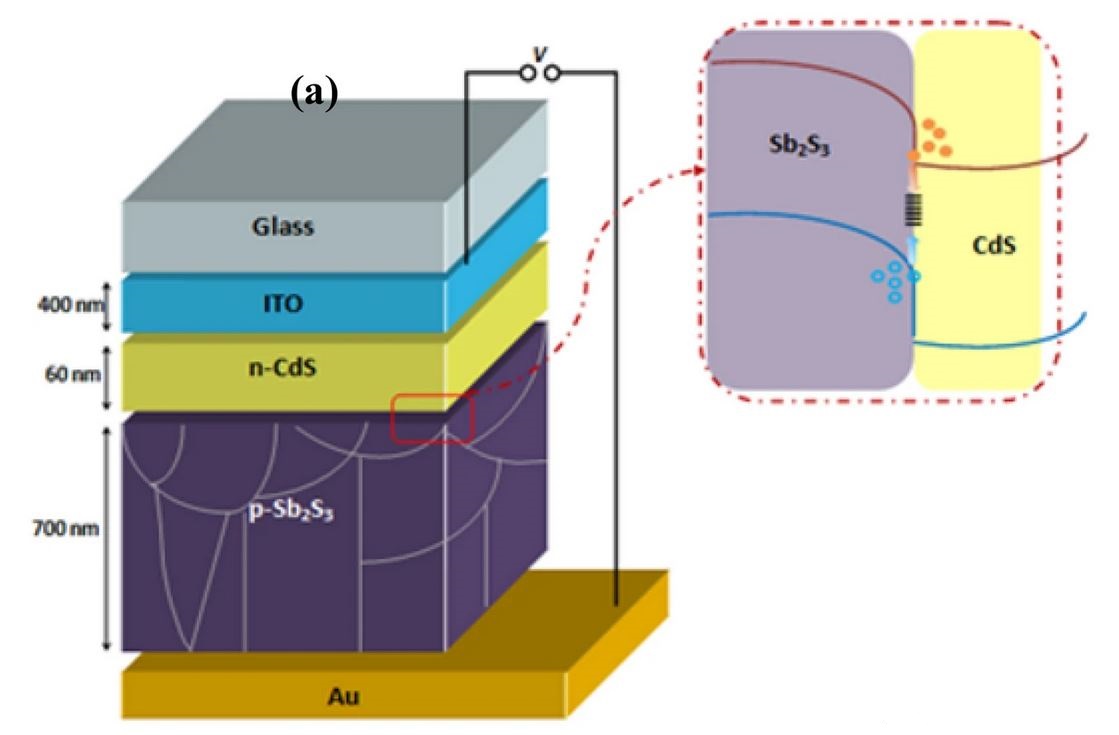
The proposed modeling was applied to a conventional Sb2S3 cell structure with a glass-coated indium tin oxide (ITO) substrate, a CdS layer, an Sb2S3 absorber and a gold (Au) metal contact. This analysis showed that increasing CdS doping and thickness improves the generation and separation mechanisms by increasing the electric field and absorption rate.

“The optimized solar cell configuration shows significant improvements with a high short-circuit current density of 9.5 mA cm−2an open-circuit voltage of 1.16 V, a fill factor of 54.7% and a remarkable 30% increase in conversion efficiency compared to conventional solar cells,” the scientists said, adding that the proposed cell design can achieve an efficiency of 11.68% reaches. which would be comparable to 6.5% for a non-optimized device.

“The simulated work not only sheds light on current limitations and possibilities, but also lays the foundation for future research directions,” the team concluded.

The new cell architecture was introduced in the study “Investigation of transport phenomena and recombination mechanisms in thin film Sb2S3 solar panels,” published in scientific reports. The research team includes scientists from the Algerian laboratory HNS-RE2SD, the Universidad Autónoma de Querétaro in Mexico, the Indian Saveetha Institute of Medical and Engineering Sciences and the Chettinad Academy for Research and Education, as well as from King Saud University in Saudi Arabia and Yeungnam University in South Korea.

This content is copyrighted and may not be reused. If you would like to collaborate with us and reuse some of our content, please contact: editors@pv-magazine.com.

Source link

achieve antimony cells efficiency Optimized solar trisulfide
Share. Facebook Twitter Pinterest LinkedIn Tumblr Email
solarenergy
  • Website

Related Posts

Distributed solar capacity in Argentina grew by 34.5% in the first half of the year

July 23, 2026

The UK government has urged to ensure that plug-in solar is properly regulated

July 22, 2026

SmartestEnergy, Greentech ink CfD PPA for the Kent solar project

July 22, 2026
Leave A Reply Cancel Reply

Don't Miss
Technology

Northvolt closes Cuberg operations and moves lithium metal battery research and development to Sweden – SPE

By solarenergyAugust 22, 20240

Northvolt, Europe’s torchbearer in battery manufacturing, has announced the decision to move the development of…

BMW, Exolum bet on H2 logistics – SPE

December 3, 2024

Arizona Corporation Commission on track to preserve the Grid Access Charge

December 12, 2024

Soltage protects $ 260 million to expand the Buildout on solar energy on utilities | Solar financing Spotlight

June 25, 2025
Stay In Touch
  • Facebook
  • Twitter
  • Pinterest
  • Instagram
  • YouTube
  • Vimeo
Our Picks

Distributed solar capacity in Argentina grew by 34.5% in the first half of the year

July 23, 2026

The UK government has urged to ensure that plug-in solar is properly regulated

July 22, 2026

Cornwall Insight cuts price ceiling forecast after Burnham’s VAT cut

July 22, 2026

SmartestEnergy, Greentech ink CfD PPA for the Kent solar project

July 22, 2026
Our Picks

Distributed solar capacity in Argentina grew by 34.5% in the first half of the year

July 23, 2026

The UK government has urged to ensure that plug-in solar is properly regulated

July 22, 2026

Cornwall Insight cuts price ceiling forecast after Burnham’s VAT cut

July 22, 2026
About
About

Stay updated with the latest in solar energy. Discover innovations, trends, policies, and market insights driving the future of sustainable power worldwide.

Subscribe to Updates

Get the latest creative news and updates about Solar industry directly in your inbox!

Facebook X (Twitter) Instagram Pinterest
  • Contact
  • Privacy Policy
  • Terms & Conditions
© 2026 Tsolarenergynews.co - All rights reserved.

Type above and press Enter to search. Press Esc to cancel.