

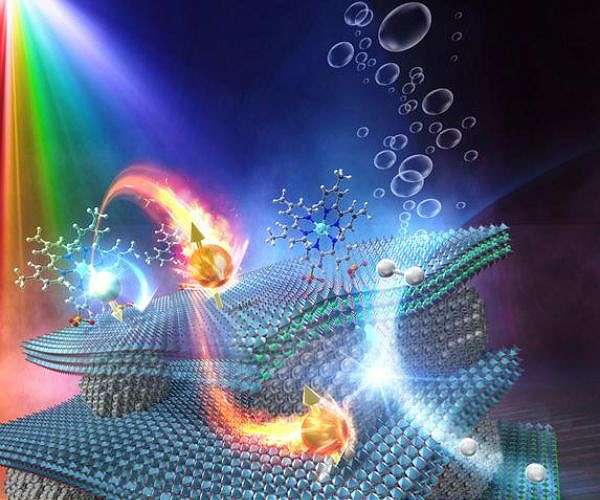
Generating hydrogen from sunlight offers a route to low-carbon fuel production by converting solar energy into chemical energy stored in hydrogen. Researchers use photocatalysts to absorb light and split water into hydrogen and oxygen, but many existing systems harvest only part of the visible spectrum, leaving much of the incoming solar energy unused. To increase the efficiency of solar energy to hydrogen, researchers are investigating photocatalysts that respond to a wider range of visible wavelengths.
A team led by Professor Kazuhiko Maeda and graduate student Haruka Yamamoto of the Institute of Science Tokyo has developed a dye-sensitive photocatalyst that absorbs long-wavelength visible light down to about 800 nanometers. The study, published in ACS Catalysis on December 5, 2025, reports an up to twofold increase in solar-to-hydrogen conversion efficiency compared to conventional systems. This performance gain indicates that the new material converts a greater proportion of incident photons into hydrogen under illumination conditions.
Dye-sensitive photocatalysts combine a light-absorbing dye molecule with a catalytic material. In these systems, the dye acts as an antenna that captures visible light and transfers the excitation energy or charge to the catalyst surface, where hydrogen evolution reactions occur. The choice of metal complex in the dye strongly influences which wavelengths are absorbed and how effectively the system drives charge transfer.
“Dye-sensitive photocatalysts typically use ruthenium complexes as photosensitizing dyes. However, ruthenium-based complexes typically only absorb shorter visible wavelengths up to 600 nm,” Maeda explains.
To extend the absorption to longer wavelengths, the team replaced the ruthenium metal center in the complex with osmium. This replacement broadened the absorption profile, allowing the photocatalyst to use light with wavelengths greater than 600 nanometers and harvest a larger portion of the solar spectrum. The osmium-containing dye generates additional excited electrons that participate in hydrogen evolution, contributing to the reported two-fold efficiency improvement.
The enhancement is related to the heavy atom effect of osmium, which enhances the singlet-triplet excitation in the metal complex. This low-energy electronic transition enables absorption of long-wavelength visible photons that ruthenium dyes do not effectively capture. By exploiting this effect, the new photocatalyst accesses a spectral region that is abundant in natural sunlight but previously underutilized in many dye-sensitive systems.
“In our efforts to expand the range of light absorption, osmium proved to be a key element in accessing wavelengths that ruthenium complexes could not utilize, leading to a twofold increase in hydrogen production efficiency,” says Maeda.
The osmium-based system shows improved performance even in weak or diffuse sunlight, indicating operation under real outdoor conditions. This behavior is important for technologies such as artificial photosynthesis and solar energy conversion materials, which must function under variable irradiance and atmospheric scattering. Better use of long-wavelength light could help stabilize hydrogen production under different weather and seasonal conditions.
The researchers note that further optimization of the metal complexes and photocatalyst architecture remains an active area of work. Their current results provide a design framework for next-generation dye-sensitized photocatalysts that utilize heavy metal effects and singlet-triplet transitions to increase light absorption. This approach could support broader deployment of solar-powered hydrogen production and related sustainable energy systems.
