

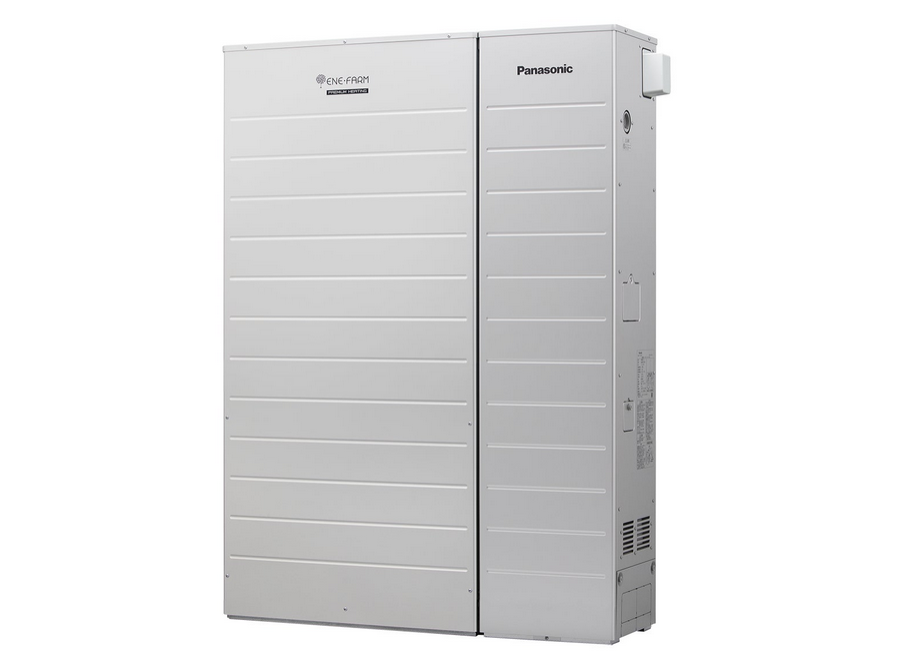
Panasonic has launched a new fuel cell system for detached houses, designed to boost solar self-consumption through HEMS-based smart planning. The unit generates electricity and heat from gas, supports demand response and can provide emergency power during disruptions.
Japanese industrial group Panasonic has unveiled a new fuel cell cogeneration system under the long-standing Ene-farm brand, aimed at detached homes and designed to increase on-site solar self-consumption.
The system integrates with a home energy management system (HEMS) that can predict excess electricity from solar or the grid. Based on these predictions, the HEMS schedules fuel cell operation to coincide with periods when solar panels produce more electricity than the household needs, maximizing self-consumption.
The device also supports Echonet Lite, a Japanese standard for smart devices, which enables participation in demand response (DR) programs. When the system receives a power reduction order, Ene-farm pauses electricity generation, allowing more power to flow from the grid and increasing household consumption. Conversely, a request for electricity generation results in electricity production, which reduces the amount of grid power required and alleviates supply constraints.
The system runs on methane or liquefied petroleum gas (LPG). Inside the unit, a fuel processor extracts hydrogen from the methane in the delivered gas, and this hydrogen is then fed into the fuel cell stack to generate electricity through an electrochemical reaction. The system provides a power generation capacity of 200–700 W for the city gas model and 300–700 W for the LPG model. It achieves a nominal electrical efficiency of 41.0% for lower heating value (LHV) or 37.0% for higher heating value (HHV) with methane, and 40.0% (LHV) or 36.8% (HHV) with LPG.
In addition to producing electricity, the system captures the heat generated during the reaction process and reuses it to heat water stored in an approximately 100 liter tank for domestic applications such as showers, taps and space heating. The nominal heat recovery efficiency is 57.0% for LHV or 51.5% for HHV for methane, and 61.0% for LHV or 56.2% for HHV for LPG. Thanks to this combined production of electricity and useful heat, the total efficiency increases to 98.0% for LHV or 88.5% for HZV with methane, and to 101.0% for LHV or 93.0% for HZV with LPG.
When the demand for hot water exceeds the available heat from the fuel cell, the system is automatically supplemented with a backup boiler or an auxiliary heat source to ensure a stable and continuous supply. During power outages, the device can also provide emergency power with a maximum AC power of 500 W.
The fuel cell unit measures 1,650 mm x 400 mm x 350 mm, while the hot water storage unit measures 1,650 mm x 790 mm x 350 mm. The dry weight is 59 kg for the fuel cell unit and 73 kg for the hot water storage unit.
The product will be available for purchase in Japan from April 1.
In September, Panasonic started testing a new energy management system (EMS) that helps increase self-PV consumption in homes by combining solar energy generation with heat pumps and batteries. It also recently released a new version of its Eco Cute CO2 heat pump, which features a solar radiance shift function that adjusts daytime hot water (DHW) production to match rooftop PV energy generation.
Last year it also integrated a range of home energy management solutions into its Aquarea air-to-water heat pumps for commercial and multi-home residential applications.
This content is copyrighted and may not be reused. If you would like to collaborate with us and reuse some of our content, please contact: editors@pv-magazine.com.
