

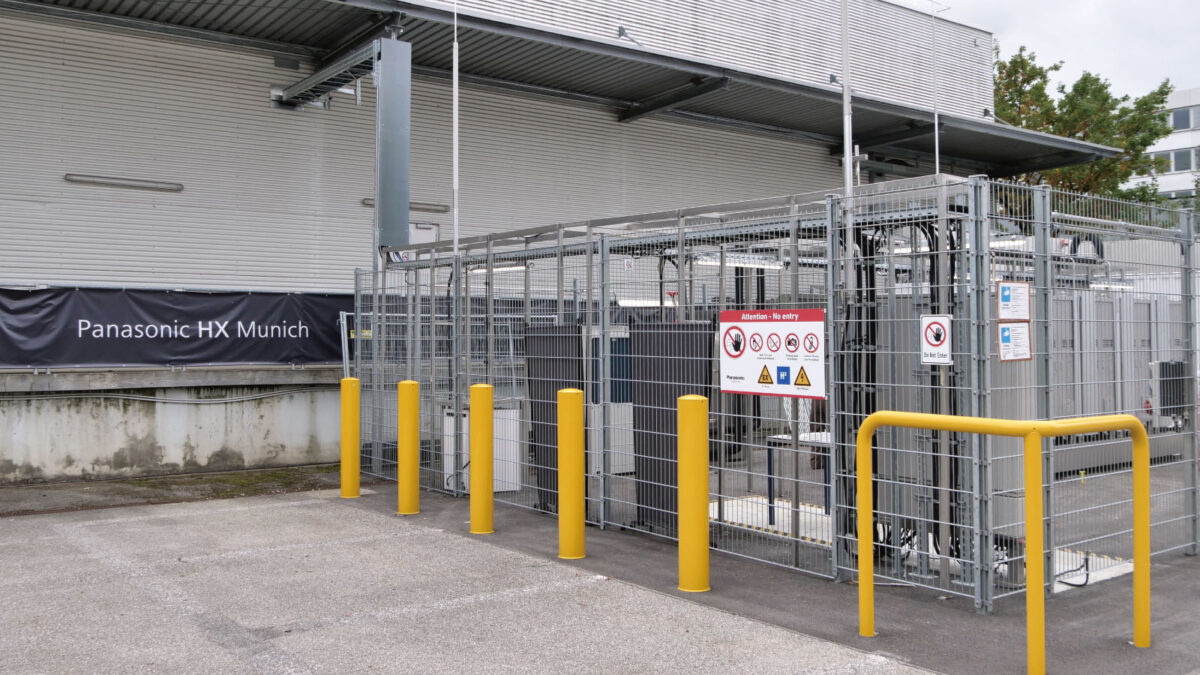
The Japanese conglomerate has deployed its Panasonic HX hydrogen solution at its Munich factory. The system uses an AI-based power management system that reportedly eliminates the need for battery storage.
Panasonic has announced that it has started testing its Panasonic HX hydrogen energy solution at its office in Munich, Germany.
The Panasonic HX platform typically consists of a renewable energy generator, Panasonic PH3 fuel cells and battery storage. However, for the German project, batteries were deemed redundant thanks to an AI-based energy management system (EMS) that performs real-time fuel cell control in response to fluctuations in renewable energy under European weather conditions.
“The unique feature of hydrogen is its long-term storage capacity,” he says Florian Sobek, Business Development Manager at the European Hydrogen Business Promotion Office, who oversees the Panasonic HX project in Europe. “Batteries are excellent for absorbing excess power peaks and responding to power fluctuations. However, as the solar energy generation at the Munich site is small and the fluctuations in power demand in the building are minimal, we decided that installing batteries was not necessary.”
Avoiding the installation of batteries reduced the initial costs and physical footprint of the project. “The biggest hurdle was installing the fuel cell equipment, as we had to coordinate with the relevant authorities and go through multiple approval and licensing processes,” Sobek explains. “The process of designing and assessing the fuel cell itself, as well as the surrounding infrastructure, such as green hydrogen storage facilities and grid connection, is a challenge that potential customers will inevitably face.”
The company said this is the first time it is targeting an office facility instead of a factory with a 100% renewable energy supply.
The HX platform at the Munich site relies on 190 kW of rooftop PV and three 10 kW PH3 fuel cell systems.
According to Panasonic, the PH3 system achieves approximately double the maximum power of previous models and can now be adjusted in 1 kW increments. Thanks to its compact size and quiet operation, it is very suitable for urban areas and office spaces.
The system uses green hydrogen produced in Germany and Austria by unspecified suppliers. The fuel is supplied via a 40-foot hydrogen tank trailer.
The first Panasonic HX pilot project was launched in April 2022 at a fuel cell factory in Kusatsu, Shiga Prefecture, Japan, and later deployed at a microwave oven assembly plant in Cardiff, Wales, UK.
“As infrastructure development, including green hydrogen supply networks, progresses in Europe, the cost of green hydrogen will fall, supporting the widespread adoption of fuel cells,” Soebek said. “Ultimately, fuel cells will become a viable clean energy option, just as solar energy is today. Our efforts in Munich are a sure step towards a future where hydrogen solutions around fuel cells will become an essential part of society and contribute to sustainable lifestyles.”
This content is copyrighted and may not be reused. If you would like to collaborate with us and reuse some of our content, please contact: editors@pv-magazine.com.
