

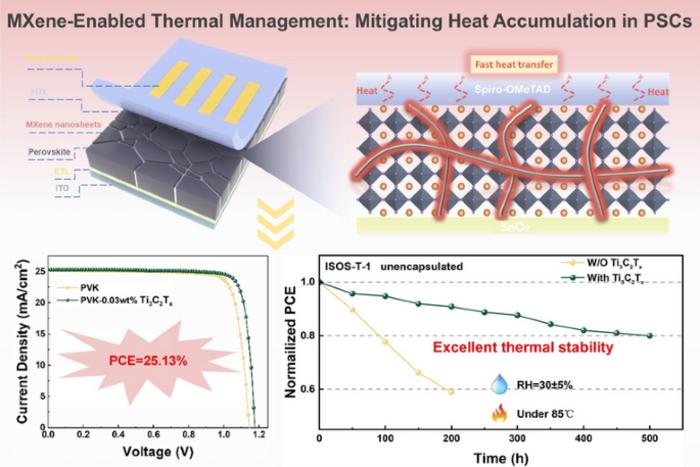
A Chinese research group claims to have achieved remarkable efficiency and stability in a solar cell based on a perovskite absorber that incorporates MXene, a new type of 2D material known for its excellent conductivity, chemical stability and thermal resilience. The device reportedly retained 80% of its original efficiency after 500 hours.
Researchers from the University of Electronic Science and Technology of China (UESTC) have fabricated a perovskite solar cell based on a light absorber containing two-dimensional titanium carbide (Ti3C2Tx), also known as MXeen.
MXeen compounds take their name from their graphene-like morphology and are made via selective etching of certain atomic layers from a bulk crystal known as MAX. Recently, these materials have shown promise for use in PV technology due to their unique optoelectronic properties, such as their high charge carrier mobility, excellent metal conductivity, high optical transmission, and tunable work function (WF).
“These multifunctional benefits highlight the great potential of Ti3c2TX to construct perovskite solar cells with not only high energy conversion efficiency, but also excellent thermal stability,” the scientists explained, noting that when Ti3c2TX Nanosheets are embedded in the perovskite layer and serve as multifunctional additives to simultaneously improve heat dissipation and optoelectronic properties.
The cell is built with a substrate made of glass and indium tin oxide (ITO), an electron transport layer (ETL) based on tin oxide (SnO2), the perovskite absorber with Ti3C2Tx, a hole transport layer (HTL) relying on Spiro-OMeTAD, and a gold (Au) metal contact.
Thanks to the integration of Ti3C2Tx, the perovskite film was built with a thickness of only 15.2 nm, compared to 24.9 nm for a perovskite film without the Ti3C2Tx treatment. This translated into improved morphology and surface smoothness in the absorber, which in turn resulted in the formation of efficient thermal conduction pathways.
“This improvement in morphology can be attributed to the excellent heat transfer ability of Ti3c2TXthat provides a stable thermal field for uniform grain growth, which increases the grain size,” the research team emphasizes.3c2TX-modified perovskite film showed stronger absorption in the visible light region compared to control films.”
Using energy dispersive spectroscopy (EDS), the research team verified that the Ti was uniformly distributed throughout the perovskite film, which in this way can act as a heat conduction pathway and defect passivator at grain boundaries. X-ray photoelectron spectroscopy (XPS) also confirmed that Ti3c2TX contributes to the local redistribution of electrons at the grain boundaries of the perovskite absorber.
Tested under standard lighting conditions, the solar cell achieved an energy conversion efficiency of 25.13%, an open-circuit voltage of 1.177 V and a short-circuit current density of 25.29 mA cm.2and a fill factor of 84.4%, while a reference solar cell without Mxene nanosheets achieved values of 23.70%, 1.145 V, 25.18 mA cm2and 82.2% respectively.
Furthermore, the Mnexe-based device was found to retain approximately 80% of its original efficiency after 500 hours at 85% relative humidity.
The scientists specified that the main hurdle to the commercialization of this type of solar cells remains the high cost and complexity of Ti3c2TX materials. “Future studies should focus on optimizing the synthesis routes to reduce costs and improve reproducibility. In addition, alternative MXene materials with unique structures and electronic properties, such as Ti2C.TXfor the thermal management of perovskite solar cells can provide comparable or even superior performance,” they concluded.
The cell was described in “Multifunctional MXene for thermal management in Perovskite solar cells”, published in Macro-Micro Letters.
Previous attempts to use Mxene in perovskite solar cells resulted in devices with an efficiency of 23% and cells with an efficiency of 17%. In addition, another international research group recently conducted a study to find out how MXenes can be used as materials for solar cells
This content is copyrighted and may not be reused. If you would like to collaborate with us and reuse some of our content, please contact: editors@pv-magazine.com.
