

A research team at DGIST has developed a perovskite-based self-powered betavoltaic battery that they say achieves the world’s highest conversion efficiency for this class of devices, while maintaining long-term operational stability. The work focuses on applications that require continuous reliable power without external charging, such as artificial intelligence systems, Internet of Things devices and space exploration hardware that operate in harsh or inaccessible environments.
The team, led by Professor Su Il In from the Department of Energy Sciences and Engineering at DGIST, focused on improving the performance of the radiation absorber, a key component in betavoltaic batteries that convert beta particles into electricity. Conventional lithium-ion batteries face limitations such as limited lifespan, fire risk, and the need for frequent charging and replacement, while existing betavoltaic devices are limited by the low energy conversion efficiency of their absorber materials.
Betavoltaic batteries generate electrical power by converting beta particles, which are high-energy electrons emitted during radioactive decay, into electron-hole pairs in a semiconductor absorber. Because the radioactive source can have a long half-life and the radiation dose can be maintained at acceptable levels, such batteries can provide autonomous power for extended periods without any external power supply or maintenance. However, low conversion efficiency and material challenges have slowed the path to commercialization.
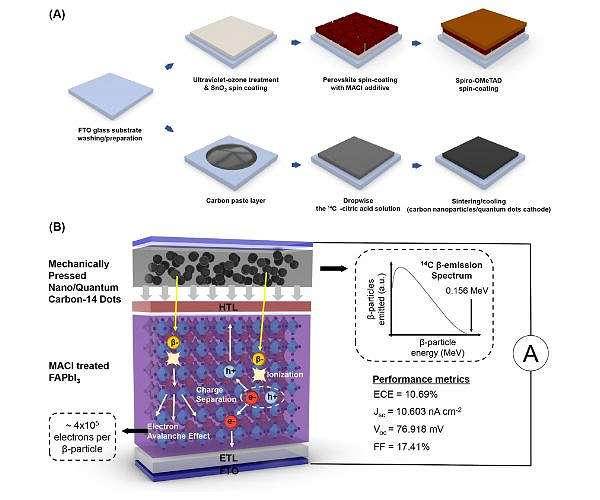
To address these issues, the DGIST-led collaboration used carbon-14 nanoparticles as the beta radiation source and introduced a perovskite semiconductor as the radiation-absorbing layer. The work, conducted in collaboration with Professor Jong Hyeok Parks group of the Department of Chemical and Biomolecular Engineering at Yonsei University, applied additive engineering and anti-solvent process control to optimize the microstructure of the perovskite film.
Specifically, the researchers used methylammonium chloride as an additive in the perovskite manufacturing process and used an isopropanol-based anti-solvent treatment during film formation. This combination proved effective for promoting crystal growth and controlling defects in the perovskite absorber, leading to larger crystallites and a lower density of internal defects that would otherwise trap charge carriers.
With the improved microstructure, electrons generated by interactions with beta particles can travel more freely through the perovskite without undergoing recombination losses. Under these conditions, the team experimentally observed an electron avalanche effect, in which a single incident beta particle causes the generation of approximately 400,000 electrons as it propagates through the absorber structure.
The resulting betavoltaic cell achieved an energy conversion efficiency of 10.79 percent, which the authors say is about six times higher than the previously reported best performance of about 1.83 percent for perovskite-based betavoltaic batteries. In continuous operation tests of more than 15 hours, the device maintained stable power output with no measurable degradation in performance, a result the team says compares favorably with similar international work reported in Nature in 2024.
According to the researchers, the study is the first to propose and validate a nanoscale design strategy that tightly controls both the material properties and structural characteristics of the radiation absorber to simultaneously increase efficiency, reduce costs and improve commercialization prospects. By experimentally demonstrating the feasibility of high-efficiency betavoltaic batteries beyond theoretical predictions, the work points toward practical, self-powered energy sources for uses where battery replacement is difficult or impossible.
Potential target applications highlighted by the team include implantable medical electronics that require continued operation for many years, spacecraft and space exploration instruments that operate far from maintenance support, and autonomous mobility platforms and AI-based systems that benefit from continuous self-sustaining energy. The reported performance indicates that perovskite betavoltaic cells using carbon-14 sources could become nuclear power units for a range of next-generation devices.
“This study is significant because it has overcome the low efficiency limitations of conventional betavoltaic batteries by using perovskite materials and empirically achieved a high efficiency of more than 10 percent,” said Professor Su Il In. “We will continue follow-up research to enable commercialization as an independent energy source in industries of the Fourth Industrial Revolution and future AI technology areas that require energy self-sufficiency.”
The research received support from the General Research Programs of DGIST, the Next Generation Isotope Battery Core Materials Technology Advancement Project of the Ministry of Science and ICT, the InnoCORE Project of the Four Major Institutes of Science and Technology, and the Individual Basic Research Program for Mid-Career Researchers of the National Research Foundation of Korea. The findings appear in the international journal Carbon Energy, which focuses on topics in the field of energy and carbon transition.
Research report:Carbon-14 perovskite betavoltaics achieves record efficiency of 10.79%
