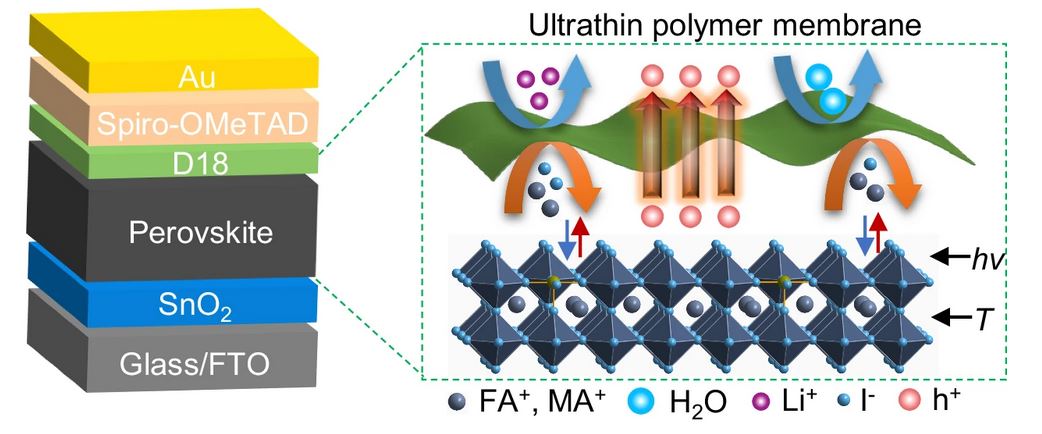
Researchers in China claim to have built a perovskite solar cell that can effectively reduce ion migration and provide superior stability. The device uses an ultra-thin membrane made of a polymeric material known as PDTBT2T-FTBDT (D18), which is said to provide conformal coverage on the surface of the perovskite film due to its high fluidity.
Scientists from Huaqiao University in China have designed a perovskite solar cell that uses a hole-selective interlayer that inhibits ion diffusion to increase the device’s stability.
Ion migration is considered the main cause of instability for perovskite solar cells. It occurs when the soft crystal lattice and relatively weak bonds in the perovskite film lead to low defect formation energies, so that heat and light can easily activate ionic defects in the perovskite lattice. The accumulation of ions distorts the local crystal structure and degrades the perovskite film, both the electron transport layer (ETL) and the hole transport layer (HTL), as well as the electrodes.
“The idea of incorporating a hole-selective interlayer into perovskite solar cells was inspired by fuel cells with a proton exchange membrane (PEM), where the PEM serves as a proton conductor while simultaneously blocking the diffusion of other chemical species,” the researchers explain. “Designing internal barriers that block ion diffusion from layer to layer is critical to improving the lifetime of perovskite solar cells.”
The research team built the hole-selective interlayer using an ultra-thin polymer material known as PDTBT2T-FTBDT (D18), which reportedly provides conformal coverage on the surface of perovskite film due to the high fluidity of the dilute solution. It also features a matched energy level alignment with the perovskite absorber and the Spiro-OMeTAD HTL.
The academics deposited the interlayer by spin-coating a hot chlorobenzene (CB) solution of D18 on top of the perovskite film, which reportedly led to the formation of a dense membrane. They constructed the solar cell with a substrate of glass and fluorine-doped tin oxide (FTO), a tin oxide-based ETL (SnO2), a perovskite absorber, the D18 interlayer, the Spiro-OMeTAD HTL and a gold (Au) metal contact.
The group assessed the effectiveness of the interlayer in terms of ion diffusion and found that it provides superior performance compared to the most commonly used polymers P3HT and PTAA. “The results show that the D18 layer has robust ion blocking ability under thermal stress,” it further explains. “D18 is in close contact with the perovskite grain and the grain boundary, providing conformal coverage.”
The proposed 0.12 cm2 The solar cell was tested under standard lighting conditions and found to achieve an energy conversion efficiency of 26.39%, an open-circuit voltage of 1.185 V, a short-circuit current of 26.54 mA cm−2 and a fill factor of 83.92%. For comparison, a reference cell built without the D18 layer achieved an efficiency of 24.43%, an open-circuit voltage of 1.152 V, a short-circuit current of 26.39 mA cm−2 and a fill factor of 80.37%.
“We have shown that the introduction of the polymeric D18 interlayer can effectively block layer-to-layer ion diffusion within perovskite solar cells while maintaining highly efficient hole transport, leading to significantly improved stability of the nip cells with a certified efficiency of more than 26%. ,” the researchers said, noting that the cell was also able to maintain 95.4% of its original efficiency after 1,100 hours.
They also claimed that the device is currently the “most stable” perovskite solar cell with high efficiency levels.
The new cell concept was presented in the study “Ultra-thin polymer membrane for improved hole extraction and ion blocking in perovskite solar cells”, which was recently published in communication about nature.
This content is copyrighted and may not be reused. If you would like to collaborate with us and reuse some of our content, please contact: editors@pv-magazine.com.
Popular content