

Researchers from China and the United Arab Emirates tested the performance of a photovoltaic-thermoelectric generator module on the receiving end of a wireless laser power transmission system. Under a variety of atmospheric turbulence conditions, they found that the device could address thermal stress and improve PV receiver performance.
A team of researchers from China and the United Arab Emirates has proposed a photovoltaic-thermoelectric generator module (PV-TEG) for use in the receiving subsystem of a laser wireless energy transmission system (LWPT). They tested the module under conditions of low, medium and high atmospheric turbulence, finding that it reduced thermal stress and improved PV receiver performance.
LWPT, also known as power beaming, transmits energy over long distances using a laser for transmission and a photovoltaic (PV) component in the receiving subsystem. Both single and multiple cells are being evaluated for use in such receivers.
Thermoelectric generators (TEGs) convert heat into electricity through the Seebeck effectwhich occurs when a temperature difference between two dissimilar semiconductors causes a voltage difference. TEGs are often used in industrial applications to recover waste heat and convert it into electricity. However, high costs and limited efficiency have limited its wider application so far.
With PV-TEG systems, the PV panel generates electricity during the day, while the TEG uses temperature differences around the cell to produce electricity at night.
“In previous studies, many researchers mainly focused on the performance of PV-TEG receivers under uniform light irradiation. This study innovatively investigated the impact of the Gaussian laser passing through atmospheric turbulence on the output performance of the PV-TEG receiver and evaluated the energy efficiency improvement compared with a traditional PV receiver under different environmental conditions,” said Meng Xianlong, first author of the study. pv magazine.
Under a Gaussian beam with a total power of 6 W, the overall output performance of the PV-TEG system improved by 25.81% compared to a receiver using only PV, Xianlong said.
In LWPT applications, there is a “critical” need to efficiently manage heat and energy use, especially during long-term, high-intensity laser exposure, the researchers noted.
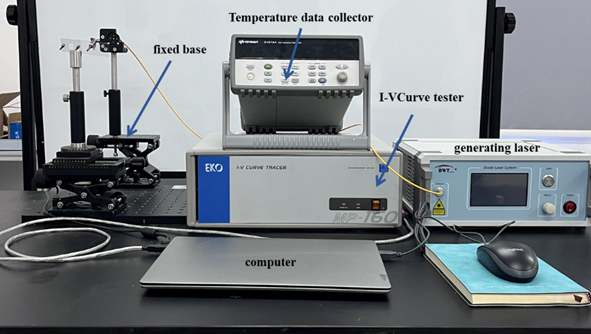
To evaluate the thermal, electrical and optical performance of the PV-TEG system under varying laser powers and atmospheric turbulence intensities, the team developed a multiphysics simulation model, which analyzed the effect of the laser irradiation intensity on the output characteristics of the system and its ability to absorb residual laser energy that is not converted into electricity by the PV cell. Ray tracing was used to calculate the surface intensity and the results were experimentally validated.
The hybrid device combined a single gallium arsenide (GaAs) solar cell for power conversion with a commercially available TEG module.
According to Xianlong, the most challenging aspect was determining the Seebeck coefficient and proving the feasibility of the system.
The team calculated the thermoelectric conversion characteristics of the TEG module under multiple coefficients. “By comparing the results obtained with the measurements of our experimental samples, we finally determined that the Seebeck coefficient is a fixed constant,” explains Xianlong.
To demonstrate the PV-TEG receiver’s ability to optimize the operating temperature of GaAs cells, the researchers compared the temperatures of a PV unit and a PV-TEG receiver under different atmospheric turbulence structure constants. The findings showed that the PV-TEG receiver significantly reduced the operating temperature of PV cells by up to 31.94 K compared to conventional PV receivers.
“The results clearly indicate that the PV-TEG receiver maintains a lower operating temperature for the GaAs photovoltaic cells compared to the PV system under low and moderate turbulence conditions,” the researchers said. Specifically, under moderate atmospheric turbulence, the PV-TEG system showed a remarkable increase in output power, with improvements up to 66.06%.
They also noted that, under strong turbulence, the uneven energy distribution was introduced, but the PV-TEG receiver maintained “superior” performance by utilizing its dual energy recovery capability.
The system was presented in “Improved wireless laser transmission efficiency with a new PV-TEG hybrid receiver: dual thermal management and energy recovery”, published in Scientific reports.
The research team included scientists from China’s Northwestern Polytechnical University, the United Arab Emirates-based Amity University and Khalifa University of Science and Technology.
Another test of the atmospheric turbulence effects of laser is planned using multiple solar cells in the PV receiver. Xianlong noted that the “extremely high light intensity at the receiving end” creates a need for new requirements for thermal management and PV cell system management. The group also studies overall thermal management and PV management in high energy density photovoltaic systems.
This content is copyrighted and may not be reused. If you would like to collaborate with us and reuse some of our content, please contact: editors@pv-magazine.com.
