

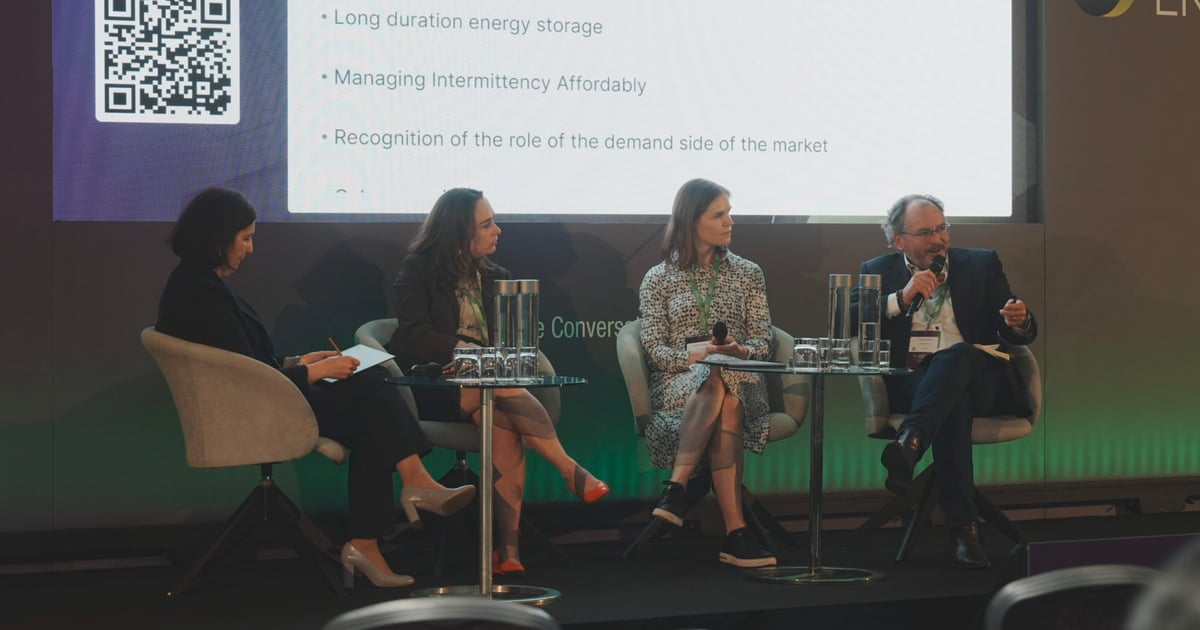
Political uncertainty in Britain is “the biggest challenge” in delivering the energy transition, as a lack of long-term political coherence could deter the necessary long-term investment to achieve energy security in Britain.
This was the view of David Maguire, founder and CEO of BNRG, who spoke on a panel at Solar Media’s Renewables Procurement & Revenue Summit this afternoon. He said that “we are quite long-term thinkers” at BNRG, which operates in the Republic of Ireland, the United Kingdom and North America, and as a result has been held back from investing in the UK network in the long term. there are already discrepancies between offtake agreement valuations that have hindered deal-making.
“There is a reluctance to invest in the medium to long term when you look at an election cycle [where] The attitude of the emerging opposition, which is gaining ground in the polls, means that once you have spent millions of pounds on development risks, you will no longer have a route to the market,” Maguire explained, referring to the Reform UK party, which has performed very well in local elections and has an anti-renewable energy stance, and has pledged to open new oil and gas production in the North Sea and withdraw all government financial support mechanisms for renewables.
This is especially urgent in Britain, where according to Sonia Dunlop, CEO of the Global Solar Council, the National Energy System Operator (NESO) should strive to meet all electricity demand with renewable energy.
“The question is, can we run the UK electricity grid on 100% clean energy?” she asked. “We know NESO is working on this, and renewables with grid-forming investors can provide the supporting services… so we just need to start making those preparations to take the next step to running the system on 100% renewable energy.”
Maguire added that he believes Britain already has the technical competencies to deliver the energy transition, and that work needs to be done to convince the industry’s “establishments” to change their behavior.
“The biggest barrier we continually face is incumbents and political inertia to address what is a semi-monopoly, or in some jurisdictions an outright monopoly,” he said. “All the technology is in place to solve this and to balance the electricity grid and deliver really cheap electricity from solar, BESS and wind energy.”
Rethinking UK energy security
Dunlop also said that achieving energy security in Britain means rethinking the definition of “energy security” as renewables are a much more flexible technology than the fossil fuels that have defined the UK energy mix for years.
“When we think about energy security, we need to think about the multi-layered energy security that renewables bring,” she explained. “We need to stop thinking about energy security in the traditional oil and gas way.
“We, solar, battery storage and renewables, can find energy security at the national level by diversifying electricity sources. But the distributed nature of our technologies creates a new resilience for our grid that is fundamentally different from the resilience that ‘energy security’ provides.” [resembled] in the past.”
Martina Lindovska, managing director at FTI Consulting, agreed, saying we need to maintain the focus on all three components of the ‘energy trilemma’: energy security, energy bills and decarbonisation, which can exist in a state of “slight tension”.
“We see the slight tension that exists between these three,” Lindovska explains. “Due to the emphasis placed on the three legs of the trilemma, there are ebbs and flows over time in response to external events.
“For energy security itself, we look at it through two lenses: one is global energy security for one region as a whole – so we don’t want to repeat the Spanish experience [with negative hours and curtailment]– that is quite difficult and challenging. The second [is] security of supply for local consumers: do I have sufficient power and do I have sufficient quality power?”
This week Summit on Procurement and Income from Renewable Energy Sourcesheld from May 20-21 in London, is hosted by Solar Power Portal publisher Solar Media. The event will cover PPA design, tackling high energy prices and more; for more information, including the full agenda and ticket options, visit the event website.
