

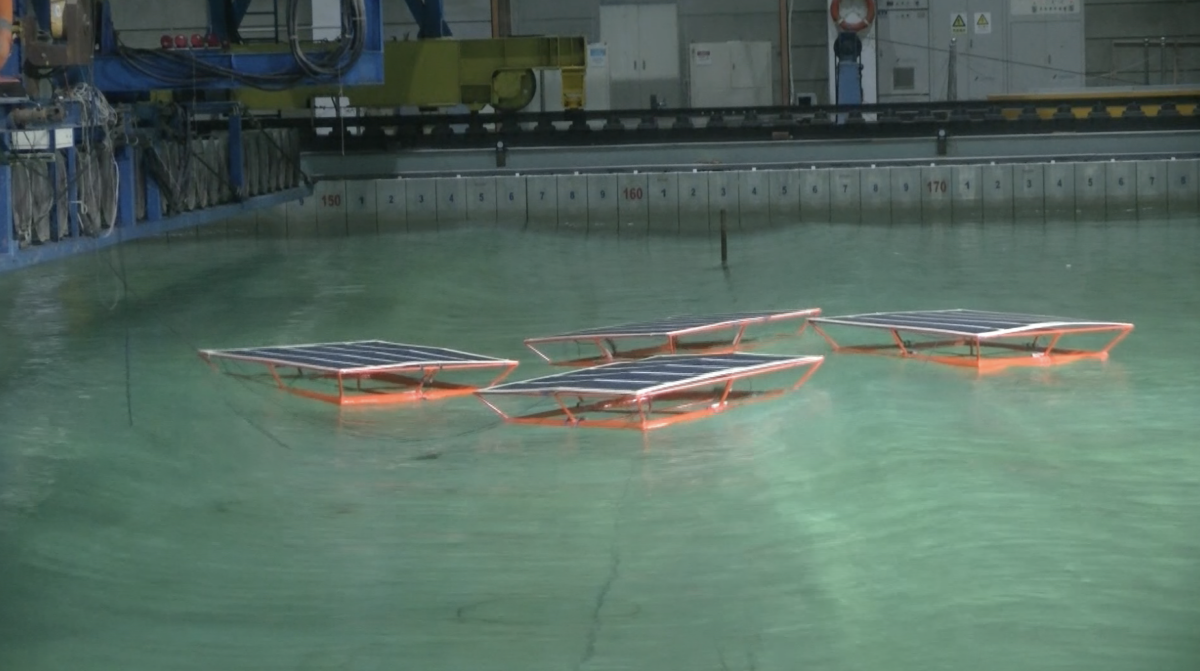
Researchers in China have developed a floating structure for offshore PV that reportedly offers improved stability and dynamic responses compared to conventional semi-submerged floating designs. The floating structure consists of a pontoon truss platform consisting of four pontoons and a steel truss connected by soft ropes.
A group of researchers from Shanghai Jiao Tong University in China have developed a new floating structure for floating offshore PV that reportedly offers a range of advantages over conventional semi-submersible structures.
“We proposed a new concept for the floating photovoltaic structure at sea, a pontoon-type floating structure designed with a high freeboard to prevent waves from crashing or overtopping on the deck and solar panels,” said the lead author of the study, Xianta Zhang. pv magazine. “By choosing a suitable size for each unit, it has the ability to follow the waves. Moreover, we chose the cable-type multi-module connection, which may be more reliable compared to the traditional hinged connection, which suffers from disadvantages such as poor stability and negative air gap.”
The research team described the floating structure as a pontoon-truss platform consisting of four pontoons and a steel truss connected by soft ropes. It also features an angle range of 0 degrees to 14 degrees, which is said to offer “exceptional” stability. “The four pontoons float on the free surface and a square zone is enclosed,” the scientists added, noting that this design is intended to increase installation capacity while reducing mooring costs.
The system also includes steel frames and deck beams. “The steel truss is constructed by connecting horizontal and vertical members to the pontoons, providing a design that is both lightweight and effective in reducing wave run-up,” the group said. “The deck beams are then mounted at the top, creating space for the installation of PV panels.”
The performance of the system was tested through a series of experiments and compared to that of a semi-submersible foundation with four submerged horizontal pontoons and four semi-submerged vertical columns.
This analysis showed that the semi-submersible system has a “marginal” advantage in terms of maximum recovery time, which is the the rotational force that acts in the opposite direction of a rotating body, but can only achieve this at an angle of inclination of more than 20 degrees. In contrast, the pontoon truss system was found to provide optimal stability within 10 degrees.
Popular content
The system was also found to have a “superior ability” to resist capsizing and respond quickly to wave incoming waves. “Both experimental and numerical results indicate that this pontoon truss design is feasible in a marine environment and away from green water and negative air gaps. However, this conclusion was obtained from in-basin scale tests and ideal simulation,” the researchers said.
The proposed floating structure was described in the study “Conceptual design and model test of a pontoon truss type offshore floating soft connection photovoltaic system”, which was recently published in Ocean engineering. “It should be noted that the current study provides a novel floating photovoltaic system, but is limited to the early design phase,” the academics concluded. “To promote this plan, there are still some challenging and interesting points for future research.”
This content is copyrighted and may not be reused. If you would like to collaborate with us and reuse some of our content, please contact: editors@pv-magazine.com.
