

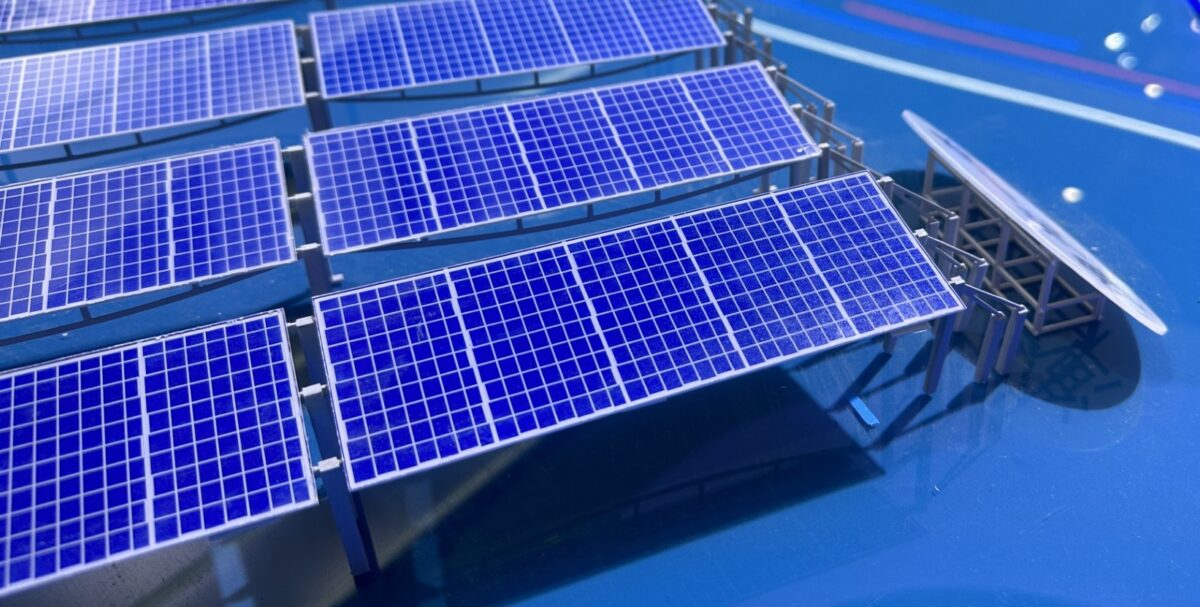
Scientists from Singapore have designed new floating breakwaters that integrate wave energy converters that can be used to reduce the impact of waves on offshore PV systems. Their analysis showed that the wave energy systems can achieve the highest additional power when the wavelength is shorter.
Researchers from the Singapore Institute of Technology have investigated the performance of new floating breakwaters (FBs) that integrate wave energy converters (WECs).
The breakwaters are intended for use in offshore floating PV parks (OFPV). “As the OFPVs move towards the open sea, they are exposed to severe random waves and therefore the design of the structure must take these cyclic loads into account,” the study’s corresponding author Zhi Yung Tay told us. pv magazine. “There are few research works that focus on studying the effect of hybrid FB and WECs in mitigating the response of the floating solar PV farm and improving the wave energy extraction from the OFPV.”
Using numerical simulations, the scientists examined I-shaped, L-shaped, U-shaped and box-shaped FBs surrounding the PV farm from all directions. They also developed an internal finite element boundary element method (FE-BE) to simulate the PV farm and the FB on the sides. While FE analysis breaks structures into smaller elements to analyze the structure, BE analysis focuses on solving problems at its boundaries.
The FE-BE method takes into account, among other things, the water domain, the structure domain and the power absorption, using mathematical equations. “The validation of the model was carried out by comparing the natural frequencies and vibration modes with their counterparts obtained from the software Abaqus,” Tay pointed out.
In the simulations, the OFPV had a square layout of 101.2 m x 101.2 m and a depth of 0.2 m. The FB is 103.2 m long and 2 m wide and is located 1 m away from the floating PV -park. Raft-type WECs are assumed to be hinged to the FB, each with a depth of one meter.
“Considering that the OFPVs will be deployed in regions with tropical climate and temperate sea state, the wave period assumed in the case studies is taken as T = 3s, 4s and 5s, while the water depth is assumed to be 10 m,” added Tay to it.
Through their analysis, the academics found that the WECs achieve the highest additional power when the wavelength is shorter. Under a head sea, where waves approach the structure directly, the I-shaped configuration generates the most power. Under a sloping sea, where waves approach diagonally, the box shape works best.
“The highest efficiency in wave energy extraction was obtained by the FB-WEC-I configuration, while the FB-WEC-U and FB-WEC-BOX configurations had lower efficiency but a larger operating range due to their ability to extract oblique catch waves. ‘, the research team said. “The FB-WEC-BOX is the most effective in reducing the hydroelastic response of the OFPV, followed by FB-WEC-U, FB-WEC-L and FB-WEC-I when the wave period is small, that i.e. 3s and 4s.” It added that the FB and FB-WEC are not effective when the encounter wavelength is longer than 5 seconds.
The researchers explained that their work was limited to linear order assumptions and said that more research is needed to optimize the design parameters of the FB-WECs after experimental validation.
Their findings were presented in “Performance of integrated FB and WEC for floating marine photovoltaic solar farms considering the effect of hydroelasticity”, published in Ocean engineering.
This content is copyrighted and may not be reused. If you would like to collaborate with us and reuse some of our content, please contact: editors@pv-magazine.com.
