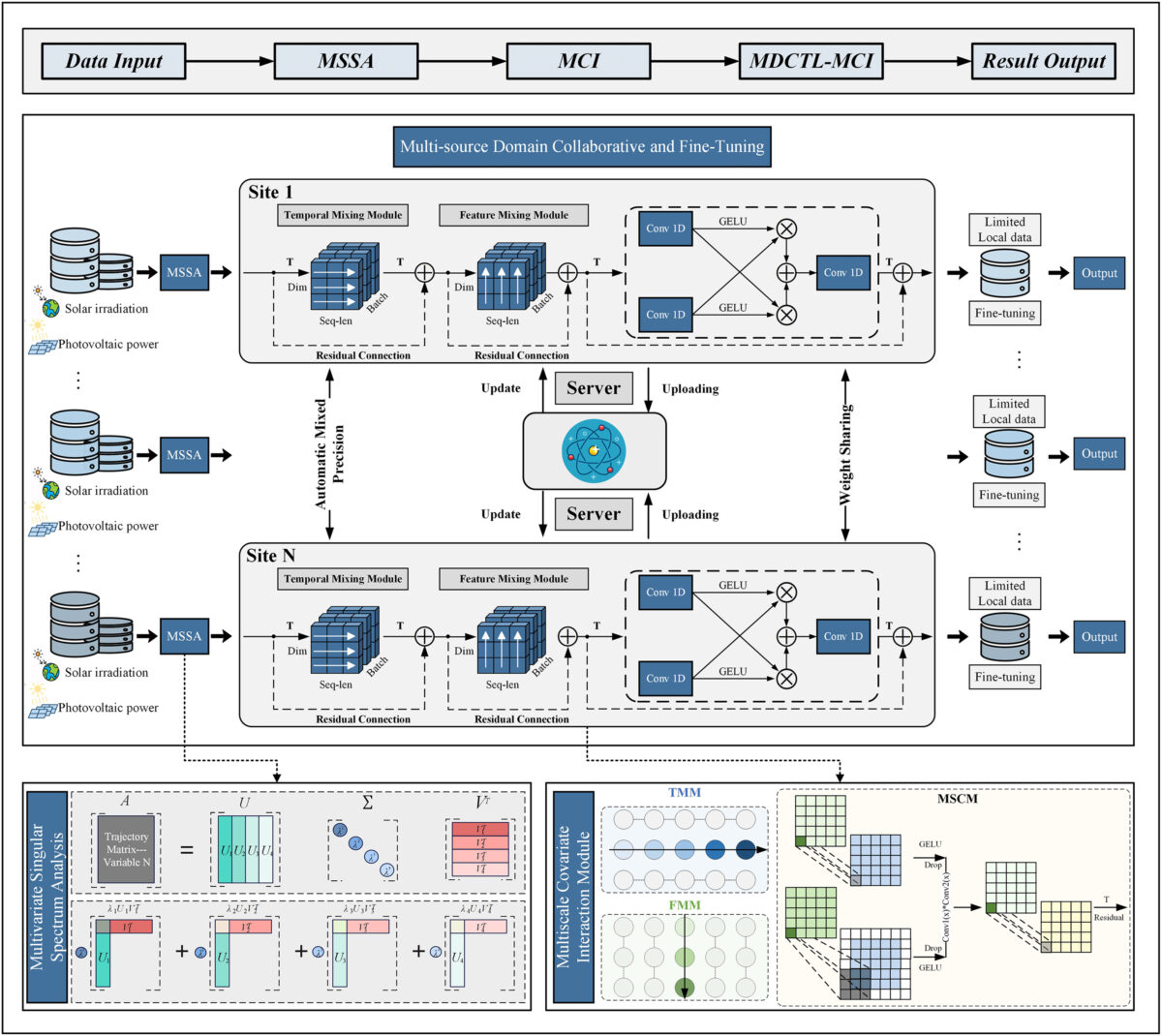
Scientists in China have developed a new signal-missing aware energy prediction method using signal decomposition, multi-scale covariate interaction, and collaborative transfer learning across multiple domains. The approach reportedly improves average prediction accuracy by 15.3%.
A research team led by China’s Hunan University has developed a new missing PV power prediction method designed to handle missing and incomplete data.
The multi-domain collaborative transfer learning-multiscale covariate interaction (MDCTL-MCI) methodology combines signal decomposition, multi-scale covariate interaction and multi-domain collaborative transfer learning.
“This study investigates how covariate information can be effectively used to improve predictive performance, and whether the inherent generalization capacity and robustness of deep learning algorithms can be leveraged to directly predict solar irradiance in the presence of substantial missing input features, without performing additional imputation, and to perform a thorough analysis of the various influencing factors and the underlying predictive mechanisms,” the group said.
To achieve this, the method first applies multivariate single spectrum analysis (MSSA) to reduce noise and improve data representation. Then, a lightweight MCI approach models the relationships between variables and extracts deep temporal patterns. In the third step, the MDCTL strategy improves the robustness of the model under low-quality data conditions by integrating data from multiple PV locations. Finally, a Shapley Additive Declaration (SHAP) technique identifies the key factors affecting forecast performance.
The dataset used in the study consists of one year of continuous operational data from four solar PV stations in northern, central and northwest China, recorded at 30-minute intervals. These stations have a nominal output power ranging from 30 MW to 130 MW. According to the researchers, the dataset exhibits “significant data quality issues.” Although PV power output data is relatively complete, covariates such as solar radiation and weather conditions show missing rates ranging from 0% to 80% for different stations. The data was divided into training, validation, and test sets using a 6:1:1 ratio.
Image: Hunan University, Applied Energy, CC BY 4.0
“Given the critical role of covariate types in determining model accuracy, both Pearson correlation analysis (for linear relationships) and Spearman correlation analysis (for nonlinear relationships) are performed on six variables,” the team explains. “Global horizontal irradiance (GHI), direct normal irradiance (DNI) and total solar irradiance (TSI), which show the strongest correlation with PV power, are selected as input variables for subsequent experiments. To better understand the data distribution, marginal histograms are plotted to show the relationship between each selected variable and the display PV power.”
The MDCTL-MCI model takes 48 historical time steps as input and performs multi-step predictions for the next 48 time steps in a single forward pass. Performance was compared against several state-of-the-art time series forecasting methods, including Pyraformer, Transformer, Informer, TimeXer, iTransformer and PatchTST, as well as MLP-based models such as LightTS, TSMixer and MCI.
“Extensive experiments on four Chinese PV plants show that, compared to baseline methods, the proposed method improves the average accuracy by 10.5% under full data conditions and by 15.3% under various missing data scenarios,” the results said. “In summary, the MDCTL-MCI method proposed in this study effectively addresses the limitations of covariate underutilization and the instability and inaccuracy of predictions under conditions of poor data quality, which remain common in existing research. The proposed model lays a solid foundation for the deployment of PV systems in complex environments and offers significant contributions to the development of PV technology.”
The new approach was described in “Robust photovoltaic prediction under severe missing data via multi-domain collaboration and covariate interaction”, published in Applied energy. Scientists from China’s Hunan University, Zhejiang University, Japan’s Kyushu University and Australia’s James Cook University contributed to the research.
This content is copyrighted and may not be reused. If you would like to collaborate with us and reuse some of our content, please contact: editors@pv-magazine.com.
Popular content