

In a new weekly update for pv magazineOPIS, a Dow Jones company, provides a brief overview of the major price trends in the global PV industry.
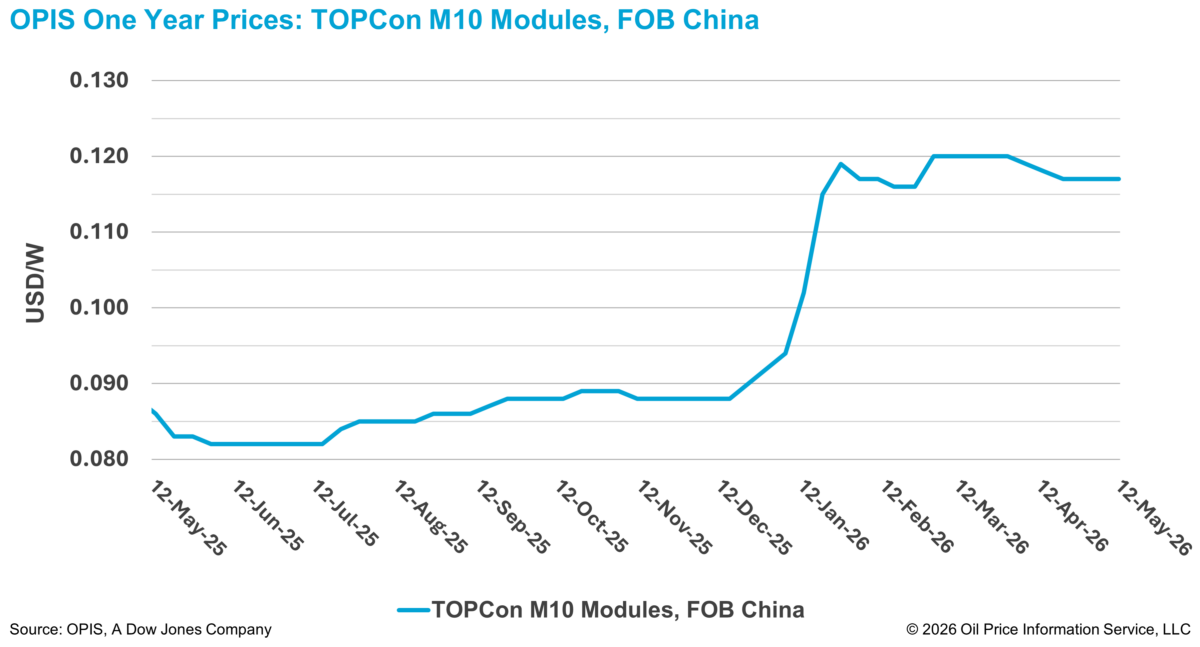
Free-On-Board (FOB) Chinese TOPCon module prices remained stable for another week as manufacturer offers remained largely unchanged despite sluggish post-holiday trading activity in early May.
Industry sources say top manufacturers have kept their offers steady since April, while smaller manufacturers have become more aggressive in their pricing to secure orders, leading to a widening price gap in both FOB China spot and forward-loading freights.
According to the OPIS Global Solar Markets Report released on May 12, the Chinese Module Marker (CMM), the OPIS benchmark rating for TOPCon modules from China, was maintained at $0.117/W FOB China.
FOB China TOPCon module forward curve prices for Q2 2027 loading increased on firmer market guidance, while the rest of the loading periods remained stable. Q2 2027 loads were assessed 0.83% higher at $0.121/W, while Q1 2027 loads remained at $0.120/W. Q3 2026 freight loads also remained at $0.117/W, while Q4 2026 loads were assessed stable at $0.119/W.
On the buyer side, some sources said higher container freight rates since March have weighed on near-term purchasing decisions. The decline in FOB module prices in China since April has partially offset the impact of higher freight costs. A top manufacturer source added that the net impact also depends on the region of destination, with the freight burden for Asian destinations being less heavy than for Europe.
A source from a Southeast Asian developer said that while freight costs have increased, one strategy is to consolidate module requirements for projects and ship larger volumes in bulk. The source added that module prices have recently stabilized after a sharp and volatile increase in the first quarter of 2026.
According to the Drewry World Container Index (WCI), container rates have risen by more than 30% since the end of February to $2,553 per 40ft container on May 14, amid ongoing tensions in the Middle East. Shanghai-Rotterdam rates rose 11% this week to $2,413 per 40ft container, while Shanghai-Genoa rates rose 20% to $3,701 per 40ft container.
In China’s domestic markets, market participants said demand from large-scale utility projects has yet to see a meaningful recovery, indicating that further module price increases remain difficult to sustain. According to industry sources, prices for TOPCon modules used in distribution projects continue to outperform those for larger utility-scale projects by about 5-10%.
China’s CHN Energy has shortlisted JA Solar and LONGi for its 59 MW TOPCon 610 W module tender for a renewable energy replacement project at the company’s thermal power plant in Inner Mongolia. Offer prices were CNY0.778-0.783/W, or around $0.115/W FOB China. JA Solar was the successful bidder, according to industry sources.
In addition, China’s Shenergy has launched a 1 GW tender for high-efficiency BC and TOPCon modules, requiring delivery within one month of signing the contract until the end of 2027.
Market consolidation also continued in the solar energy sector. HT-SAAE has announced plans to sell its 81.76% equity stake in its wholly owned subsidiary, Lianyungang Shenzhou New Energy Co., Ltd, which has a 1.2 GW cell and module manufacturing subsidiary. The company said the divestiture was caused by overcapacity and fierce price competition in the photovoltaic industry, as well as the subsidiary’s insufficient competitiveness. The sale is expected to help HT-SAAE restructure its business and improve the quality of its asset business, the company said.
OPIS, a Dow Jones company, provides energy prices, news, data and analysis on gasoline, diesel, jet fuel, LPG/NGL, coal, metals and chemicals, as well as renewable fuels and environmentally friendly feedstocks. It acquired assets with pricing data from Singapore Solar Exchange in 2022 and now publishes the OPIS APAC Solar Weekly Report.
The views and opinions expressed in this article are those of the author and do not necessarily reflect those of the author pv magazine.
This content is copyrighted and may not be reused. If you would like to collaborate with us and reuse some of our content, please contact: editors@pv-magazine.com.
