

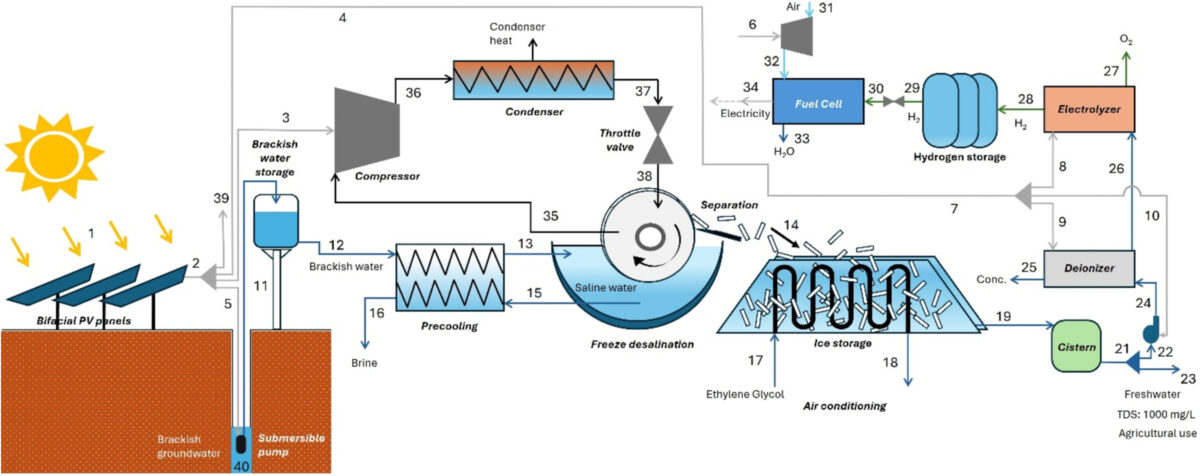
Scientists have proposed a standalone system that uses freeze desalination and ice for air conditioning. It requires 10,785 square meters of c-Si double-sided PV panels and can operate all day long. The energetic efficiency is calculated at 17.8% during the day and 56% at night.
Researchers from Hamad Bin Khalifa University (HBKU) in Qatar have proposed a new PV-powered multifunctional system for agriculture in desert environments.
The standalone system includes water desalination, green hydrogen production, air conditioning and electricity production. The performance of the system was simulated based on thermodynamic principles.
“Agricultural operations in remote desert locations face significant challenges due to high water and energy demands and the lack of necessary infrastructure,” the scientists said. “Efficient use of naturally available energy and water resources to supply essential raw materials would greatly support the implementation of agricultural activities in desert climates.”
The system features 10,785 square meters of bifacial c-Si PV panels, with each module producing 600 W with an efficiency of 23.2% under standard test conditions. The system generates 1.5 MW of electricity, with 100 kW allocated for direct energy supply to farmers. The rest feeds the independent system, which initially pumps and pre-cools the groundwater.
A vapor compression cycle with R134a refrigerant subcools salt water for freeze desalination, forming ice crystals from pure water without salts and impurities. The ice is stored and the cold energy is recovered during melting for air conditioning. The melted ice can also be used for agriculture.
“Part of the produced water is further purified in an electro-deionization module under an electrical conductivity of 1 μS/cm,” the academics said. “A proton exchange membrane (PEM) water electrolyzer is used to use the deionized water for hydrogen production. High-purity compressed hydrogen produced by the PEM electrolyzer is stored in metal hydride storage tanks. A fuel cell is integrated with hydrogen storage to generate electric power at times when solar energy is insufficient or unavailable.”
The scientists explained that the freeze desalination and air conditioning for ice storage run continuously all day long. The electrolyzer runs eight hours during the day, while the fuel cell runs sixteen hours at night. Simulations assume a temperature of 30 C, 50% relative humidity, atmospheric pressure of 101.325 kPa and a wind speed of 5 meters per second.
“The system generates 311.3 m3/day of groundwater, 52.8 m3/day of ice, 6271.2 kWh/day of cooling, 1,581 l/day of demineralized water and 177 kg/day of hydrogen,” the scientists said. “Hydrogen produced during the day is stored in metal hydride tanks with a total volume of 3 m3 to operate the 229.7 kW fuel cell throughout the night for continuous use. Hydrogen release from metal hydride tanks is facilitated by applying the heat (129.2 kW) recovered from the fuel cell stack. The total membrane area for the electrolysis and fuel cell stacks is calculated at 52.6 m2 and 36.7 m2 respectively.”
The standalone system produces 6.3 MWh of air conditioning per day. Its energetic and energetic efficiency is calculated at 17.8% and 13.5% during the day and 56% and 34.9% during the night, respectively.
“This synergistic integration aims to use the input energy efficiently,” the academics concluded.
They described the proposed system in “Integrated solar freeze desalination and water electrolysis system with energy recovery and storage for sustainable agriculture in desert environments”, which was recently published in Desalination.
This content is copyrighted and may not be reused. If you would like to collaborate with us and reuse some of our content, please contact: editors@pv-magazine.com.
