
Close Menu
  • News
  • Industry
  • Solar Panels
  • Commercial
  • Residential
  • Finance
  • Technology
  • Carbon Credit
  • More
    • Policy
    • Energy Storage
    • Utility
    • Cummunity
What's Hot

Zendure launches battery ranges for residential PV – SPE

April 23, 2026

The CFO’s Guide To Nature Based Solutions

April 23, 2026

Inside PV Manufacturing: Belga Solar’s module factory in Belgium

April 23, 2026
Facebook X (Twitter) Instagram
Solar Energy News
Thursday, April 23
  • News
  • Industry
  • Solar Panels
  • Commercial
  • Residential
  • Finance
  • Technology
  • Carbon Credit
  • More
    • Policy
    • Energy Storage
    • Utility
    • Cummunity
Solar Energy News
Home - Solar Industry - PV redox flow battery with a conversion efficiency of 4.2% from solar energy to electricity
Solar Industry

PV redox flow battery with a conversion efficiency of 4.2% from solar energy to electricity

solarenergyBy solarenergyDecember 24, 2025No Comments3 Mins Read
Facebook Twitter Pinterest LinkedIn Tumblr Email
Share
Facebook Twitter LinkedIn Pinterest Email

Scientists in China have built and tested a device that uses redox couples combined with a single three-junction amorphous-silicon photoelectrode. When tested under a xenon lamp simulating a single sun, the device achieved an average solar energy to electricity conversion efficiency of 4.2%.

December 24, 2025
Lior Kahana

A research team from China’s Nanjing Tech University (NanjingTech) has developed and built a new anthraquinone-based solar redox flow battery (SRFB) device.

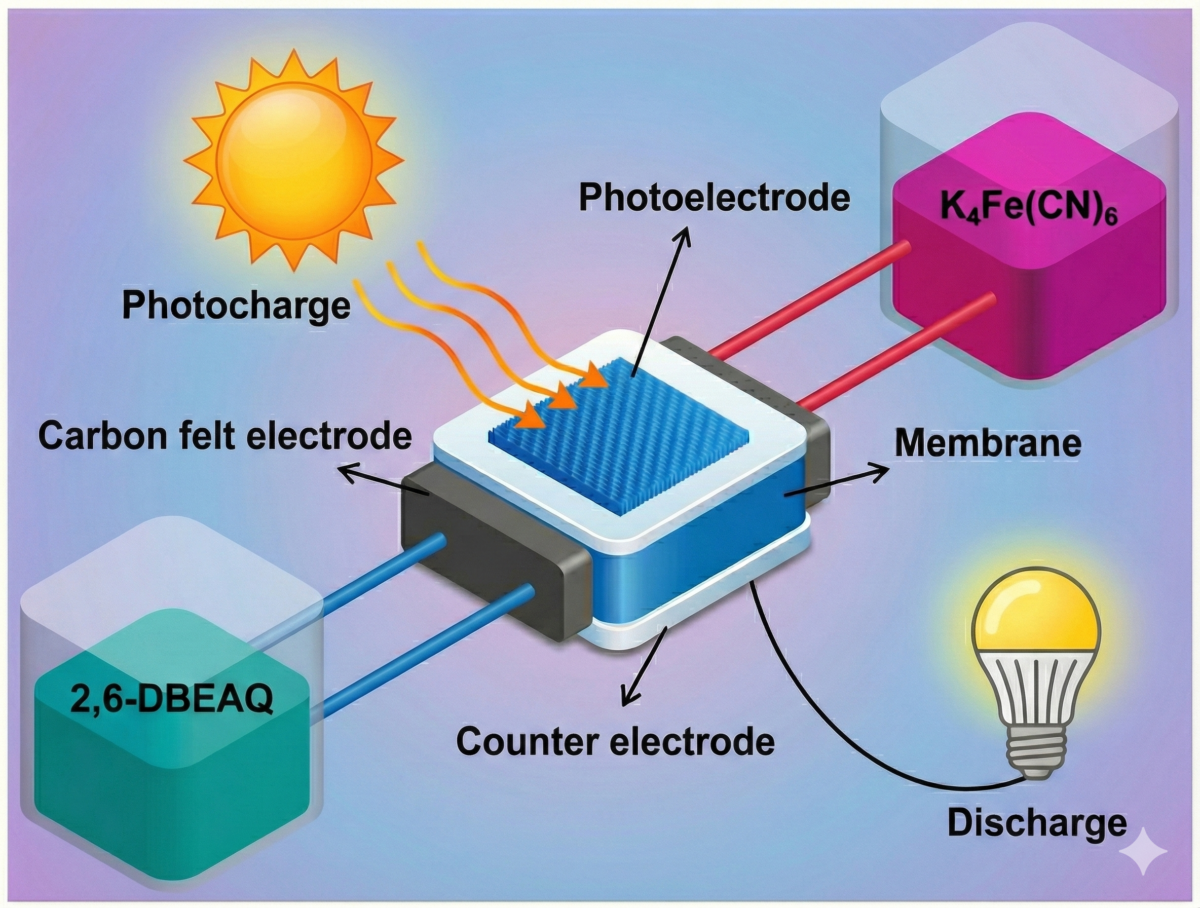
The system consists of redox couples known as 2,6-DBEAQ and K4[Fe(CN)6]combined with a single three-junction amorphous silicon photoelectrode. SRFBs are systems that combine a solar cell with a redox flow battery, allowing simultaneous sunlight capture and chemical energy storage.

“Among the redox couples used in SRFBs, aqueous organic anthraquinone derivatives have gained recognition as the favored materials for energy storage,” corresponding author Chengyu He shared. pv magazine. “Anthraquinone-based SRFBs typically employ redox couples such as AQDS and 2,6-DHAQ, which operate in both strongly acidic and alkaline conditions. However, due to the corrosion of photoelectrodes and the instability of the paired redox couple, these SRFB devices exhibit relatively low solar electricity efficiency.”

For the photocathode portion of the device, the group cut commercial amorphous silicon (3jn-a-Si) photovoltaic cells with three junctions into 2 cm x 2 cm pieces. The cell consists of stacked compounds of amorphous silicon-germanium alloys deposited on a stainless steel substrate covered with a layer of indium tin oxide (ITO). It is electrically connected to a carbon felt counter electrode via an external circuit.

The photocathode is in chemical contact with the catholyte containing 2,6-DBEAQ, which is reduced during photocharging. In contrast, the anolyte containing K₄[Fe(CN)₆] is oxidized at the carbon felt electrode. The two electrolytes flow continuously from external tanks through the cell using a peristaltic pump. They are kept separated by a Nafion ion exchange membrane that allows ion transport to maintain charge balance but prevents mixing of electrolytes.

See also  Chinese-American silicon stops production at a solar cell factory

The performance of the SRFB device was evaluated by a cyclic test, a repeated charge-discharge experiment. Before measurements, the electrolytes were flushed with argon for 30 minutes to remove dissolved oxygen. During charging, the photocathode was irradiated with a xenon lamp simulating the intensity of 1 sun at 100 mW cm2. The device was discharged at a current density of 10 mA cm-2 until the battery voltage dropped to 0.2 V.

“The SRFB device can be charged and discharged in ten cycles without external bias, while the electricity efficiency of solar energy is up to 4.3%,” said Chengyu He. “The successful preparation of this SRFB device opens new opportunities for the further development of advanced solar-to-chemical energy conversion technologies.”

The results are presented in “An aqueous anthraquinone solar redox flow battery for efficient solar energy conversion and storage”, published in Electrochimics Acta.

This content is copyrighted and may not be reused. If you would like to collaborate with us and reuse some of our content, please contact: editors@pv-magazine.com.

Popular content

Source link

battery conversion efficiency electricity Energy flow redox solar
Share. Facebook Twitter Pinterest LinkedIn Tumblr Email
solarenergy
  • Website

Related Posts

Zendure launches battery ranges for residential PV – SPE

April 23, 2026

Inside PV Manufacturing: Belga Solar’s module factory in Belgium

April 23, 2026

Solar energy’s rebound effect could increase European electricity demand by 5% by 2050 – SPE

April 23, 2026
Leave A Reply Cancel Reply

Don't Miss
News

Planning and infrastructure account to launch to speed up the supply of solar energy

By solarenergyJanuary 27, 20250

Propied changes in the NSIP process request a more flexible approach for solar -nsips. Image:…

European PPAs lagged due to differing price expectations, says Pexapark – SPE

November 4, 2025

K2 Systems will offer mounting systems for green solar roofs

April 30, 2024

Textile-integrated organic solar PV canopy provides shade and area lighting – SPE

October 24, 2025
Stay In Touch
  • Facebook
  • Twitter
  • Pinterest
  • Instagram
  • YouTube
  • Vimeo
Our Picks

Zendure launches battery ranges for residential PV – SPE

April 23, 2026

The CFO’s Guide To Nature Based Solutions

April 23, 2026

Inside PV Manufacturing: Belga Solar’s module factory in Belgium

April 23, 2026

Solar energy’s rebound effect could increase European electricity demand by 5% by 2050 – SPE

April 23, 2026
Our Picks

Zendure launches battery ranges for residential PV – SPE

April 23, 2026

The CFO’s Guide To Nature Based Solutions

April 23, 2026

Inside PV Manufacturing: Belga Solar’s module factory in Belgium

April 23, 2026
About
About

Stay updated with the latest in solar energy. Discover innovations, trends, policies, and market insights driving the future of sustainable power worldwide.

Subscribe to Updates

Get the latest creative news and updates about Solar industry directly in your inbox!

Facebook X (Twitter) Instagram Pinterest
  • Contact
  • Privacy Policy
  • Terms & Conditions
© 2026 Tsolarenergynews.co - All rights reserved.

Type above and press Enter to search. Press Esc to cancel.