

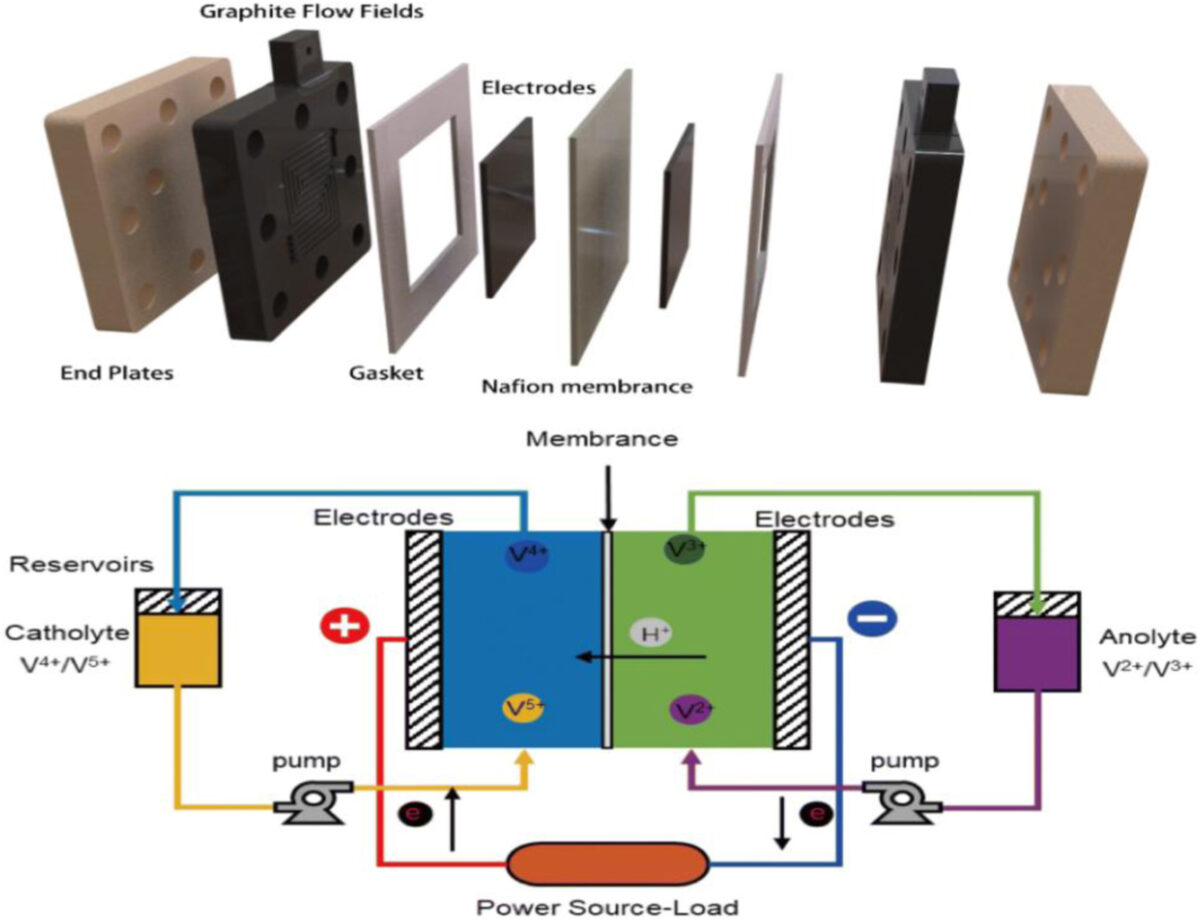
After their review of redox flow battery research, Norway-based scientists said pv magazine that despite high initial capital costs and lower energy density compared to metal ions, the technology can provide safety, reliability and scalability benefits for standalone, large-scale applications.
Deploying redox flow batteries (RFBs) at the system level is more expensive than cheap metal ion alternatives. Not only this, but the energy density of RFBs is significantly lower than that of a metal ion battery. Both factors together cause investors to view RFBs as high risk.
According to the authors of the new study “A critical review of recent advances in vanadium redox flow battery materials for the preparation of electrolytes, membranes and electrodes,”published in the Power Sources Journalthe technology can have advantages over the more common lithium-ion, and this is especially evident when expanding storage to network scale.
“The future looks bright in the field of redox flow batteries,” said Yansong Zhao, professor at Western Norwegian University of Applied Sciences and corresponding author of the study. pv magazine.
“RFBs show their advantage in the stationary grid-scale energy storage application instead of electric vehicles (EVs) or small-scale devices,” Zhao explains, noting that educating investors about the benefits of RFBs “can eradicate the risk element.”
“RFBs provide safety, reliability and scalability, while demonstrating energy-efficient performance for more than 10,000 operating cycles,” he said, adding that RFBs, on the other hand, require “a tremendously high initial capital investment” and have “low energy density, low operational potential, volatile material procurement costs, a lack of standardization and awareness compared to traditional, well-developed and researched lithium-ion batteries.”
He noted that the suitability of RFBs for scale-up in grid-scale scenarios could potentially compensate for their low energy density compared to metal-ion batteries.
His critical review looked at the impact of different electrolytes and membranes on the performance of RFBs. It also investigated modifications to electrodes aimed at improving redox kinetics.
“Although several reviews have been published on vanadium RFBs, most focus on individual aspects such as electrolyte chemistry, membrane development or electrode activation. In contrast, this review provides an integrated summary of recent progress in all three crucial components, with a particular emphasis on work published in the last two to three years. By systematically addressing these aspects of RFBs, researchers aim to overcome existing limitations and unlock the full potential of this promising energy storage technology for a wide range of applications, from grid-scale energy storage to EVs and beyond,” the paper said.
Zhao said the price volatility associated with the redox-active material plus the high cost for ion exchange membrane can account for more than half of the total RFB cost and this is one of the main factors hindering large-scale commercialization.
He added that further research into integrating alternative redox-active materials that demonstrate cost-effectiveness while demonstrating competitive performance could help move toward replacing vanadium. He also proposed titanium as a potential replacement for the anolyte solution, noting its abundance, relatively competitive performance, and low acquisition cost of materials.
He told it pv magazine that in a stationary grid-scale storage context, the volume of liquid electrolytes in RFBs can be scaled according to system requirements. He added that research is underway into numerous component combinations of electrolytes that could improve energy density. Work is also underway to advance membranes and explore solvent alternatives to water.
Based on their critical review of the literature and the approaches of others, the paper’s authors recommended that future research should prioritize optimizing different material combinations to improve system performance, making them more feasible for large-scale energy storage applications in the future.
This content is copyrighted and may not be reused. If you would like to collaborate with us and reuse some of our content, please contact: editors@pv-magazine.com.
