

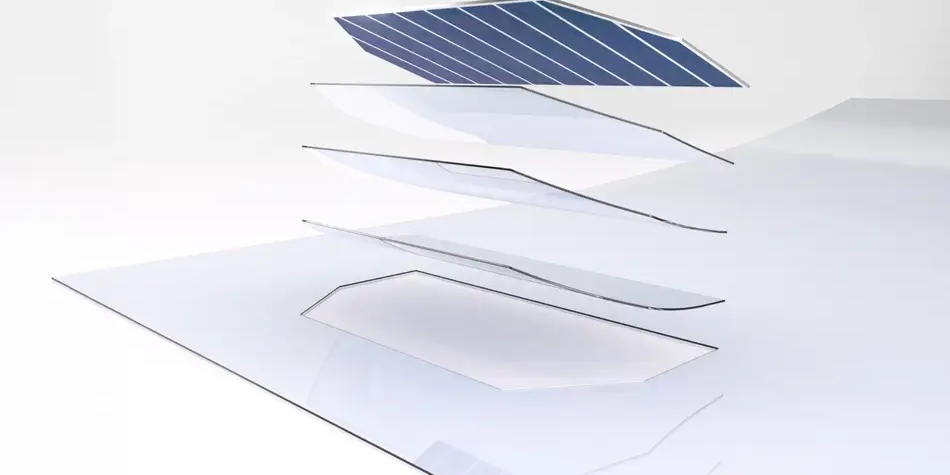
The German manufacturer of specialty glass and materials has announced a new cerium-doped solar cover glass that is compatible with a range of space solar cell technologies, including III-V and silicon-based concepts. It is designed for use in multiple satellite orbits.
Germany manufacturer of special glass and materials Schott announced its latest space cover glass, designed for new cell architectures and higher power density PV devices, at a recent aerospace industry trade show and conference in Bremen, Germany.
The cerium-doped cover glass technology is designed for use in low, medium and geostationary orbit satellites. The development was supported by the European Space Agency (ESA) and the German Aerospace Center (DLR).
The new Schott Solar Glass Exos product is the result of a collaboration with Germany-based Azur Space Solar Power, the space cell manufacturing unit of Canadian materials supplier 5N Plus. The partnership included testing and initial validation.
The key driver of the development was “the clear shift in space missions toward higher power density, longer mission lifetimes and new cell architectures,” a company spokesperson said.
Schott has a portfolio of solar cover glass products for aerospace, but an evolving satellite market demanded greater radiation durability, thermomechanical compatibility, coating flexibility and large sizes.
“Schott Solar Glass Exos is designed to complement our portfolio by better supporting next-generation cell technologies, including advanced III-V and silicon-based concepts, extended mission profiles and emerging spacecraft designs, rather than replacing existing products.” the spokesperson said pv magazine.
The cerium-doped Exos glass is available in different thicknesses and sizes. According to the company, it is designed to maintain its high transparency and optical stability even after intense UV exposure. It has a UV cut-off range of 308 nanometers with a light transmittance of over 91%.
It features a coefficient of thermal expansion (CTE) of 6.9 × 10⁻⁶ K⁻¹ that is matched to gallium arsenide (GaAs)-based solar cells to minimize mechanical stress during thermal cycling.
It is currently undergoing qualification for compliance with the European Cooperation for Space Standardization (ECSS) E-ST-20-08C standard.
Azur Space noted in a statement that the collaboration with Schott marks “a critical step” toward establishing a “resilient supply chain” for next-generation satellite power systems. “This collaboration strengthens Europe’s technological independence and ensures the reliable availability of high-quality solar energy solutions for future space missions,” said Roland Dubois, Executive Vice President Specialty Semiconductors of Azur Space.
This content is copyrighted and may not be reused. If you would like to collaborate with us and reuse some of our content, please contact: editors@pv-magazine.com.
