
Close Menu
  • News
  • Industry
  • Solar Panels
  • Commercial
  • Residential
  • Finance
  • Technology
  • Carbon Credit
  • More
    • Policy
    • Energy Storage
    • Utility
    • Cummunity
What's Hot

Dutch solar owners asked to switch off during peak periods to ease the distribution crisis

June 7, 2026

The hydrogen flow: Toyota demonstrates its racing prototype on liquid hydrogen

June 7, 2026

Era of electrification exposing Australia’s weakest link

June 6, 2026
Facebook X (Twitter) Instagram
Solar Energy News
Sunday, June 7
  • News
  • Industry
  • Solar Panels
  • Commercial
  • Residential
  • Finance
  • Technology
  • Carbon Credit
  • More
    • Policy
    • Energy Storage
    • Utility
    • Cummunity
Solar Energy News
Home - Technology - Scientists create ‘affordable’ TEG-PV generator for off-grid, energy-efficient applications – SPE
Technology

Scientists create ‘affordable’ TEG-PV generator for off-grid, energy-efficient applications – SPE

solarenergyBy solarenergyNovember 21, 2024No Comments4 Mins Read
Facebook Twitter Pinterest LinkedIn Tumblr Email
Share
Facebook Twitter LinkedIn Pinterest Email

Scientists in Malaysia have tested a system that combines a PV panel and thermoelectric generators (TEGs) and found it offers the potential for ‘moderate’ night-time power generation. It is suitable for small household applications such as LED lighting, laptops, phone chargers and wireless routers.

November 20, 2024
Lior Kahana

Researchers from Multimedia University in Malaysia have designed and analyzed a new hybrid system that integrates PV with thermoelectric generators (TEGs). While the PV panel produces electricity during the day, the TEG uses temperature differences around the cell to produce electricity at night.

TEGs can convert heat into electricity through the ‘Seebeck effect’, which occurs when a temperature difference between two different semiconductors causes a voltage difference between two substances. The devices are often used for industrial applications to convert excess heat into electricity. However, its high cost and limited performance have so far limited its wider application.

“While previous studies have mainly focused on improving the daytime efficiency of PV-TEG systems, or investigating the impact of TEG area and series configurations specifically for nighttime applications,” said the study’s corresponding author Chan Kah Yoong , On pv magazine. “The research aims to bridge the gap in existing literature by demonstrating how larger TEG areas and optimized configurations can significantly improve night-time power production, providing a sustainable solution for continuous energy generation.”

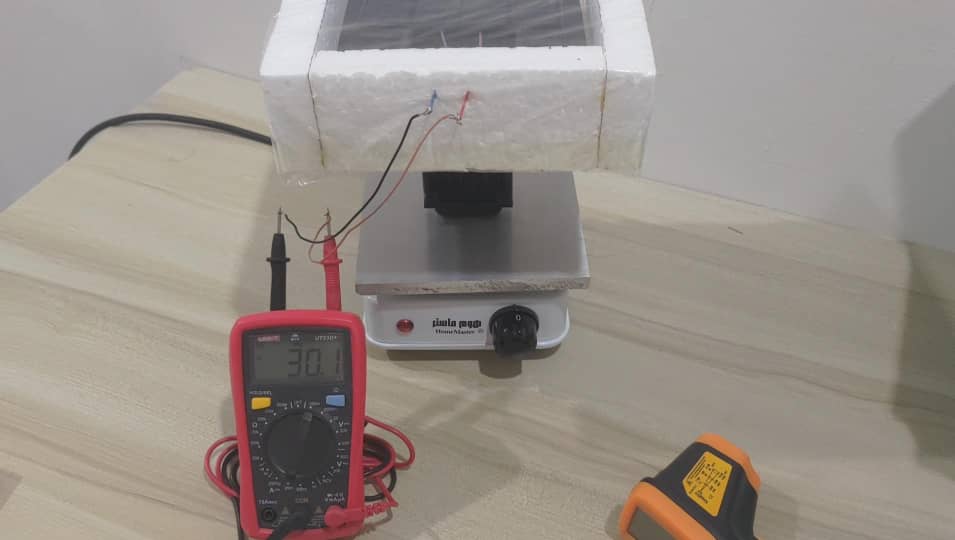
During their testing, the team placed a heater underneath the heat sink to monitor and simulate various temperature differences. Three different TEG surfaces were tested: one 3 cm x 3 cm system; another with a size of 4 cm × 4 cm; and two TEGs connected in series, each 4 cm x 4 cm. The PV cell to which they were attached was a polycrystalline device with an operating voltage of 9 V and an operating current range of 0–100 mA, capable of producing a peak power of 1 W.

See also  Hitachi Energy unveils AI-based solar forecasting solution – SPE

“The 3cm x 3cm TEG can produce up to 0.9mW of power when the temperature difference reaches 55C, while the 4cm x 4cm TEG has a maximum power of 3.8mW,” the academics said . “The two quantities of 4cm x 4cm TEG in series have double the output power compared to 4cm x 4cm TEG. The maximum power here is 7.7 mW.”

In all three TEG cases, the maximum power produced was just above zero, while the temperature difference was minimal at 5 C. In the 3 cm x 3 cm TEG, the peak voltage was 114.9 V and the peak current was 8.67 A. voltage for the 4 cm x 4 cm TEG was 180.2 V and the peak current was 21.5 A. In the case of two TEGs connected in series, the maximum voltage was 340.4 V, while the peak current was approximately 21.5 A.

“This study shows how useful and affordable the system is,” the team concluded. It also noted that if a PV system with a dual 4cm x 4cm TEG were placed on the average US roof with a clear area of ​​1,500 square meters, the TEGs alone would produce an additional 375W of power.

“The system could be used for certain home appliances such as desktops, laptops, phone chargers, LED TVs and lights,” Yoong said. “Its potential scalability suggests that, with enough space on the roof, a significant amount of energy could be generated at night.”

The system was presented in the study “Solar-based nighttime electric power generator based on radiant cooling”, published in Energy reports.

This content is copyrighted and may not be reused. If you would like to collaborate with us and reuse some of our content, please contact: editors@pv-magazine.com.

See also  Expansion of PV for self-consumption reduces the Rust tax PV Magazine International

Popular content

Source link

affordable applications create energyefficient generator offgrid scientists SPE TEGPV
Share. Facebook Twitter Pinterest LinkedIn Tumblr Email
solarenergy
  • Website

Related Posts

Pexapark registers 17 European PPAs for 966 MW in April – SPE

May 27, 2026

Saudi Arabia gets first BESS production facility – SPE

May 27, 2026

Seven countermeasures against negative electricity prices – SPE

May 26, 2026
Leave A Reply Cancel Reply

Don't Miss
Commercial & Industrial

PS Renewables, Ørsted launches new One Earth project consultation

By solarenergyMay 17, 20240

The proposed One Earth Solar Farm could power more than 200,000 homes. Image: One Earth…

Panasonic introduces propane heat pump for light industrial multi-residential buildings – SPE

March 27, 2026

Jinkosolar launches 670 W Topcon Solar module with 24.8% efficiency

September 6, 2025

Engie puts a lightweight 2.3 MW PV roof system into use in Belgium – SPE

October 19, 2024
Stay In Touch
  • Facebook
  • Twitter
  • Pinterest
  • Instagram
  • YouTube
  • Vimeo
Our Picks

Dutch solar owners asked to switch off during peak periods to ease the distribution crisis

June 7, 2026

The hydrogen flow: Toyota demonstrates its racing prototype on liquid hydrogen

June 7, 2026

Era of electrification exposing Australia’s weakest link

June 6, 2026

‘Come out from behind your screen, our industry is ultimately about people’

June 6, 2026
Our Picks

Dutch solar owners asked to switch off during peak periods to ease the distribution crisis

June 7, 2026

The hydrogen flow: Toyota demonstrates its racing prototype on liquid hydrogen

June 7, 2026

Era of electrification exposing Australia’s weakest link

June 6, 2026
About
About

Stay updated with the latest in solar energy. Discover innovations, trends, policies, and market insights driving the future of sustainable power worldwide.

Subscribe to Updates

Get the latest creative news and updates about Solar industry directly in your inbox!

Facebook X (Twitter) Instagram Pinterest
  • Contact
  • Privacy Policy
  • Terms & Conditions
© 2026 Tsolarenergynews.co - All rights reserved.

Type above and press Enter to search. Press Esc to cancel.