
Close Menu
  • News
  • Industry
  • Solar Panels
  • Commercial
  • Residential
  • Finance
  • Technology
  • Carbon Credit
  • More
    • Policy
    • Energy Storage
    • Utility
    • Cummunity
What's Hot

Fraunhofer ISE develops colored film technology for patterned solar panels

April 23, 2026

Thermoacoustic heat pumps are on the verge of commercial breakthrough – SPE

April 23, 2026

The federal court has halted Trump administration orders that hinder solar and wind energy development

April 23, 2026
Facebook X (Twitter) Instagram
Solar Energy News
Thursday, April 23
  • News
  • Industry
  • Solar Panels
  • Commercial
  • Residential
  • Finance
  • Technology
  • Carbon Credit
  • More
    • Policy
    • Energy Storage
    • Utility
    • Cummunity
Solar Energy News
Home - Solar Industry - Scientists create PV-powered synaptic device for AI processing
Solar Industry

Scientists create PV-powered synaptic device for AI processing

solarenergyBy solarenergyNovember 26, 2024No Comments3 Mins Read
Facebook Twitter Pinterest LinkedIn Tumblr Email
Share
Facebook Twitter LinkedIn Pinterest Email

A team from Tokyo University of Science has developed a solar cell-based computing device that mimics human synaptic behavior for use in edge AI processing. The researchers say the device has the potential to accelerate the development of low-power edge AI sensors in applications such as health monitoring, surveillance and automotive technologies.

November 26, 2024
Patrick Jowett

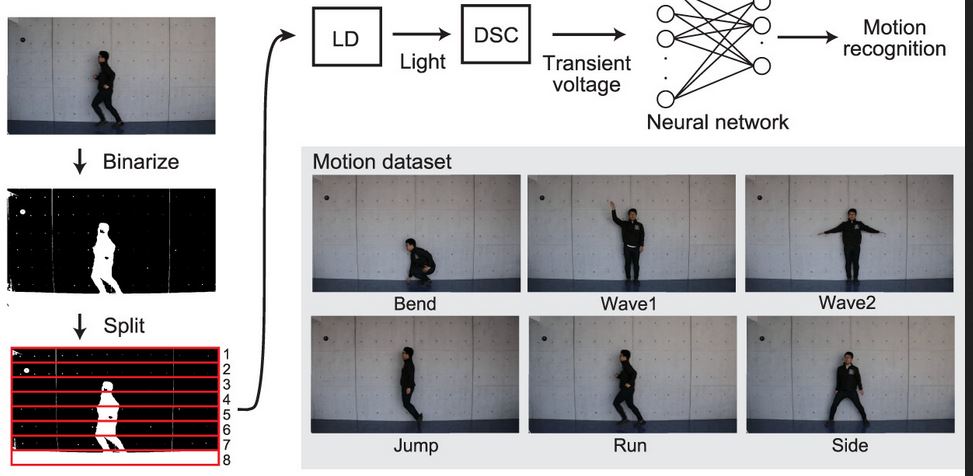
Scientists of the Tokyo University of Science have fabricated a self-powered, dye-sensitized solar cell-based device that mimics human synaptic behavior for edge AI processing.

The research paper “Self-powered dye-sensitized solar cell-based synaptic devices for multi-scale time series data processing in Physical Reservoir Computing”, available in the magazine ACS applied materials and interfacesexplains that Physical Reservoir Computing (RPC) using synaptic devices is a promising edge AI device for use in predicting emergency situations such as heart attacks, natural disasters and pipeline failures.

The study describes how the scientists fabricated a dye-sensitive synaptic device based on solar cells with controllable time constants by changing the light intensity. “To process optical time series data with different time scales, it is essential to fabricate devices according to the desired time scale,” says Takashi Ikuno, one of the research leaders. “Inspired by the eye’s afterimage phenomenon, we devised a novel optoelectronic human synaptic device that can serve as a computational framework for low-power optical AI sensors.”

The device uses squarylium derivatives-based dyes and includes optical input, AI calculations, analog output, and material-level power supply functions. It showed synaptic features, such as paired pulse facilitation and paired pulse depression, in response to light intensity

See also  Combining PV-powered heat pumps with district heating in buildings with Multi-apartment-PV Magazine International

When the device was used as PRC’s reservoir layer, it classified human movements such as bending, jumping, running and walking with an accuracy of more than 90%. The scientists found that performance of a time processing task was achieved by changing light intensity, even as the input pulse width was varied.

Thanks to the solar cell, energy consumption was 1% of that of conventional systems. “We have demonstrated for the first time in the world that the developed device can operate with very low power consumption and still identify human movements with high accuracy,” Ikuno said, noting that the proposed innovation could revolutionize low-power AI applications in health monitoring, surveillance and automotive technologies.

“This invention could be used as a hugely popular optical AI sensor that can be attached to any object or person, and could have an impact on the costs associated with power consumption, such as car-mounted cameras and car-mounted computers” , Ikuno explains. “This device can function as a sensor that can identify human movements with low energy consumption, and thus has the potential to contribute to the improvement of vehicle energy consumption.”

The system could also be used as a low-power optical sensor in standalone smartwatches and medical devices, significantly reducing costs to become comparable or even lower than current medical devices.

This content is copyrighted and may not be reused. If you would like to collaborate with us and reuse some of our content, please contact: editors@pv-magazine.com.

Popular content

Source link

create device processing PVpowered scientists synaptic
Share. Facebook Twitter Pinterest LinkedIn Tumblr Email
solarenergy
  • Website

Related Posts

Fraunhofer ISE develops colored film technology for patterned solar panels

April 23, 2026

Inside PV Manufacturing: Belga Solar’s module factory in Belgium

April 23, 2026

No evidence that PFAS leaks from solar panels, research shows

April 22, 2026
Leave A Reply Cancel Reply

Don't Miss
Policy

S&P Global launches daily spot market price assessment for solar panels – SPE

By solarenergyJuly 18, 20240

The tool has been billed as the world’s first independent daily spot market price assessment…

Sigenergy secures top position for multiple storage markets as installer adoption accelerates – SPE

January 27, 2026

PV-powered sorption system for capturing atmospheric water – SPE

October 9, 2025

Neighbor to neighbor Solar Trading Lifts Returns and illuminates the tension on the schedule

August 17, 2025
Stay In Touch
  • Facebook
  • Twitter
  • Pinterest
  • Instagram
  • YouTube
  • Vimeo
Our Picks

Fraunhofer ISE develops colored film technology for patterned solar panels

April 23, 2026

Thermoacoustic heat pumps are on the verge of commercial breakthrough – SPE

April 23, 2026

The federal court has halted Trump administration orders that hinder solar and wind energy development

April 23, 2026

Zendure launches battery ranges for residential PV – SPE

April 23, 2026
Our Picks

Fraunhofer ISE develops colored film technology for patterned solar panels

April 23, 2026

Thermoacoustic heat pumps are on the verge of commercial breakthrough – SPE

April 23, 2026

The federal court has halted Trump administration orders that hinder solar and wind energy development

April 23, 2026
About
About

Stay updated with the latest in solar energy. Discover innovations, trends, policies, and market insights driving the future of sustainable power worldwide.

Subscribe to Updates

Get the latest creative news and updates about Solar industry directly in your inbox!

Facebook X (Twitter) Instagram Pinterest
  • Contact
  • Privacy Policy
  • Terms & Conditions
© 2026 Tsolarenergynews.co - All rights reserved.

Type above and press Enter to search. Press Esc to cancel.